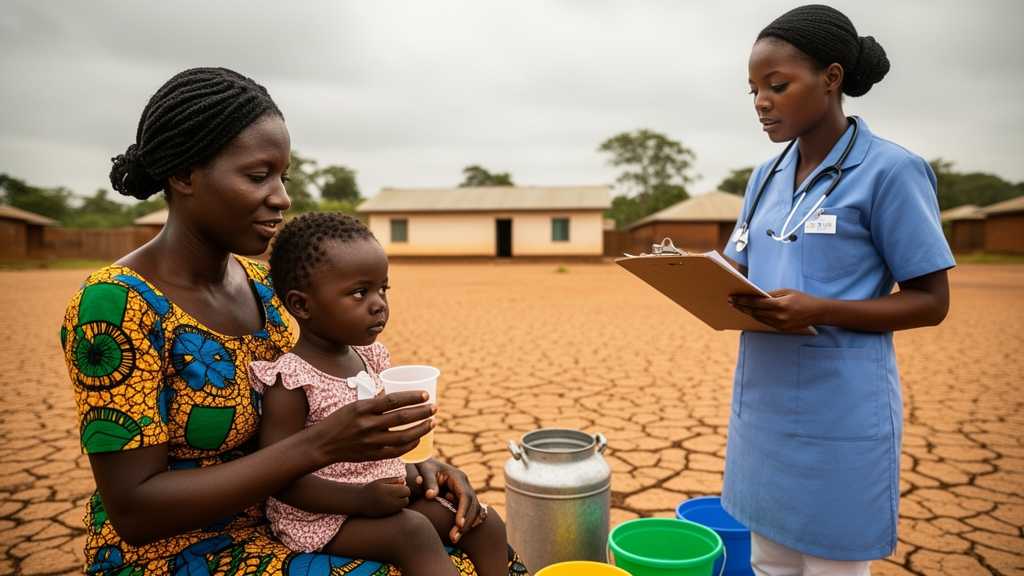
Non-optimal temperatures and rainfall were jointly attributable to an estimated 1,667,998 cases of diarrhoea in children under five across Ghana between 2013 and 2024, according to a spatiotemporal Bayesian modelling study published in Environmental Health. The analysis, which covered all 261 districts of the country, estimated that about 916,176 cases were attributable to non-optimal mean temperature and 927,352 to non-optimal cumulative rainfall, with overlapping contributions when the two exposures were considered together.
The study applied the Standards for Official Statistics on Climate–Health Interactions (SOSCHI) framework, a scalable approach designed to generate subnational climate–health burden indicators from routine surveillance data. Its motivation, as stated in the paper, is that subnational estimates of the climate-attributable burden remain limited in official health statistics, constraining adaptation planning, even though diarrhoeal disease is a leading cause of under-five mortality and is sensitive to temperature and rainfall through their associations with pathogen survival, water availability and sanitation.
Methodologically, the researchers analysed monthly diarrhoea cases in children under five from 261 Ghanaian districts over the period 2013 to 2024. They fitted a spatiotemporal Bayesian hierarchical model with embedded distributed lag non-linear models, using integrated nested Laplace approximation (INLA) and a negative binomial likelihood to handle markedly overdispersed counts. Monthly mean temperature and cumulative rainfall came from the ERA5 reanalysis, with relative humidity and surface runoff included as confounders. Temperature effects were modelled over two-month lags and rainfall effects over three-month lags.
The model reproduced observed counts well, with a correlation of 0.915 between fitted and observed values, and outperformed a linear-exposure specification by 410 WAIC units, supporting the use of non-linear exposure–response functions. Attributable numbers, fractions and rates were estimated against a reference exposure selected by a pre-specified rule that resolved to the 95th percentile.
The results point to distinctly non-linear relationships. Diarrhoeal risk peaked at a mean temperature of 26.2 °C, with a peak relative risk of 1.079 (95% credible interval 1.031–1.130), and at cumulative rainfall of 60 mm, with a peak relative risk of 1.082 (95% credible interval 1.035–1.132). In both cases risk declined at higher values of the exposure, meaning that the burden arises from deviations from these optimal levels rather than rising monotonically with heat or wetness.
The attributable burden of non-optimal mean temperature was estimated at 916,176 cases (95% credible interval 432,418–1,392,238), corresponding to an attributable fraction of 5.5% (2.6–8.3) and an attributable rate of 184.8 per 100,000 (87.2–280.8). For non-optimal cumulative rainfall, the estimate was 927,352 cases (531,314–1,323,541), an attributable fraction of 5.5% (3.2–7.9) and an attributable rate of 187.0 per 100,000 (107.1–266.9). The joint estimate for the two exposures combined, 1,667,998 cases (1,015,181–2,308,052), is smaller than the sum of the separate estimates, reflecting overlap between the two contributions.
The spatial pattern of the burden was heterogeneous. Temperature-associated risk was concentrated in the far north of Ghana, while rainfall-associated risk was concentrated in the wetter south. Seasonally, the burden peaked between April and July, a window that the district-level estimates can help health authorities anticipate.
The authors present SOSCHI as a standardised, scalable framework for estimating subnational climate–health burden from routine surveillance data, here yielding district-level estimates for Ghana over 12 years. They describe the non-linear, spatially heterogeneous associations reported as a basis for prioritising adaptation planning and for embedding climate–health indicators into official health statistics. As a modelling study based on surveillance data and reanalysis climate fields, its estimates carry wide credible intervals and reflect statistical associations rather than experimentally established causal effects, and the version shared ahead of final publication remains subject to further edits.
Subject of Research: Spatiotemporal Bayesian modelling of the childhood diarrhoeal disease burden attributable to non-optimal temperature and rainfall across Ghanaian districts
Article Title: Subnational burden of childhood diarrhoeal disease associated with non-optimal climatic exposures in Ghana: a spatiotemporal Bayesian modelling study
Article References: Dzakpa, E. Y., Sylla, M. B., Seknewna, L. L., Dzodzomenyo, M., Dwomoh, D., Blangiardo, M., Pirani, M., Hashizume, M., Sewe, M. O., & Ingole, V. (2026). Subnational burden of childhood diarrhoeal disease associated with non-optimal climatic exposures in Ghana: a spatiotemporal Bayesian modelling study. Environmental Health. https://doi.org/10.1186/s12940-026-01351-2
Image Credits: AI Generated
DOI: 10.1186/s12940-026-01351-2
Keywords: Ghana, childhood diarrhoea, climate and health, Bayesian hierarchical model, temperature, rainfall, under-five mortality, subnational burden, SOSCHI framework, surveillance data, attributable fraction, adaptation planning
News Source: Ophelia Keating. (October 27, 2026). Non-optimal temperatures and rainfall linked to 1.7 million child diarrhoea cases in Ghana. Scienmag.