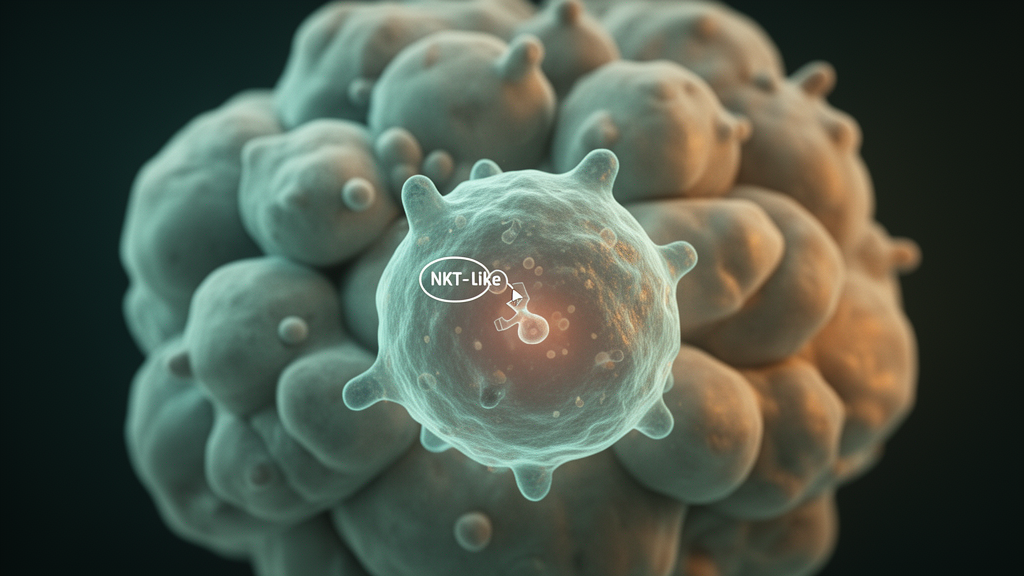
Patients with hepatocellular carcinoma who carry a high hepatitis B virus load show a distinctive form of immune dysfunction in a rare but important population of circulating immune cells, according to a new study published in Cancer Immunology, Immunotherapy. The research focuses on CD3-positive CD56-positive NKT-like cells, which bridge features of T cells and natural killer cells and contribute to both antiviral defense and tumor immune surveillance. In patients whose serum HBV DNA exceeded 10,000 IU per milliliter, these cells displayed clear signs of hypofunction, raising questions about how chronic viral replication shapes antitumor immunity in the liver.
The researchers found that TIGIT levels on peripheral blood NKT-like cells rose in parallel with HBV DNA concentration, so the higher a patient's viral load, the more TIGIT their NKT-like cells carried. Functionally, the high-HBV group's NKT-like cells secreted reduced amounts of antiviral effector cytokines, indicating that the cells were present but blunted in their ability to respond. To test whether TIGIT itself was responsible for the impaired activity rather than merely a marker of it, the team compared the behavior of TIGIT-positive and TIGIT-negative NKT-like cells within the same patients.
The TIGIT-positive subset showed significantly lower immune activity, supporting the idea that expression of this receptor tracks with a functionally exhausted state rather than simply accompanying it. A second layer of the mechanism involves plasmacytoid dendritic cells, or pDCs, which present the ligand CD155 that engages TIGIT. In patients with high HBV DNA, CD155 expression on pDCs was markedly upregulated compared with HCC patients whose viral loads were low.
The most direct evidence came from co-culture experiments in which NKT-like cells and pDCs from patients were grown together and stimulated with hepatitis B core antigen, the viral protein that NKT-like cells would normally recognize. When the investigators blocked the TIGIT pathway, the effector function of the patients' NKT-like cells was restored, demonstrating that the receptor-ligand interaction was actively suppressing the cells rather than simply correlating with their dysfunction. The new data provide a rationale for developing TIGIT-directed immunotherapy specifically for hepatocellular carcinoma patients with high HBV loads, a group whose disease is driven by both chronic viral infection and tumor progression.
The clinical context matters. Persistent HBV infection can lead to chronic hepatitis and cirrhosis, and high serum HBV DNA is recognized as a major risk factor for the development of hepatocellular carcinoma. The study's scope should be kept in mind.
The work examined peripheral blood cells rather than tumor-infiltrating lymphocytes, and the functional restoration was demonstrated in co-culture assays rather than in patients. Whether TIGIT blockade would improve clinical outcomes in high-HBV HCC patients remains an open question that would require clinical testing. Nevertheless, by linking viral load, receptor expression, ligand upregulation, and reversible dysfunction in a single mechanistic chain, the study offers a coherent account of how chronic HBV replication may undermine one arm of antitumor immunity and identifies a concrete molecular target for future intervention.
Subject of Research: TIGIT-mediated hypofunction of NKT-like cells in hepatocellular carcinoma patients with high HBV viral load
Article Title: TIGIT expression induces NKT-like cell hypofunction in hepatocellular carcinoma patients with high HBV load
Article References: Huang, R., Liu, X., Yu, X., Dai, X., Zheng, Y., Zheng, M., Xu, Y., & Zong, L. (2026). TIGIT expression induces NKT-like cell hypofunction in hepatocellular carcinoma patients with high HBV load. Cancer Immunology, Immunotherapy. https://doi.org/10.1007/s00262-026-04598-3
Image Credits: AI Generated
DOI: 10.1007/s00262-026-04598-3
Keywords: TIGIT, NKT-like cells, hepatocellular carcinoma, hepatitis B virus, immune checkpoint, plasmacytoid dendritic cells, CD155, HBV DNA, immune evasion, liver cancer immunotherapy, expression, induces
News Source: Nathaniel Bowman. (October 27, 2026). TIGIT receptor drives NKT-like cell exhaustion in high-HBV liver cancer patients. Scienmag.