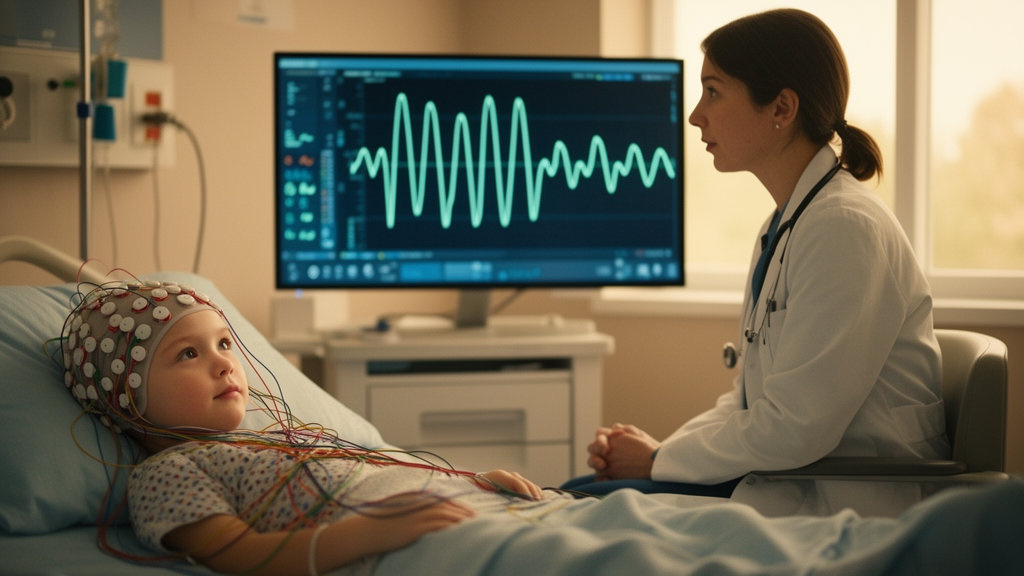
A new deep learning model can classify the severity of viral encephalitis in children from electroencephalogram recordings with an accuracy of 97.04 percent, according to a peer-reviewed study published in BioMedical Engineering OnLine. The model, called TFG–CBNN, was developed to address a long-standing bottleneck in pediatric neurology: conventional EEG-based assessment of encephalitis depends heavily on manual interpretation by specialists, a process that is subjective, time-consuming, and difficult to scale for early clinical screening.
Pediatric viral encephalitis is characterized by sudden onset and rapid progression, and accurate early assessment of disease severity is essential for preventing severe complications and long-term neurological sequelae. The research team, led by Xiewan Wang, Weijie Wang, and Qizhong Zhang, with Tiejia Jiang among the co-authors, designed the framework to automate this assessment by combining several signal-processing and machine-learning techniques into a single pipeline.
Technically, the model integrates three components. First, multichannel EEG signals are fused with multiband frequency-domain features, allowing the system to draw on both the raw time-series waveforms and information distributed across different frequency bands. Second, these fused features are encoded into a sequence of Gramian Angular Field images, a representation that preserves temporal information, amplitude relationships, and dependencies across EEG channels in a visual format suitable for image-based learning.
Third, the classification stage pairs a convolutional neural network with a bidirectional long short-term memory network. The CNN extracts spatial features from the GAF images, while the BiLSTM models temporal dependencies across the image sequence, capturing how the EEG patterns evolve over the recording period. This combination is intended to exploit both the spatial structure of the encoded images and the chronological order of the underlying brain activity.
In experiments on EEG recordings from 20 pediatric patients, TFG–CBNN achieved an accuracy of 97.04 percent and outperformed a set of baseline models in accuracy, precision, and F1 score. The baselines included MobileNet, ResNet50, CNN–LSTM, EfficientNet, and ConvNeXt, representing a range of established convolutional and hybrid architectures commonly used in medical image and signal classification.
The authors report that the findings demonstrate the potential of the proposed framework for computer-aided severity assessment and clinical decision support in pediatric viral encephalitis. By automating the interpretation step, such a system could, in principle, help clinicians triage children more quickly and reduce the variability introduced by subjective visual reading of EEG traces.
The study’s scope carries important limitations. The evaluation relied on EEG data from only 20 patients, a small sample that leaves open questions about how the model would perform across larger, more diverse patient populations, different hospitals, and varying recording conditions. The published version is also an early-release, peer-reviewed accepted manuscript that is subject to further edits before the final version of record appears.
As with any machine-learning tool trained and tested on limited clinical data, the reported accuracy should be understood as a research result rather than a validated diagnostic performance. The authors position the model as decision support rather than a replacement for clinical judgment, and further validation would be needed before any deployment in real-world screening settings.
Subject of Research: A children’s encephalitis condition detection model combining spatiotemporal features
Article Title: A children’s encephalitis condition detection model combining spatiotemporal features
Article References: Wang, X., Wang, W., Zhang, Q., & Jiang, T. (2026). A children’s encephalitis condition detection model combining spatiotemporal features. BioMedical Engineering OnLine. https://doi.org/10.1186/s12938-026-01642-2
Image Credits: AI Generated
DOI: 10.1186/s12938-026-01642-2
Keywords: children, encephalitis, condition, detection, model, combining, spatiotemporal, features, scientific research
News Source: Ophelia Keating. (October 27, 2026). AI model reads children’s EEG patterns to gauge encephalitis severity. Scienmag.