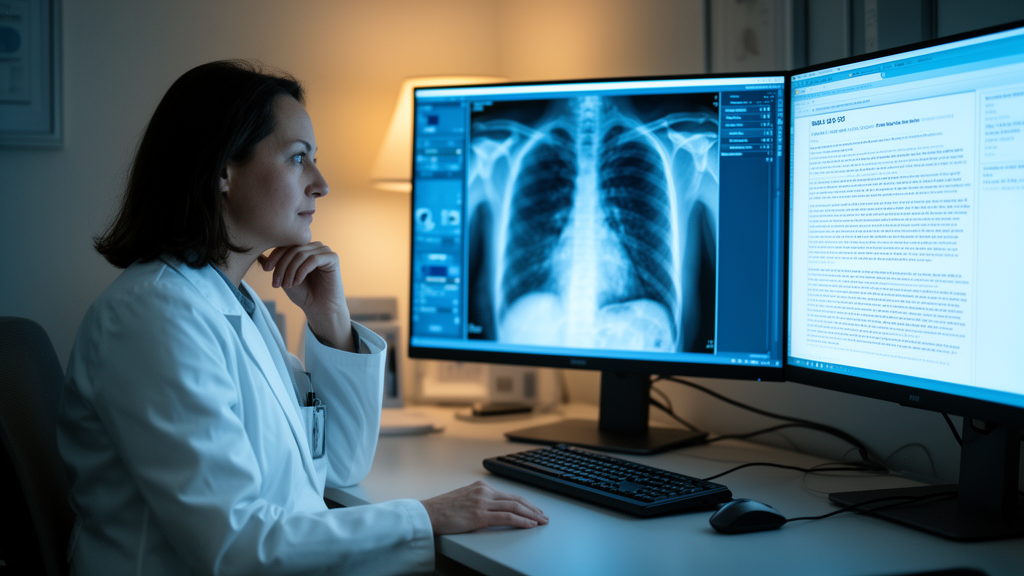
Vision–language foundation models, the class of artificial intelligence systems that jointly interpret medical images and clinical text, have advanced at remarkable speed since 2020, but a new narrative review argues that the evidence supporting their use in real hospitals remains fragmented, unevenly reported, and far from deployment-ready. Rather than pooling results into a single ranking, the authors deliberately keep each system's performance on its own dataset and protocol, warning that cross-task comparisons are exploratory at best. The most striking finding comes from a focused audit of 13 representative studies.
Only 4 of the 13, or 31 percent, reported standard language metrics such as BLEU or ROUGE alongside their results. Six studies, or 46 percent, used CheXpert- or CheXbert-derived label evaluation, which checks whether generated reports correctly state the presence or absence of a fixed set of chest findings. Just one study reported BERTScore, a semantic similarity measure, and only four included human expert evaluation.
Perhaps most tellingly for clinical use, none of the 13 reported inference latency or throughput, the numbers that determine whether a model can operate within the time constraints of a working radiology department. The authors are careful to note that these percentages describe only the displayed audit sample and should not be read as field-wide prevalence estimates. Lexical metrics such as BLEU and ROUGE score how closely a generated report overlaps with a reference report in wording, but the review emphasizes that these scores correlate poorly with clinical correctness.
A model can achieve high overlap by reproducing template phrases like "no acute cardiopulmonary process" while missing a genuine abnormality, and a model that describes a finding accurately in different words can be penalized for the paraphrase. Behind the measurement problem sit four deeper barriers to clinical translation. First, generative models hallucinate: they can produce clinically plausible statements about findings that are not actually present in the image, invent negations, or mis-localize abnormalities, and the review stresses that fluent language alone does not reveal these errors.
Second, interpretability remains limited. Attention maps and generated rationales are candidate user interfaces, but the authors caution that they are not proof that a model has revealed the causal basis of its output; a fluent explanation may be post hoc or itself hallucinated. Third, robustness under distribution shift is poorly tested, meaning a model trained on one hospital's imaging protocols may degrade at another.
Fourth, the evidence base is demographically and geographically narrow, dominated by English-language adult chest radiography from a small number of institutions. That narrowness is rooted in the datasets themselves. MIMIC-CXR, with 377,110 images and 227,835 reports from a single United States intensive care population, has played a role comparable to ImageNet in medical multimodal learning, but it is single-center, adult-only, and North American.
IU X-Ray contains fewer than 4,000 reports and is prone to data leakage. PadChest adds Spanish-language reports and SLAKE adds Chinese-language questions, but their regional scope remains limited. Biomedical figure corpora such as ROCO, MedICaT, and PMC-15M, which supplied 15 million image–text pairs for pretraining BiomedCLIP, carry caption noise and weak clinical context.
The review concludes that models trained on these resources may generalize poorly to pediatric, non-Western, or multilingual populations, and that automated labelers introduce systematic annotation noise that can propagate into spurious correlations and hallucinated findings. The technical architecture of these systems helps explain both their promise and their limits. Dual-encoder contrastive models, following the recipe popularized by CLIP, train separate image and text networks so that matching pairs land close together in a shared embedding space.
This approach scales well and supports retrieval and zero-shot classification, but because the two streams only meet at a final similarity comparison, these models struggle with fine-grained reasoning such as linking the phrase "right lower-lobe opacity" to a specific region of an image. Unified encoders such as MMBERT and MedViLL process images and text in a single transformer, enabling richer cross-modal attention, at the cost of heavier computation. Retrieval results illustrate how protocol-dependent the evidence is.
BiomedCLIP, pretrained on 15 million pairs, reports Recall@1 of 0.58 and Recall@10 of 0.89 on its benchmark, while ConVIRT reports Recall@10 of 0.81 on MIMIC-CXR and GLoRIA reports 0.87. The review explicitly refuses to rank these systems against each other, because dataset, candidate-pool size, retrieval direction, and preprocessing all differ. Similarly, on medical visual question answering, MMBERT reports 62.5 percent accuracy on VQA-RAD and MedViLL reports 67.8 percent, but the authors note that answer formats, splits, and normalization differ across studies, so these numbers measure benchmark performance rather than clinical capability.
No system, the review concludes, has demonstrated human-equivalent performance or deployment readiness. Regulatory context adds another layer of complexity. The review maps the field against complementary but non-interchangeable frameworks: the 2021 GMLP principles issued jointly by the United States FDA, Health Canada, and the United Kingdom's MHRA, harmonized through the IMDRF in 2025, address lifecycle practice for machine-learning-enabled devices; TRIPOD+AI and CLAIM are reporting guidelines for prediction models and medical-imaging AI respectively; and the EU AI Act is binding risk-based law whose applicability depends on jurisdiction and intended purpose.
The authors propose a minimum clinical validation and reporting standard covering data provenance, patient-level splits, clinically meaningful metrics with confidence intervals, external and subgroup validation, blinded human evaluation with documented reader expertise, and transparent reporting of compute, latency, and post-deployment monitoring. Adhering to reporting guidelines, they stress, does not itself constitute regulatory authorization. The review's roadmap for future work identifies eleven priorities, several of which target the trust gap directly.
Retrieval-augmented generation could ground outputs in external literature or past cases, and knowledge-graph reasoning could tie predictions to structured clinical entities. Temporal modeling is another priority: clinical reasoning depends on comparing current scans with priors, yet most benchmarks treat cases as static images, with MS-CXR-T one of the few benchmarks targeting temporal semantics. Federated learning could train models across hospitals without sharing raw data, though scaling it to large vision–language models remains technically difficult.
Synthetic data from diffusion models such as RoentGen, which generates chest radiographs from text prompts, might augment rare cases, provided the synthetic examples do not introduce their own artifacts. Integration with electronic health records and multi-omics data could supply the clinical context that pure image-to-text models lack. The authors also flag concerns that extend beyond accuracy.
Training billion-parameter models is energy-intensive and risks concentrating innovation in a few well-resourced institutions, motivating work on distillation, quantization, and parameter-efficient tuning such as LoRA. Privacy remains a live issue: de-identification mitigates but does not eliminate the risk that models memorize specific patient images or text verbatim, and adversarial perturbations known to fool medical image classifiers may also affect report-generating systems. On the human side, an emergency-department reader study cited in the review found physicians rated generative-AI chest radiograph reports as similar in quality to radiologist reports, an early signal of workflow value that the authors say must be replicated prospectively.
Their bottom line is measured: medical vision–language foundation models are promising, but progress should be judged by source-traceable, clinically grounded, externally validated evidence rather than by benchmark scores alone.
Subject of Research: Vision–language foundation models for medical image understanding and radiology report generation
Article Title: Vision–language foundation models for multimodal medical image understanding and report generation: a narrative review with quantitative synthesis
Article References: Mehmood, S., Khan, F. M., Alharbi, A. A. K., Saudagar, A. K. J., Alkhattabi, M., Khan, M. A., & Khan, M. A. (2026). Vision–language foundation models for multimodal medical image understanding and report generation: a narrative review with quantitative synthesis. Frontiers in Medicine, 13, Article 1958283. https://doi.org/10.3389/fmed.2026.1958283
Image Credits: AI Generated
DOI: 10.3389/fmed.2026.1958283
Keywords: medical AI, vision–language models, radiology report generation, hallucination, MIMIC-CXR, multimodal learning, clinical evaluation, dataset bias, BiomedCLIP, EU AI Act, federated learning, reporting standards
News Source: Ophelia Keating. (October 27, 2026). Medical AI Models That Read Images and Write Reports Still Face a Trust Gap. Scienmag.