On Graciosa, the second smallest island of the Azorean Archipelago at just 61 square kilometres, there is no true native forest left. What remains is a single small secondary patch of woodland dominated by the heather Erica azorica, surrounded by agricultural land, plantations and urban areas that have replaced the original vegetation since human colonisation. It is against this backdrop that researchers of the SLAM project, the Long-Term Ecological Study of the Impacts of Climate Change in the natural forest of Azores, have resumed and sustained arthropod monitoring on the island, aiming to document which insects and other arthropods persist, where introduced species have established, and whether any previously unrecorded species can still be found.
The monitoring effort, conceived and led by Paulo A. V. Borges, focuses on two contrasting sites on Graciosa. The first, Caldeirinha de Pêro Botelho, sits at 348 metres above sea level and consists of Erica azorica woodland, classified as Erica-Morella Coastal woodland. The crater exhibits a near-circular morphology and provides access to the island's sole documented volcanic cave, a cavity with a vertical extent of approximately 37 metres that opens at its base into a subhorizontal gallery oriented roughly northeast to southwest, measuring 24.6 metres in length and 7.4 metres in width.
The gallery floor is largely occupied by angular blocks derived from the gravitational collapse of the cavity walls and ceiling. The cave was first systematically explored and documented in 1964 by the Sociedade de Exploração Espeleológica – Os Montanheiros. The surrounding crater rim overlooks the Northwest Platform of Graciosa, a predominantly basaltic terrain characterised by a high density of monogenetic volcanic landforms, comprising approximately 55 cinder cones.
Because of its geological uniqueness, Caldeirinha de Pêro Botelho is classified as a priority geosite within the Azores Geopark, with recognised regional significance for scientific research, geoscience education and geotourism. The second sampling site, Caldeira da Graciosa-Furna da Maria Encantada, lies at 227 metres above sea level and consists of exotic and mixed forest. Furna da Maria Encantada is a natural heritage site within the Graciosa Nature Park, corresponding to a lava tube developed on the slope of the Caldeira da Graciosa.
According to Pereira and colleagues, the cavity is 56.5 metres long, with a maximum width of 4.9 metres and a maximum height of 5.8 metres, and it offers a privileged view over the interior of the caldera along the walking trail Volta à Caldeira – Furna do Enxofre. Graciosa is one of the warmest and driest islands of the archipelago, qualifying as Csa in the Köppen Climate Classification, meaning a temperate climate with hot and dry summers. Its maximum elevation is only 405 metres, the lowest of any island in the Azores.
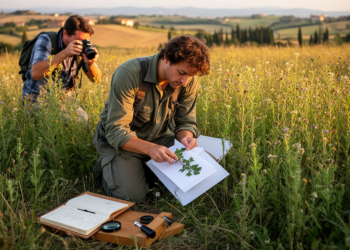
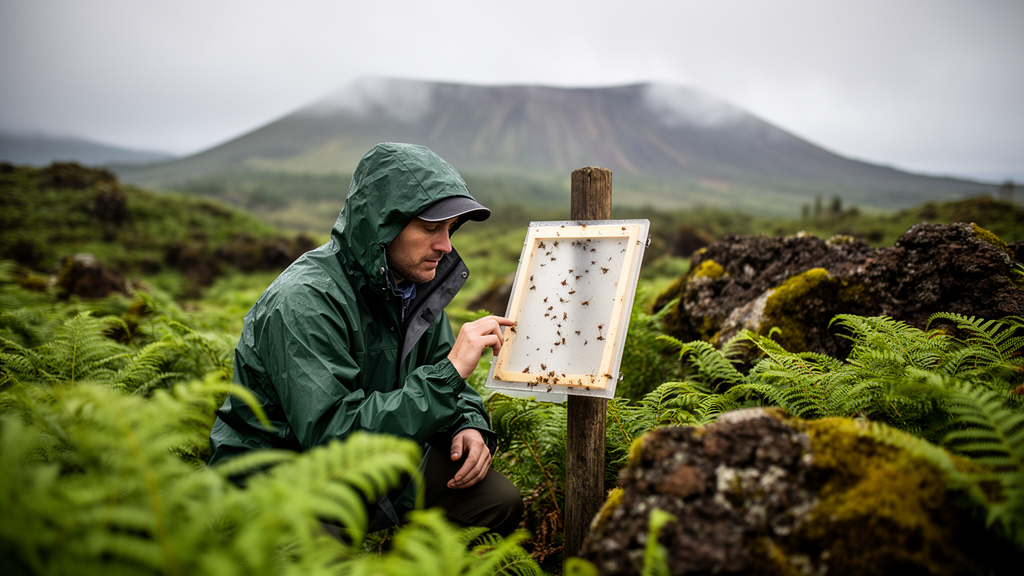
These conditions, combined with the small size and poor quality of the remnant habitat, make the island's native vegetation especially vulnerable to disturbance and to colonisation by exotic arthropod species dispersing from the surrounding altered environments. The two study sites, one secondary native woodland and one mixed native-exotic forest fragment, therefore offer a critical test of whether small remnant patches of native vegetation can still function as refuges for endemic arthropod biodiversity on an island where such habitat has been almost entirely lost. Fieldwork at both sites is carried out monthly or every two months by Forest Rangers, with the collaboration of the Natural Park of Graciosa, yielding a large dataset that allows a reliable characterisation of the richness and composition of the arthropod communities present.
This continuity matters: Graciosa had not been surveyed since 2015, and the resumption of sampling was made possible by the Azorean Government and the Forest Rangers, even though the island is not part of the LIFE BEETLES project that since 2020 funds long-term monitoring on Terceira, Flores and Pico. The SLAM project itself began in 2012 on Terceira Island under the NETBIOME ISLANDBIODIV project and expanded in August and September 2013 to seven more islands, including Flores, Faial, Pico, Graciosa, São Miguel and Santa Maria. The scientific rationale for this persistence is sobering.
Oceanic islands are especially vulnerable to biodiversity loss because their biotas are typically small, highly isolated and rich in endemic species, making them particularly sensitive to habitat destruction, fragmentation and biological invasions. In the Azores, human colonisation profoundly transformed the original landscape, and most remaining native habitats are now small, isolated patches embedded in human-dominated matrices, conditions that favour ecological degradation and the spread of exotic species. On such islands, biodiversity erosion is often visible not only in outright species loss but also in shifts in community composition and the increasing representation of introduced taxa.
Graciosa presents a particularly instructive case. It is estimated to have one of the highest Red List Index values of all islands of the Azorean Archipelago, an index measuring trends in species' extinction risk over time that ranges from 1, meaning species are not expected to become extinct soon, to 0, meaning all species are extinct. A high value would normally suggest a lower proportion of threatened species.
Yet researchers suspect this result derives from the very early extinction of species endemic to Graciosa, meaning the island's apparently favourable score may reflect an already depleted endemic fauna rather than a healthy one. Meanwhile, the rise of exotic species across the Azorean Archipelago has been described as very alarming and could pose a major risk to the remaining endemic biodiversity. The stakes are heightened by earlier research indicating that native forest destruction in the Azores has been associated with a potentially severe extinction debt for endemic arthropods, an accumulated future loss of species following past habitat loss.
Endemic island species are often habitat specialists with small ecological niches and limited dispersal possibilities, which makes continued biodiversity surveys essential to document current assemblages, detect newly established exotic species and provide the baseline information needed for conservation actions. Native forest fragments are especially relevant in the Azores because they support the most distinctive indigenous arthropod assemblages and may buffer the impacts of habitat degradation and the spread of exotic species. The operational side of the programme reflects its long-term ambition.
Fieldwork was performed by Carlos Picanço with the collaboration of Pedro Raposo of the Natural Park of Graciosa, while a team of parataxonomists processed the samples, including Martha Vounatsi, Alexandra Dal Lago, Sophie Wallon, Alejandro Torres Expósito, Guillaume Péron, José Luis Laguna Fernández, Luna Serrano Navarro, Noelia Reverón García and Yeray Gómez López. Taxonomic work was carried out by Paulo A. V. Borges and Luís C. Crespo, voucher specimen management was undertaken by Vounatsi, Dal Lago, Wallon, Crespo and Borges, and the Darwin Core database was curated by Sébastien Lhoumeau and Borges. This pipeline, from monthly sampling in volcanic terrain to curated specimen archives and standardised databases, is what turns routine monitoring into a durable scientific record.
For an island where the last remnants of native vegetation cling to crater rims and lava tube entrances, the value of this dataset lies in what it makes possible: a reliable picture of which endemic arthropods still survive in Graciosa's two remaining refuge-like habitats, an early warning system for newly arrived exotic species, and the baseline against which future community change, driven by climate and invasion, can be measured. In island systems where extinction debt may already be falling due, such continuous documentation is not a luxury but a prerequisite for any conservation action that hopes to arrive in time.
Subject of Research: Long-term arthropod biodiversity monitoring in the remnant native and mixed forests of Graciosa Island, Azores
Article Title: SLAM Project – Long-Term Ecological Study of the Impacts of Climate Change in the natural forest of Azores: VII – Long-term arthropod monitoring in Graciosa Island
Article References: Vounatsi, M., Lhoumeau, S., Dal Lago, A., Wallon, S., Crespo, L. C., Picanço, C., Raposo, P., & Borges, P. (2026). SLAM Project – Long-Term Ecological Study of the Impacts of Climate Change in the natural forest of Azores: VII – Long-term arthropod monitoring in Graciosa Island. Biodiversity Data Journal, 14, Article e194216. https://doi.org/10.3897/bdj.14.e194216
Image Credits: AI Generated
Keywords: Azores, Graciosa Island, SLAM project, arthropods, biodiversity monitoring, endemic species, exotic species, native forest, conservation, island biogeography, extinction debt, volcanic caves
News Source: Sloane Callahan. (October 27, 2026). Research report: SLAM Project – Long-Term Ecological Study of the Impacts of Climate Change in the natural forest of Azores: VII – Long-term arthropod monitoring in Graciosa Island. Scienmag.