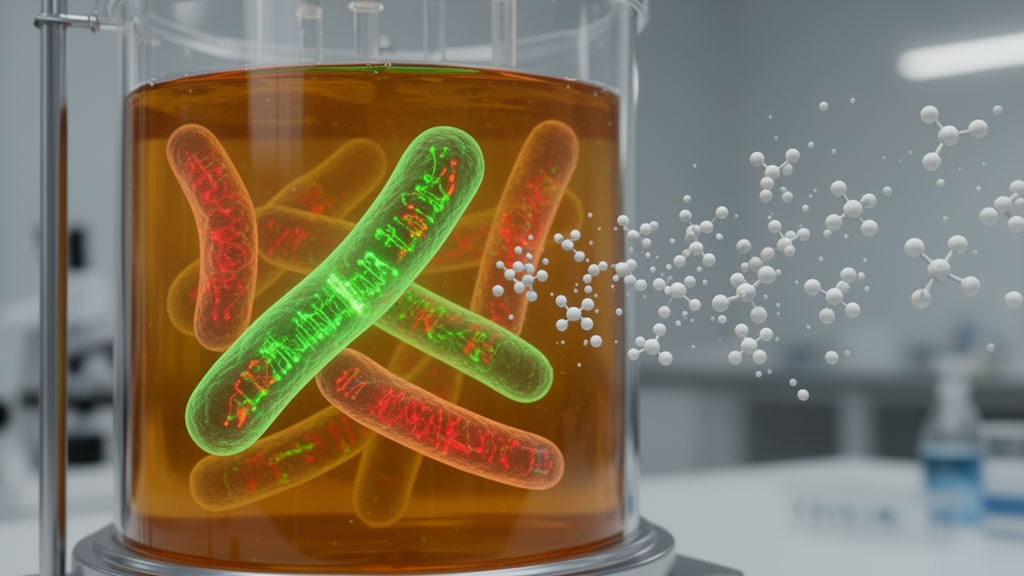
Engineered bacteria can serve as microscopic production plants for valuable chemicals, but a fundamental conflict limits their output: the same cell must grow and manufacture at the same time, and both processes draw on a shared pool of resources. A team at Shandong University led by Professors Quanfeng Liang and Qingsheng Qi reports a way to ease that conflict with a pathway-independent, three-module self-induced regulatory system that switches production genes on automatically as the bacterial culture matures. When the researchers applied the circuit to Escherichia coli engineered to make 3-hydroxypropionic acid (3-HP), a commercially interesting platform chemical, the shake-flask yield reached 7.0 g/L, 27% higher than a traditional approach in which the production genes run continuously. The engineered cells also grew better and consumed less sugar than the conventionally engineered strain, the team reports in Engineering Microbiology.
The problem the circuit addresses is well known in metabolic engineering. In a conventional microbial cell factory, the genes for a target product are kept permanently active. That constant expression diverts precursors, energy and ribosomal capacity away from growth, so heavily burdened cells grow poorly and, paradoxically, often produce less. Dynamic regulation offers an alternative: genes are switched on only when the time is right, much like a timer. Most earlier dynamic systems, however, depend on sensing a specific chemical signal tied to a particular product or pathway, which makes each regulatory design product-specific and difficult to transfer to new targets.
The Shandong team instead built their timer from signals that are intrinsic to the bacteria themselves. The circuit combines quorum sensing, which reports cell density, with stationary phase signals, which report the culture’s growth state. “Simply put, when the number of bacteria is low, the first switch turns on; when they enter stationary phase, the second switch turns on; and a bit later, the third switch turns on,” Liang explains. “The three switches start at about 3, 5, and 9.5 hours, without adding any external inducers.” Because the triggers are the cell’s own state rather than a product-linked chemical, the same regulatory architecture can, in principle, be attached to different biosynthetic pathways.
To test the concept, the researchers deployed the system in E. coli for 3-HP production, where two competing metabolic branches consume the same raw materials as the desired route. “The three switches work together: one shuts down a branch that steals raw material, another opens the production line for 3-HP, and the third shuts down another competing branch,” Qi says. The staggered activation times mean that early growth proceeds with minimal production burden, while the flux of central metabolites is progressively redirected toward 3-HP as the culture enters its production phase. The result was the 7.0 g/L shake-flask titer, alongside improved growth and reduced sugar consumption relative to the traditional always-on configuration.
A key practical advantage is portability. “The system is triggered by the bacteria’s own state, not by a specific product,” Liang notes. “To switch to a different target product, only the corresponding genes need to be replaced, allowing the bacteria to be quickly re-engineered.” In other words, the regulatory modules act as a reusable chassis: the timing logic stays the same, while the downstream production genes are swapped according to the desired chemical.
The study also carries a cautionary lesson about circuit design. When the team built a strain carrying only two of the three modules, that strain grew and produced less than the full three-module version, showing that adding regulatory switches does not automatically improve performance. “If the strength or timing of the switches is wrong, it can harm the bacteria, indicating that metabolic regulation is complex and needs careful optimization,” Qi says. The relative strength of each module and the hours at which each activates must be matched to the pathway being controlled; mis-timed or overly strong repression can itself become a burden.
The authors position the work as a general-purpose tool for building microbial cell factories, one that decouples the regulatory design from the product chemistry. Because the reported results come from shake-flask experiments with E. coli producing a single target compound, further engineering and scale-up would be needed to establish how the system performs for other products, at higher titers and in industrial fermenters. Within that scope, the study demonstrates that a pathway-independent, self-induced timer built from quorum sensing and stationary phase signals can raise yield, improve growth and lower sugar consumption simultaneously, while the two-module comparison shows that the number, strength and timing of the switches must be tuned rather than simply maximized. The findings are published in Engineering Microbiology under the DOI 10.1016/j.engmic.2026.100281, and the authors declare no known competing financial interests or personal relationships that could have influenced the work.
Subject of Research: A pathway-independent self-induced regulatory gene circuit for microbial 3-hydroxypropionic acid production
Article Title: Universal gene circuit boosts microbial production of 3-hydroxypropionic acid
Article References: Universal gene circuit boosts microbial production of 3-hydroxypropionic acid. Original publication (Bibliographic details unavailable.)
Image Credits: AI Generated
DOI: Not provided
Keywords: metabolic engineering, gene circuit, quorum sensing, stationary phase, 3-hydroxypropionic acid, Escherichia coli, microbial cell factory, dynamic regulation, self-induced system, Shandong University, Engineering Microbiology, Universal
News Source: Juliet Wilcox. (October 26, 2026). Self-timing gene circuit lifts microbial 3-hydroxypropionic acid yields. Scienmag.