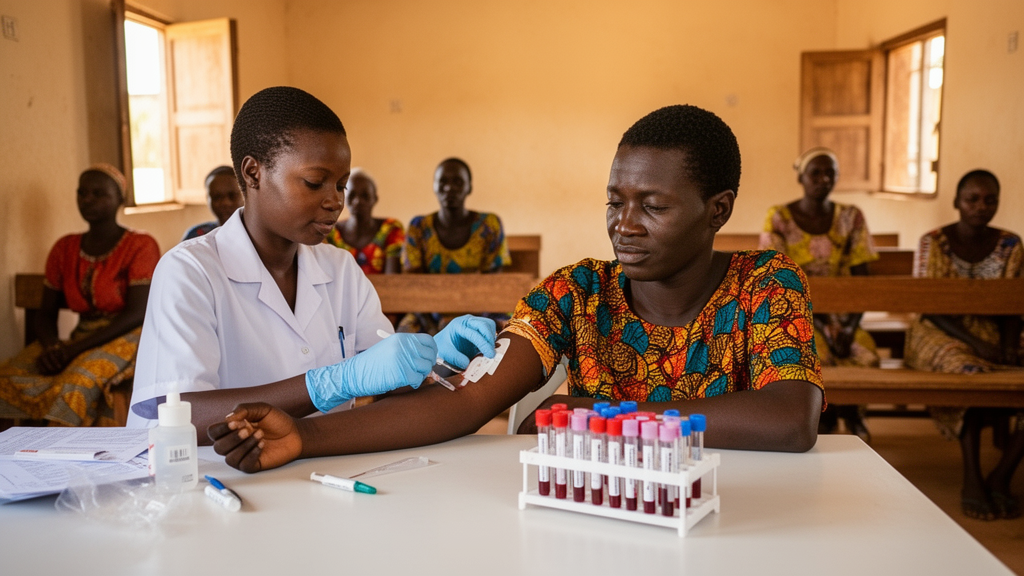
A large community-based serosurvey spanning Burkina Faso, Ghana and Nigeria has found that between 24.1 percent and 76.4 percent of participants carried IgG antibodies against SARS-CoV-2, indicating that exposure to the virus was far more widespread in West African communities than officially reported case counts during the pandemic had suggested. The study, published in Frontiers in Public Health, recruited 20,748 participants across the three countries and is described by its authors as one of the largest multi-country community-based SARS-CoV-2 seroepidemiology studies conducted in Africa to date. The research was designed to address a puzzle that had persisted since the early phase of the COVID-19 pandemic.
Africa appeared to have experienced low SARS-CoV-2 infection rates and comparatively low COVID-19 morbidity and mortality, at least as measured by reported cases and deaths. Several earlier studies, however, had reported high levels of SARS-CoV-2 seropositivity among apparently healthy Africans, a discrepancy that raised two competing explanations. One possibility was that the virus had indeed spread extensively through African populations while causing relatively little severe clinical disease.
The other, advanced by some researchers, was that apparent seropositivity could have resulted from pre-existing cross-reactive antibodies, antibodies raised against other coronaviruses or related pathogens that happen to bind in SARS-CoV-2 tests without reflecting true infection. To track exposure trends over time, the research teams conducted cross-sectional surveys at study sites conveniently selected within each of the three countries. Sampling was carried out during two distinct phases of the pandemic: the period when the Delta variant was dominant and the period when the Omicron variant was dominant, both nationally and globally.
Because the investigators did not perform widespread viral sequencing on participant samples, they could not attribute any individual's seropositivity to infection with a specific variant. Instead, they classified the sampling periods by whichever variant was reported as dominant at the time the samples were collected, an important methodological limitation that shapes how the results should be interpreted. Antibody detection relied on rapid diagnostic tests that measure two classes of immunoglobulins.
The teams used SARS-CoV-2 IgG/IgM rapid diagnostic tests from Prestige Diagnostics at the sites in Ghana and Burkina Faso, and kits from SD Biosensor at the sites in Nigeria. These immunoassay kits had published validation procedures, and the researchers describe them as validated for the purpose of detecting SARS-CoV-2 antibodies in peripheral blood. The primary outcome of the study was the proportion of each sampled population with SARS-CoV-2 antibodies, a standard measure in seroepidemiology known as seroprevalence.
In addition to blood sampling, participants' demographic and clinical data were collected using a semi-structured questionnaire. This allowed the investigators to examine how seropositivity related to factors such as age and other demographic characteristics, and to record participants' vaccination status and attitudes. The headline result was the wide range of IgG seropositivity across sites, from 24.1 percent at the lowest to 76.4 percent at the highest, with higher rates observed during the Omicron-dominant period than during the Delta-dominant period.
What the data do establish is that the fraction of community members with SARS-CoV-2 antibodies grew substantially between the two sampling windows across the study populations. A crucial contextual finding concerns vaccination. All study sites showed low self-reported vaccination rates, which the authors say suggests that the observed seropositivity was primarily driven by natural infection rather than by vaccine-induced antibodies.
The demographic analysis revealed a consistent pattern for age and a heterogeneous one for other factors. Across all sites, there was a significant positive association between seropositivity and age, meaning older participants were more likely to carry SARS-CoV-2 IgG antibodies. By contrast, the associations between seropositivity and other demographic factors were country-dependent, differing between Burkina Faso, Ghana and Nigeria.
Taken together, the findings support what the authors describe as a marked disconnect between high population exposure and low reported clinical burden in the region. The study as summarized cannot adjudicate between these possibilities, since it measured antibody prevalence rather than disease outcomes, and its sites were conveniently rather than randomly selected within each country, which limits how precisely the results can be generalized to national populations. The authors argue that their results underscore the need for strengthened community-based surveillance in West Africa.
Subject of Research: SARS-CoV-2 seroprevalence and community exposure in West Africa
Article Title: Widespread SARS-CoV-2 exposure in West Africa: findings from a 20,748-participant multi-country seroepidemiology study
Article References: Udoakang, A. J., Oduro-Mensah, D., Amegatcher, G., Folarin, O., Aliyu, I. A., Owusu, I. A., Dzabeng, F., Ouedraogo, A., Ayivor-Djanie, R., Gyamfi, J., Sanou, M. A., Tapela, K., Binyet, M., Boateng, K. A., Amole, T. G., Okolie, J., Musa, B. M., Bala, J. A., Akano, K., … Quashie, P. K. (2026). Widespread SARS-CoV-2 exposure in West Africa: findings from a 20,748-participant multi-country seroepidemiology study. Frontiers in Public Health, 14, Article 1945355. https://doi.org/10.3389/fpubh.2026.1945355
Image Credits: AI Generated
DOI: 10.3389/fpubh.2026.1945355
Keywords: SARS-CoV-2, seroprevalence, seroepidemiology, West Africa, Ghana, Nigeria, Burkina Faso, COVID-19, IgG antibodies, Omicron, Delta variant, community surveillance
News Source: Kristina Jarvis. (October 26, 2026). SARS-CoV-2 antibodies found in up to 76 percent of people across three West African countries. Scienmag.