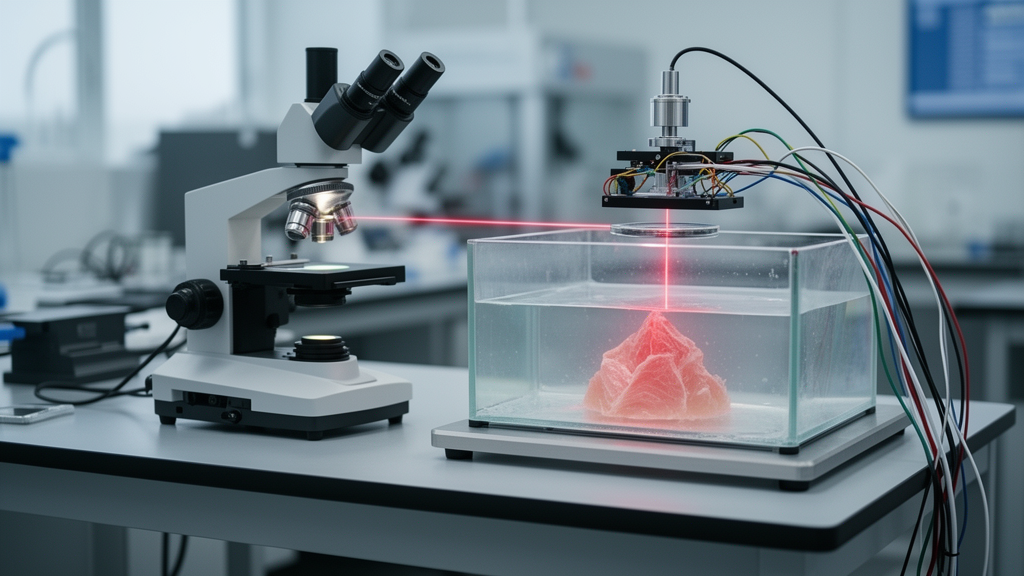
A camera cannot keep a nearby flower and a distant mountain in focus at the same time, and optical microscopes face the same trade-off when imaging structures at different depths inside the body. Tighter focusing of light improves spatial resolution but shortens the depth range over which the image stays sharp. A joint research team led by Professors Junsuk Rho and Chulhong Kim at Pohang University of Science and Technology (POSTECH) has now built a photoacoustic microscopy system around a dual-focus metalens that switches between two imaging depths simply by changing an applied voltage, with no mechanically moving optical components. The study was published in Light: Science & Applications.
Photoacoustic microscopy works by delivering laser light into biological tissue, where optical absorption generates ultrasonic waves that are detected to form an image. In its optical-resolution variant, the light is tightly focused to reach micrometer-scale spatial resolution, allowing fine vascular structures to be visualized in detail. The drawback is that tighter optical focusing inevitably produces a shorter depth of focus, so only a limited axial region can be imaged sharply. That makes it difficult to capture three-dimensional biological structures spread across a broad depth range. Conventional attempts to extend the imaging depth have used Bessel beams, which maintain a narrow central focus over a longer axial range, but these beams inherently generate pronounced side lobes around the central beam that can introduce background signals, reduce image contrast, and degrade imaging quality.
The POSTECH team’s solution relies on controlling the polarization state of light rather than moving any optics. Two integrated components do the work. The first is a dual-focus metalens that generates focal spots at different axial positions depending on whether the incident light is right- or left-circularly polarized. The second is an electrically driven liquid-crystal cell, of the same type used in smartphone displays, that changes the polarization state of the incident light in response to an applied voltage. By combining the two, the researchers could electronically switch between two focal depths just by adjusting the voltage on the liquid-crystal cell, with each switch taking only about 0.25 seconds. The metalens was further integrated with a ring-shaped ultrasonic transducer, aligning the optical and acoustic axes within a compact photoacoustic microscopy configuration.
By alternating between the two focal modes, the system achieved an overall axial imaging range of approximately 1.2 mm. The lateral spatial resolutions at the two focal positions were approximately 3.1 μm and 3.7 μm, respectively, which is sufficient to visualize microscopic vascular structures. The team validated the system experimentally by imaging the eyes of mice with chemically induced corneal injury. In the shallower focal mode, newly formed blood vessels in the cornea were clearly visualized. In the deeper focal mode, blood vessels near the iris, located approximately 2.2 mm below the surface, were selectively resolved. These results demonstrate that vascular structures at substantially different depths can be selectively visualized at high spatial resolution without mechanically moving any optical components.
The technology could be particularly useful for ophthalmic imaging, where clinically relevant blood vessels are distributed across different depths within the eye. Diseases such as diabetic retinopathy and other vascular disorders require accurate assessment of vascular structures throughout multiple regions of the eye. Professor Junsuk Rho explained, “By utilizing polarization multiplexing in a metalens, we can switch a high-resolution optical focus along the depth direction without mechanically moving optical components. Eliminating mechanical motion can also enable more compact and stable imaging systems, providing opportunities for applications in a wide range of biomedical and industrial imaging platforms.” The study was co-first-authored by Dr. Hongyoon Kim of POSTECH’s Department of Mechanical Engineering, Eunwoo Park, a Ph.D. candidate in POSTECH’s Department of Biomedical Engineering, and Professor Jungwoo Park of Kyungpook National University. The research was supported by the POSCO-POSTECH-RIST Convergence Research Center, the Global Convergence Research Support Program of the Ministry of Science and ICT and the National Research Foundation of Korea, the BK21 FOUR Program, Glocal University 30, the Asan Foundation Biomedical Science Scholarship, and the Presidential Science Scholarship.
Subject of Research: An electrically switchable dual-focus metalens for depth-extended photoacoustic imaging of ophthalmic vascular disease
Article Title: A metalens photoacoustic microscope that switches focus with voltage
Article References: A metalens photoacoustic microscope that switches focus with voltage. Original publication (Bibliographic details unavailable.)
Image Credits: AI Generated
DOI: Not provided
Keywords: metalens, photoacoustic microscopy, liquid crystal, polarization multiplexing, depth of focus, ophthalmic imaging, vascular imaging, Bessel beams, ultrasonic transducer, POSTECH, corneal neovascularization, biomedical optics
News Source: Bethany Barker. (October 26, 2026). Voltage-switched metalens extends photoacoustic microscope’s depth of focus. Scienmag.