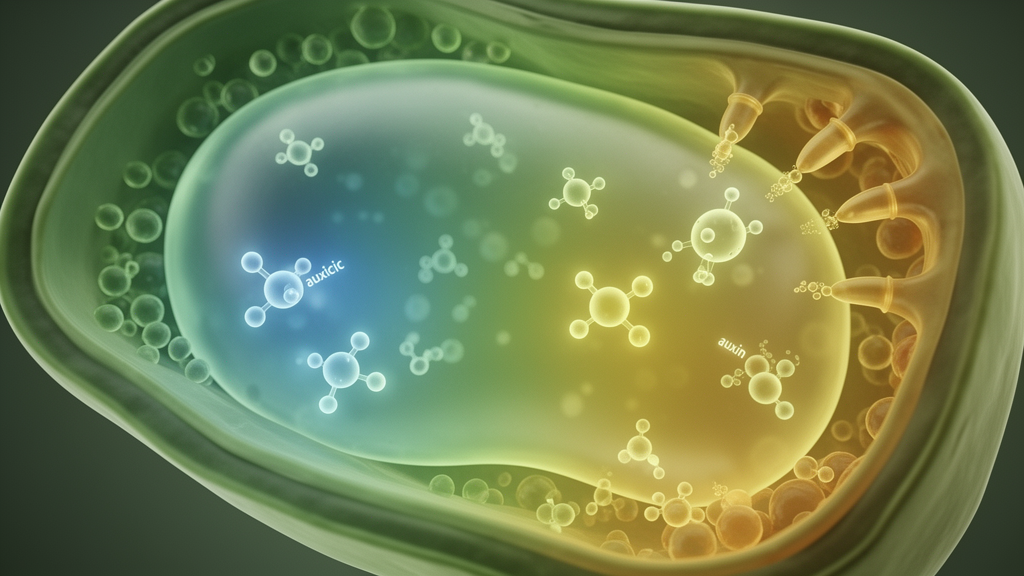
Two of the plant world's most influential hormones, auxin and abscisic acid (ABA), have long been known to pull in opposite directions, producing growth and stress responses that are often visible to the naked eye. A new review published in Plant Biosystems argues that the molecular logic behind this antagonism may lie in two system-level mechanisms that have been overlooked: opposing changes in cytosolic pH and unexpected direct binding of ABA to proteins within the auxin signalling network. The first mechanism concerns pHcyt, the pH of the cytosol.
According to the review, auxin and its signalling intermediate IAA tend to acidify the cytosol, whereas ABA alkalinises it. The shifts are modest, usually less than 0.5 pH units, but the author argues that changes of this magnitude are far from trivial. They can alter the ionisation state, shape, activity and association behaviour of proteins across the entire cytosol, effectively retuning the biochemical environment in which all signalling takes place.
Crucially, the review cites evidence that such pHcyt changes can be both necessary and sufficient to drive the transcription of ABA biosynthesis genes. This positions cytosolic pH not as a passive by-product of hormone action but as a higher-order tuner that shapes how strongly and in which direction each hormone's signal is expressed. The second proposed mechanism is more surprising: ABA appears to bind specifically to proteins that were not previously considered canonical ABA targets.
Among the candidates are auxin response factors, or ARFs, the transcriptional regulators that sit at the heart of the auxin signalling web. If ABA binding modifies ARF behaviour, it would provide a direct biochemical route by which the stress hormone can temper auxin-driven transcriptional programmes. The review suggests that this direct binding could serve as a safeguard against hyper- or excessive auxin responses.
In other words, when auxin signalling threatens to overshoot, ABA binding to ARFs, modulated by the concurrent pHcyt shift, could dampen the output and keep the two hormonal systems in balance. The author emphasises that these two mechanisms are not independent. It is reasonable to expect, the review notes, that specific ABA binding to ARFs and its downstream modifications are themselves affected by cytosolic pH changes, coupling the two proposed layers of regulation into a single dynamic system.
What emerges is a critique of how plant signalling has traditionally been studied. A static, Euclidean view of signalling pathways, in which hormones act through fixed linear routes, cannot do justice to the complex interactions between auxin and ABA, the review argues. The framework is presented as a set of proposals rather than settled results, and the author frames future research as the route to testing these ideas at both the biochemical and systems level.
If the model holds, it would explain why the phenotypic tug-of-war between growth-promoting auxin and stress-linked ABA is so readily visible, even though the underlying molecular handshake has remained difficult to pin down.
Subject of Research: System-level mechanisms of auxin and abscisic acid hormone antagonism in plants
Article Title: Unexpected ABA-binding targets and cytosolic pH changes as key components in the Auxin/IAA-ABA antagonism
Article References: Gehring, C. (2026). Unexpected ABA-binding targets and cytosolic pH changes as key components in the Auxin/IAA-ABA antagonism. Plant Biosystems, 160(6), Article 299. https://doi.org/10.1007/s44473-026-00321-3
Image Credits: AI Generated
DOI: 10.1007/s44473-026-00321-3
Keywords: auxin, abscisic acid, cytosolic pH, auxin response factors, plant hormones, signalling, ABA biosynthesis, hormone antagonism, systems biology, Plant Biosystems, Unexpected, ABA-binding
News Source: Alan Morgan. (October 26, 2026). Cytosolic pH shifts and surprise ABA targets may explain auxin-ABA antagonism. Scienmag.