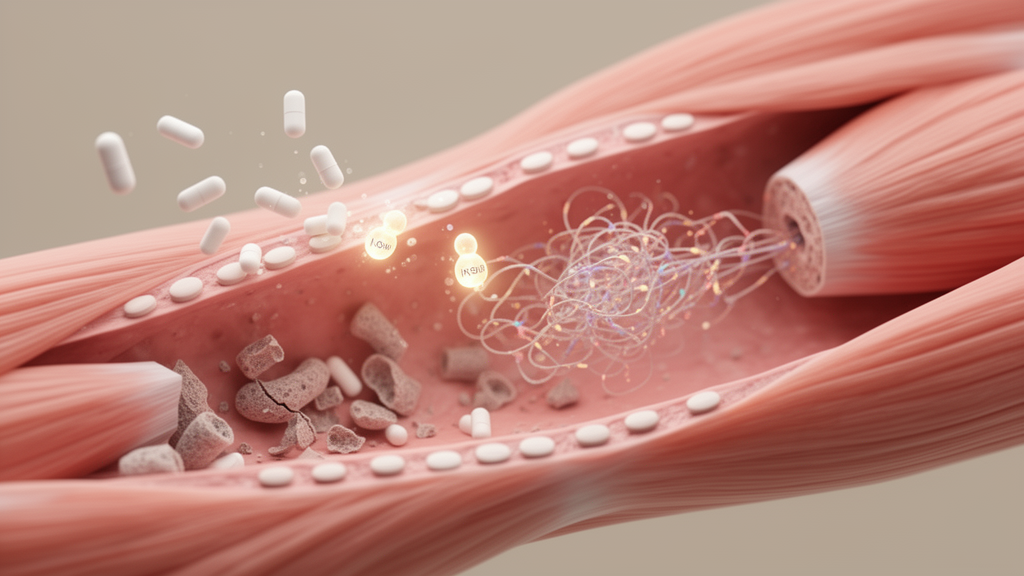
Olanzapine, one of the most widely prescribed second-generation antipsychotics, has long carried a clinical shadow: patients taking it face a markedly elevated risk of weight gain, hyperglycemia, and insulin resistance. A new study published in Frontiers in Pharmacology now dissects what happens inside skeletal muscle cells when they are exposed to the drug, and the results complicate a popular explanation. A Chilean research team reports that olanzapine fragments mitochondria and cripples insulin signaling in rat L6 myoblasts, but that blocking mitochondrial fission with the inhibitor Mdivi-1 fails to restore insulin responsiveness, even though it partially protects mitochondrial shape and cell viability.
The question matters because skeletal muscle is the body’s dominant site of insulin-stimulated glucose disposal, and muscle insulin resistance is an early step on the road to type 2 diabetes. Second-generation antipsychotics as a class are known to disturb glucose homeostasis independently of caloric intake, but the risk is not evenly distributed. Clozapine and olanzapine, two structurally related dibenzodiazepine derivatives with overlapping receptor-binding profiles, consistently show the highest metabolic liability, while agents such as aripiprazole, ziprasidone, amisulpride, and lurasidone carry a substantially lighter burden. That gradient suggests a compound-specific mechanism rather than a class-wide one, making olanzapine a logical molecule to dissect.
Mitochondria have been prime suspects in this story. In early insulin resistance, patients show reduced oxidative phosphorylation activity in muscle, and in advanced metabolic syndrome the tricarboxylic acid cycle and respiratory chain decline further, accompanied by mitochondrial DNA damage and reduced mitochondrial DNA content. People with obesity or type 2 diabetes also display reduced mitochondrial volume in skeletal muscle. Previous work from the same group had shown that silencing the fusion proteins Mitofusin 2 or OPA1 decreases insulin-induced Akt phosphorylation and glucose uptake in L6 cells, and the team had earlier reported a possible direct interaction between olanzapine and the insulin receptor itself. The new study set out to test whether preventing mitochondrial fragmentation pharmacologically could rescue olanzapine’s metabolic damage.
The experimental design was straightforward. L6 myoblasts were treated for 24 hours with 160 micromolar olanzapine, 10 micromolar Mdivi-1, both, or neither, and then stimulated with 100 nanomolar insulin for 30 minutes under serum-free conditions. The olanzapine concentration, far above therapeutic blood levels of roughly 0.064 to 0.128 micromolar, reflects the drug’s approximately 93 percent plasma protein binding and the lower sensitivity of immortalized cell lines compared with primary cells, the authors note. The team then measured cell viability by propidium iodide flow cytometry, insulin signaling by Western blot for phospho-Akt at Ser473 and phospho-ERK1/2, glucose uptake with the fluorescent analogue 2NBDG, oxygen consumption with a Clark’s electrode, mitochondrial membrane potential with TMRM, ATP content with a luciferase assay, and mitochondrial morphology with MitoTracker Green imaging analyzed through the MiNA plug-in.
The viability results offered the first surprise. Olanzapine alone caused a slight but significant drop in viability, to an average of 91 percent, while Mdivi-1 alone left viability essentially untouched. When the two drugs were combined at 10 micromolar Mdivi-1, viability returned to levels statistically indistinguishable from untreated controls, suggesting the fission inhibitor protected the cells from olanzapine-induced death. Bright-field microscopy added a caveat: the combination prevented the cell enlargement seen with Mdivi-1 alone but induced vacuolization, a mixed morphological picture that foreshadowed the metabolic results to come.
On insulin signaling, the rescue failed completely. Insulin stimulation of untreated cells reliably increased Akt and ERK1/2 phosphorylation and boosted glucose uptake, confirming the model was working. Olanzapine pretreatment abolished both the kinase phosphorylation response and the glucose uptake response, reproducing the insulin-resistant phenotype described in earlier studies. But Mdivi-1, whether given alone or with olanzapine, did not restore insulin responsiveness. Strikingly, Mdivi-1 on its own actually blunted insulin-induced Akt and ERK phosphorylation without affecting glucose uptake, an observation the authors attribute in part to the drug’s known off-target inhibition of mitochondrial Complex I, which can perturb bioenergetics and reactive oxygen species balance.
The bioenergetic measurements reinforced the disconnect. Insulin did not significantly change oxygen consumption, mitochondrial membrane potential, or ATP content under the study’s conditions. Olanzapine, however, lowered baseline mitochondrial membrane potential whether or not Mdivi-1 was present, and the combination failed to reverse this. Morphologically, olanzapine produced a dramatic shift: a significant increase in fragmented mitochondria and a significant decrease in branched mitochondrial networks, with the total mitochondrial count unchanged, indicating the effect reflected altered fission-fusion balance rather than changes in mitochondrial biogenesis or mitophagy. Mdivi-1 co-treatment partially preserved the networks but, unexpectedly, reduced the population of elongated mitochondria, and it never normalized insulin signaling or bioenergetics.
To probe whether olanzapine might engage the fission machinery directly, the team turned to computational structural biology. Docking olanzapine, Mdivi-1, and two other published DRP1 inhibitors, Drpitor1a and DRP1i27, into the crystal structure of the human DRP1 GTPase domain placed all four ligands in the guanine-nucleotide pocket, overlapping the footprint of GTP and contacting catalytic residues including Ser40, Lys216, and Gln249. Olanzapine’s docking score of minus 5.11 kilocalories per mole was marginally better than Mdivi-1’s minus 4.96. Ten-nanosecond all-atom molecular dynamics simulations followed by MM/PBSA binding free energy calculations then revealed a decisive dependence on protonation state: neutral olanzapine drifted out of the pocket almost immediately, while the physiologically predominant protonated cation remained anchored, gaining roughly 11.85 kilocalories per mole of stabilization through electrostatic contacts with Glu43 and Asp49. Protonated olanzapine and Mdivi-1 showed statistically indistinguishable binding free energies, minus 22.26 plus or minus 1.75 and minus 24.50 plus or minus 0.45 kilocalories per mole respectively at one dielectric setting, and both shared a persistent hydrophobic contact with residue Ile252. Neither compound coordinated the catalytic magnesium ion.
The authors are careful about what these numbers do and do not prove. The simulations support compatible occupancy of a shared binding region, not high-affinity or functionally competitive binding, and no direct biochemical assay of olanzapine against DRP1 was performed. More tellingly, the biology argues against a simple story: if olanzapine were a classical GTP-competitive DRP1 inhibitor, it should suppress fission, yet it promotes fragmentation. Olanzapine was also used at a 16-fold higher concentration than Mdivi-1, and the drug’s well-known polypharmacology makes a single-target explanation implausible. The team points instead to extramitochondrial candidates, noting that L6 cells express metabolically relevant G protein-coupled receptors, including 5-HT2A receptors whose activation stimulates glucose uptake independently of the canonical IRS1-PI3K-Akt pathway, and that olanzapine is a potent 5-HT2A antagonist.
The study’s central message is one of uncoupling. Mitochondrial shape, cell survival, and insulin sensitivity, usually assumed to move together, came apart under olanzapine: Mdivi-1 rescued viability and partially preserved network morphology while leaving insulin resistance and bioenergetic impairment fully intact. Within the limits of a single cell line, a high drug concentration, and purely computational structural evidence for the DRP1 interaction, the findings indicate that excessive mitochondrial fission alone does not account for olanzapine-induced metabolic dysfunction in skeletal muscle cells. The authors call for direct binding assays, more selective DRP1 inhibitors such as Drpitor1a and DRP1i27, and a systematic search for the extramitochondrial signaling nodes that olanzapine hits, work that could eventually guide co-therapies allowing patients to keep the psychiatric benefits of the drug without paying the metabolic price.
Subject of Research: Effects of the antipsychotic olanzapine on mitochondrial dynamics and insulin signaling in skeletal muscle cells
Article Title: Olanzapine induces Mdivi-1-resistant disruption of insulin signaling in skeletal muscle cells
Article References: Arias, P., Salamanca, C., Briones-Manriquez, F., Oyaneder, L., Marimán, A., Almarza, G., Yañez, E., Rodriguez, J., Troncoso, R., Rojo, L. E., Lagos, C. F., Bravo-Sagua, R., & del Campo, A. (2026). Olanzapine induces Mdivi-1-resistant disruption of insulin signaling in skeletal muscle cells. Frontiers in Pharmacology, 17, Article 1920978. https://doi.org/10.3389/fphar.2026.1920978
Image Credits: AI Generated
DOI: 10.3389/fphar.2026.1920978
Keywords: olanzapine, insulin resistance, skeletal muscle, mitochondrial fission, DRP1, Mdivi-1, second-generation antipsychotics, L6 myoblasts, molecular docking, metabolic side effects, mitochondrial dynamics, glucose uptake
News Source: Daisy Hatcher. (October 26, 2026). Antipsychotic Olanzapine Disrupts Insulin Signaling in Muscle Cells in a Way a Fission Blocker Cannot Fix. Scienmag.