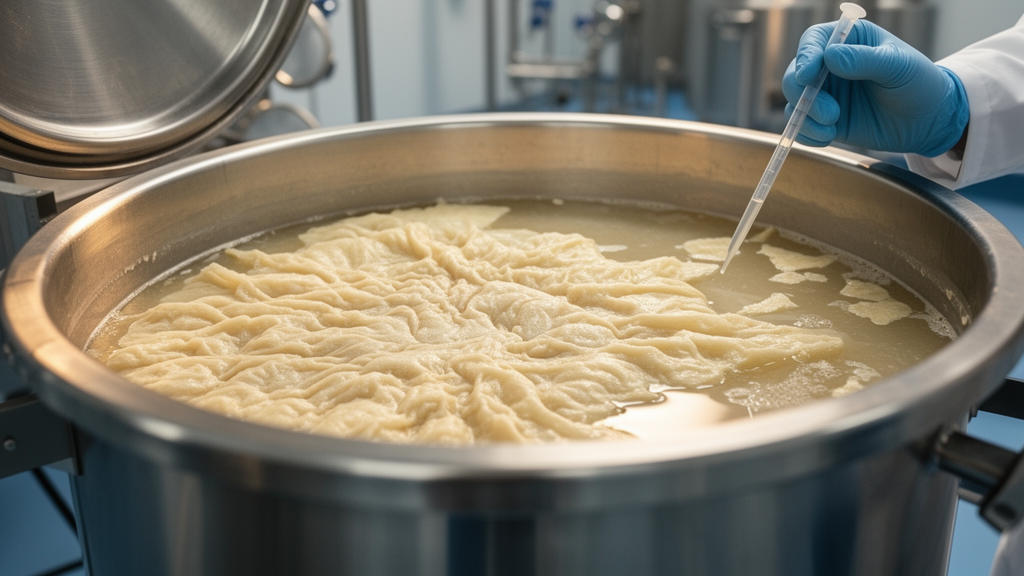
Researchers from the Universidad Bernardo O’Higgins and Universidad del Alba have identified Pseudomonas sp. ABC1 as a promising discovery-stage ecological chassis for next-generation industrial biotechnology. The study, published in Frontiers in Bioengineering and Biotechnology, demonstrates that this fluorescent bacterium forms a cohesive floating pellicle at the air-liquid interface during seven-day open, non-sterile static cultivation. Unlike conventional industrial biotechnology, which relies heavily on energy-intensive sterilization and complex downstream separation, this system operates under open conditions that mimic natural ecological dynamics. The findings suggest that ABC1 retains useful production phenotypes while interacting with a diverse microbial community, offering a new perspective on how biological process engineering might be simplified through ecological self-organization.
The investigation integrated endpoint open-culture observations with advanced analytical techniques, including scanning electron microscopy, energy-dispersive X-ray spectroscopy, 16S rRNA amplicon profiling, and liquid chromatography-tandem mass spectrometry. The team also performed comparative genomics to reconstruct the functional potential of the microbial consortium. This multi-omics approach allowed the researchers to link the physical structure of the pellicle with the underlying genetic and biochemical mechanisms. The primary objective was not to validate a specific fermentation process or demonstrate immediate industrial utility, but rather to define testable features of ABC1 that could inform future strain and process engineering efforts.
Under static cultivation conditions, ABC1 produced a robust pellicle that was enriched in elemental calcium. Microstructural analysis revealed spherical microdomains within the pellicle matrix where calcium concentrations exceeded 10%, compared to approximately 4% in the bulk pellicle signal. While these observations are compatible with a carbonate-rich phase, the authors caution that mineral identity remains unresolved and requires confirmation through phase-specific methods such as X-ray diffraction or Raman spectroscopy. These calcium-enriched microdomains may contribute to matrix organization by cross-linking extracellular polymers, although their precise functional role in pellicle mechanics remains a testable hypothesis.
Community profiling indicated that the open cultivation environment supported a non-axenic assemblage rather than an exclusive ABC1 population. The consortium included representatives from Pseudomonas, Delftia, Flavobacterium, Acidovorax, and additional environmental genera. Genome-informed reconstruction of these representative taxa revealed broadly distributed capacities for iron acquisition, oxidative-stress protection, adhesion, nutrient acquisition, and extracellular-matrix metabolism. The highest complementarity indices were observed for phosphorus acquisition, cation homeostasis, and iron acquisition, suggesting a potential division of labor among the community members. However, these values describe encoded functional potential and do not directly prove metabolic exchange or causal ecological interactions within the pellicle.
Proteomic and peptidomic analysis of the extracellular fraction recovered 1,518 de novo peptide sequences, including 1,478 non-redundant sequences. Post-translational modification analysis identified recurrent N-hydroxy-cyclo-ornithine derivatives, which are characteristic biosynthetic steps in hydroxamate-containing siderophores. These signatures are consistent with the extensive iron-acquisition machinery previously described for ABC1, including an Azotobacter-related pyoverdine-like pathway. The presence of these modified peptide forms supports the hypothesis that ABC1 maintains active siderophore biosynthesis even in the presence of competing microbial species. Nevertheless, these peptide signatures do not constitute direct structural identification of specific siderophores or establish that all detected peptides originated exclusively from ABC1.
Comparative genomics revealed that ABC1 lacks complete canonical extracellular polysaccharide systems such as Pel, Psl, alginate, and PNAG. Instead, the genome contains two extended loci encoding complementary functions for non-canonical extracellular-polysaccharide assembly. These regions, designated PSL_140 and PSL_143, include genes for precursor synthesis, multiple glycosyltransferases, candidate Wzx/Wzy-like proteins, and export-associated components. The fragmented conservation of these loci across comparator pseudomonads suggests evolutionary remodeling of broadly conserved glycan modules. These candidate loci provide defined targets for future gene disruption and expression analysis to determine their causal role in pellicle formation.
ABC1 also encodes an expanded nutrient-acquisition architecture, including 46 TonB-dependent receptors and 29 cyclic-di-GMP-associated proteins. This extensive regulatory repertoire provides genomic capacity for controlling the transition between motile and sessile growth states. The presence of manganese- and iron-dependent superoxide dismutases and catalase further supports the bacterium’s ability to manage oxidative stress associated with iron acquisition. These physiological features create a coherent context for the observed extracellular signatures, suggesting that ABC1 is well-adapted to iron-limited environments while maintaining structural integrity within a complex microbial community.
The study highlights the importance of ecological selection and matrix formation in maintaining production phenotypes under open cultivation. The persistence of the characteristic fluorescent extracellular phenotype in the mixed culture indicates that ABC1 can retain its biosynthetic capabilities despite competition. However, the authors emphasize that the current data represent an endpoint characterization and do not demonstrate equivalent or superior growth, metabolite production, or process stability relative to sterile cultivation. Quantitative validation of productivity, contamination resistance, and biomass-recovery performance remains necessary before any industrial advantage can be established.
These findings position Pseudomonas sp. ABC1 as a unique model for investigating self-organization and biosynthetic persistence in open bioproduction systems. The integration of ecological, genomic, and proteomic data provides a mechanistic framework for understanding how microbial communities can be harnessed for sustainable manufacturing. Future research will require functional genetics, chemical characterization, and controlled process studies to validate the proposed mechanisms and assess the potential of ABC1 as a robust platform for next-generation industrial biotechnology. The study underscores the value of exploring biologically distinct candidates that leverage ecological dynamics rather than relying solely on extensive genetic engineering of conventional hosts.
Subject of Research: Ecological chassis for open bioproduction
Article Title: Biological process engineering by Pseudomonas sp. ABC1: a discovery-stage ecological chassis for open bioproduction
Article References: Valenzuela-Heredia, D., Fuentes-Alburquenque, S., Trigo, C., & Henríquez-Castillo, C. (2026). Biological process engineering by Pseudomonas sp. ABC1: a discovery-stage ecological chassis for open bioproduction. Frontiers in Bioengineering and Biotechnology, 14, Article 1926795. https://doi.org/10.3389/fbioe.2026.1926795
Image Credits: AI Generated
DOI: 10.3389/fbioe.2026.1926795
Keywords: Pseudomonas sp. ABC1, Open bioproduction, Pellicle formation, Siderophores, Microbial consortium, Extracellular polysaccharides, Next-generation industrial biotechnology, Comparative genomics, Cyclic-di-GMP, Iron acquisition, Biological, process
News Source: Denise Maddox. (October 26, 2026). Pseudomonas ABC1 forms complex pellicles in open bioproduction cultures. Scienmag.