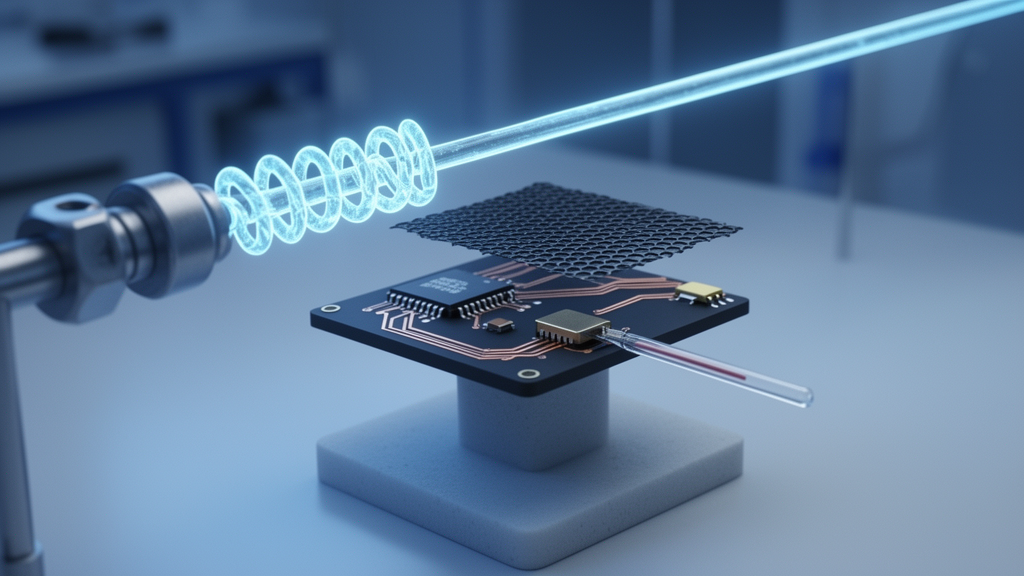
Researchers at the University of Arkansas and the University of Michigan have reported the creation of a graphene-based energy harvester that draws power from ambient radiation to run an ultra-low-power temperature sensor without any battery. The study, published in the Journal of Vacuum Science & Technology B, describes the second batteryless sensor developed by the team, whose broader goal is to build autonomous sensor systems that pull energy from multiple sources in the environment, including solar, thermal, acoustic, kinetic, nonlinear and ambient radiation. The team previously reported graphene-based solar cells capable of powering temperature sensors, and the new device extends that approach to the electromagnetic fields that permeate everyday surroundings.
The harvested energy in the latest design comes from a source that is effectively everywhere in modern life: the radiation emitted by electrical wiring, particularly the power lines running through the walls of homes and buildings. The sensor systems created by the group target the standard 60 Hertz electrical frequency commonly used in the United States. At the heart of the device is a graphene inductor that harvests energy from the magnetic fields generated by these power lines. The inductor’s signal feeds into a custom circuit that converts the alternating-current signal into direct current, which then charges the capacitors in the sensor. Because the wiring in typical buildings is not arranged with energy capture in mind, the researchers note that the radiation running through walls could, in principle, be better exploited if the wires were arranged differently.
The charging behavior of the circuit is what allows the sensor to ride through interruptions in the ambient field. “The inductor adds charge to these capacitors at a slow rate,” explained Paul Thibado, professor of physics at the University of Arkansas and corresponding author of the paper, “but it’s faster than the rate the sensor uses up the charges from the capacitors. So even if the power went out, it can still pull a charge from the capacitors. The way ours are set up, it can easily last 24 hours — probably a week even.” That reserve means the sensor does not need a continuous supply to keep operating, a property that matters for devices intended to function unattended for long stretches of time.
The team set three requirements for its sensors: they must use locally harvested energy, they must have a long unattended service life — potentially decades — and they must be able to operate at nanowatt-scale power. According to the researchers, all three requirements have been met in the latest sensor utilizing ambient radiation. The work builds on more than a decade of study of graphene’s unique properties by Thibado, who originated the graphene energy harvester concept. MD Rezaul Kabir, a Ph.D. candidate in the Materials Science and Engineering Program at the University of Arkansas, was first author on the paper. Co-authors from Arkansas included Ashadsuzzaman, Tamzeed Bani Amin, Jim Magnum and S.M. Rahman, all doctoral students, while the Michigan co-authors were Hung Do, Gordon Carichner and David Blaauw, a professor of electrical engineering and computer science who specializes in low-power wireless sensors and embedded systems.
While the research group is working with temperature sensors as a proof of concept, Thibado envisions a wide range of uses for long-lasting, low-power sensors, including tracking products, atmospheric monitoring, logistical fleet management, soil monitoring, wearable fitness monitoring and medical tracking. Because the sensors do not require batteries, they can be, in his words, “set it and forget it,” reducing the cost, effort and waste associated with replacing old batteries. The end goal is the development of multi-modal sensors that utilize more than one of the team’s power sources, exploiting the energy-harvesting capability of graphene to last for decades and help realize the Internet of Things, in which smart technology is woven into the fabric of daily life. In such a design, a sensor might harvest energy from both ambient radiation and kinetic movement, providing a backup power source in the event that one supply is interrupted, such as during a power outage.
On the commercialization side, NTS Innovations, a company specializing in nanotechnology, owns the exclusive license to develop graphene energy harvesters into commercial products. The company has provided funding for patenting, creating business plans, finding business partners and customer discovery, and its role over the course of the grant is to engage with customers on acceptance criteria, such as the minimum power levels needed for inclusion in products. Currently, more than 60 parties have expressed interest in testing the technology and working with Thibado and his colleagues to integrate it into their applications. The authors reported no conflicts of interest, and the research was described as an experimental study, with the paper, titled “Graphene powerline energy harvester powers a batteryless sensor,” published on 20 October 2026.
Subject of Research: A graphene-based energy harvester that powers a batteryless temperature sensor using ambient radiation from power lines
Article Title: Ambient radiation used to power battery-free temperature sensor
Article References: Ambient radiation used to power battery-free temperature sensor. Original publication (Bibliographic details unavailable.)
Image Credits: AI Generated
DOI: Not provided
Keywords: graphene, energy harvesting, ambient radiation, batteryless sensor, temperature sensor, nanowatt power, Internet of Things, power lines, capacitors, University of Arkansas, Journal of Vacuum Science & Technology B, NTS Innovations
News Source: Neil Sanderson. (October 26, 2026). Graphene harvester taps power-line radiation to run battery-free temperature sensor. Scienmag.