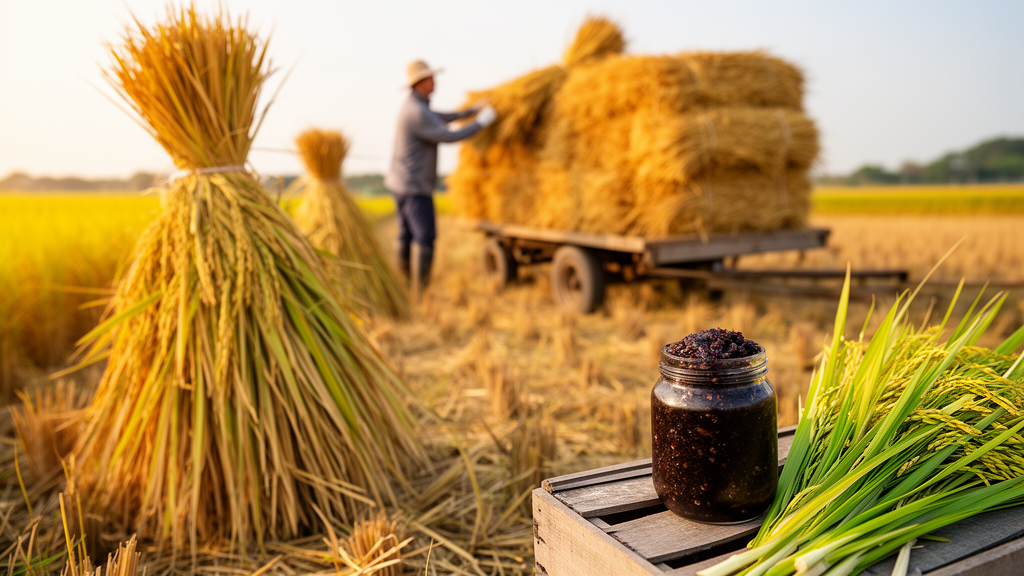
Every harvest season, China’s rice paddies generate an enormous mountain of leftover biomass. Based on a widely adopted straw-to-grain ratio of 1.0, the theoretical annual output of rice straw in the country reaches approximately 200 million tons. Yet only a small fraction of this crop residue ever reaches a ruminant’s feed trough. Fed directly to cattle or sheep, raw rice straw suffers from poor palatability and low nutritional quality, and much of the surplus is burned in open fields or dumped as waste, creating environmental risks. Ensiling, the anaerobic fermentation process that preserves forage as acidic, stable silage, offers a practical route to rescue this neglected resource. Now, a research team at Hunan Agricultural University has combined whole-genome sequencing, 16S rRNA gene sequencing, and untargeted metabolomics to show that a single bacterium harvested from the surface of a living rice plant can upgrade the fermentation quality, microbial community structure, and metabolite profile of rice straw silage.
The strain at the center of the study, designated Enterococcus faecalis YMA3, was previously isolated by the group from the surface of whole rice plants at the seedling-raising stage, where it stood out for its rapid growth, strong acid-producing capacity, and prominent antioxidant properties. That origin matters. Most commercial silage inoculants, including homofermentative Lactiplantibacillus plantarum, Pediococcus acidilactici, Enterococcus faecium, and the heterofermentative Lentilactobacillus buchneri, were recovered from non-forage matrices and may display poor ecological fitness when applied to rice straw, a substrate characterized by low water-soluble carbohydrate content and compact lignocellulosic structures. Autochthonous lactic acid bacteria isolated from local forage environments often exhibit superior adaptability to their corresponding raw materials, which can enhance fermentation stability and reduce inoculant application costs. To determine whether YMA3 could outperform exogenous commercial strains on its home substrate, the researchers first decoded its genome and then pitted it against four commercial lactic acid bacteria and a blank control in a 60-day ensiling trial.
The genomic portrait revealed a bacterium purpose-built for acid production. YMA3 carries a single circular chromosome of 2,678,952 base pairs with a GC content of 37.73 percent, no plasmid sequence was detected, and 2,449 protein-coding genes were predicted alongside 12 rRNA and 60 tRNA genes. Functional annotation against the Gene Ontology, eggNOG, KEGG, CAZy, VFDB, and CARD databases yielded 2,046, 2,181, 1,453, 94, 443, and 5 annotated genes, respectively, with metabolism-related genes predominating. Critically, the strain lacks the phosphoketolase gene required for heterofermentative lactic acid fermentation but harbors a complete Embden-Meyerhof-Parnas glycolysis pathway, from glucokinase and 6-phosphofructokinase through pyruvate kinase to L-lactate dehydrogenase, confirming that it performs homolactic fermentation, converting sugars efficiently into lactic acid rather than mixed metabolites such as acetic acid and carbon dioxide. The pentose phosphate pathway also generates NADPH, conferring oxidative-stress resistance that improves the strain’s competitive fitness under ensiling conditions. Annotation of carbohydrate-active enzymes identified 94 genes, dominated by 46 glycoside hydrolases and 22 glycosyltransferases, which may participate in partial decomposition of rice straw polysaccharides and supply fermentable substrates for lactic acid fermentation.
Safety, however, is the thorniest issue for any Enterococcus destined for the feed chain, and the team confronted it head-on. Hemolysis assays on blood agar showed that YMA3 exhibits a gamma-hemolytic phenotype with no hemolytic zones, indicating no pathogenicity at the phenotypic level. Yet genomic alignment against the Virulence Factor Database predicted 443 sequences related to potential virulence factors, from which 26 core virulence-related genes were screened, including cytolysin-encoding genes cylA, cylI, and cylR2, capsular polysaccharide synthesis genes of the Cps operon, extracellular enzyme genes such as gelatinase gelE, biofilm formation genes bopD and fsrABC, and adhesion-related genes including Ace and EbpA. Five antibiotic-resistance genes, lsaA, emeA, efrA, efrB, and dfrE, emerged from CARD annotation. Disk diffusion testing told a more reassuring phenotypic story: the strain was susceptible to penicillin, chloramphenicol, rifampicin, cefazolin, and cefuroxime, showed intermediate susceptibility to tetracycline, meropenem, and ofloxacin, and was resistant to kanamycin, vancomycin, and ciprofloxacin. The efrA and efrB genes encoding the EfrAB efflux pump matched the observed fluoroquinolone resistance pattern, while no complete vancomycin-resistance van operon was identified, suggesting the observed resistance to vancomycin and kanamycin stems from intrinsic low-level characteristics of the genus Enterococcus rather than horizontally transferable acquired resistance genes. The authors stress that these virulence predictions are homology-based only, with no gene-expression or in vivo animal safety data yet available.
With the genome decoded, the ensiling trial delivered the performance verdict. Six treatments were compared: Lactiplantibacillus plantarum (group Z), commercial Enterococcus faecalis (F), YMA3 (Y), a blank control (CK), Lactobacillus acidophilus (S), and Lentilactobacillus buchneri (B), each inoculated at 1 x 10^6 CFU per gram of fresh rice straw from cultivar Xinxang S/9WH336, with six biological replicates vacuum-sealed and stored for 3 and 60 days. Fermentation chemistry showed that all treatments declined to pH values between 3.74 and 4.03 by day 60, meeting the threshold for high-quality silage, while the non-inoculated control lagged at pH 4.52 on day 3, revealing insufficient acid-producing capacity among the epiphytic microbes. By day 60, YMA3-inoculated silage had accumulated 6.46 percent dry matter of lactic acid, significantly higher than the control, acidophilus, and buchneri groups and statistically indistinguishable from the commercial E. faecalis treatment. Trace butyric acid, a marker of spoilage, was detected only in the control at day 3 and vanished entirely from all groups by day 60. The ammonia-nitrogen to total nitrogen ratio, an index of protein degradation, rose in all treatments but reached 0.82 in the YMA3 group, comparable to the best commercial strains and below the buchneri treatment’s 1.04.
Nutritional analysis added further evidence that YMA3 remodels the forage itself. On day 60, the dry matter content of YMA3 silage reached 31.92 percent fresh matter, significantly higher than the control and acidophilus groups, while its crude protein content of 3.83 percent dry matter significantly exceeded the plantarum, commercial faecalis, and buchneri treatments. Most strikingly, the neutral-detergent fiber and acid-detergent fiber values of YMA3 silage fell to 62.97 and 37.36 percent dry matter respectively, both significantly lower than the control, suggesting potential improvements in forage digestibility and animal feed intake. A weighted membership-function analysis integrating nine key indicators, including pH, dry matter, crude protein, water-soluble carbohydrate, fiber fractions, and organic acids, ranked the treatments comprehensively: commercial L. plantarum took first place with a D-value of 0.613, YMA3 secured second at 0.593, and the non-inoculated control finished last at 0.495. The indigenous isolate thus outperformed every commercial strain except the plantarum benchmark.
High-throughput sequencing of the full-length V1-V9 region of the bacterial 16S rRNA gene exposed the microbial mechanism behind these gains. Goods-coverage values above 0.99 confirmed sufficient sequencing depth, and the alpha-diversity patterns diverged sharply between treatments. From day 3 to day 60, the control group suffered marked declines in Chao1, observed-species, and Shannon indices as acid-driven filtering eliminated acid-sensitive epiphytic microorganisms, with Chao1 falling from 1176.85 to 856.31. The YMA3-inoculated group moved in the opposite direction, its Chao1 index climbing from 1006.99 to 1471.59, maintaining high bacterial richness and diversity in late-stage silage, a finding that differs from most published silage studies in which exogenous lactic acid bacteria rapidly occupy ecological niches and reduce community diversity. The researchers speculate that metabolites produced by YMA3 may support the survival of partial acid-tolerant commensal bacteria. At the genus level, Pediococcus became the absolute dominant genus in the YMA3-treated silage, led by the species Pediococcus acidilactici, while the control shifted from Lactococcus dominance on day 3 to Lactiplantibacillus dominance on day 60. Opportunistic pathogenic genera including Methylobacterium and Klebsiella maintained low relative abundances across all late-ensiling samples. The team hypothesizes that YMA3 constructs an acidic micro-niche early in fermentation that favors the subsequent predominance of acid-tolerant Pediococcus.
Untargeted metabolomics then revealed the molecular dimension of the transformation. Of 1,208 metabolites detected in day-60 silage, 338 showed significant differences between YMA3-inoculated and control samples, comprising 240 significantly upregulated and 98 significantly downregulated metabolites. Lipids and lipid-like molecules were the predominant category at 31.9 percent of total metabolites, followed by phenylpropanoids and polyketides at 15.6 percent. The most strongly upregulated metabolites included 2-hydroxyisobutyric acid, nicotinamide, and taurine, with log2 fold changes of 4.13, 4.01, and 3.84 respectively. Elevated nicotinamide reflects enhanced vitamin B3 metabolism and redox cofactor recycling, while taurine accumulation indicates strengthened antioxidant capacity under acidic ensiling conditions. KEGG enrichment analysis showed the differential metabolites were mainly concentrated in ABC transporters, metabolic pathways, phenylalanine metabolism, phenylpropanoid biosynthesis, glycerophospholipid metabolism, isoflavonoid biosynthesis, and glutathione metabolism, indicating that YMA3 inoculation facilitates the release, transformation, or retention of plant secondary metabolites from rice straw. Among the upregulated compounds, ferulic acid, chrysoeriol, coumarin, and biochanin A are plant polyphenols with strong free-radical-scavenging capacity, while indole-3-lactic acid and indole-3-acetaldehyde are microbial tryptophan metabolites with immunomodulatory and antioxidant activities. Spearman correlation analysis showed that Pediococcus acidilactici, Lactococcus lactis, Streptococcus parasanguinis, and Enterococcus massiliensis exhibited strong positive correlations with numerous metabolites, particularly indole-3-lactic acid, ferulic acid, chrysoeriol, and coumarin, though the authors emphasize these are statistical associations rather than demonstrated causal mechanisms.
Collectively, the study paints a coherent picture: an indigenous rice-plant isolate with a complete homolactic fermentation engine and abundant carbohydrate-active enzyme genes improved rice straw silage by reshaping bacterial community succession and remodeling the metabolome, accumulating nicotinamide, taurine, and phenylpropanoid-derived secondary metabolites linked to antioxidant capacity and functional feed properties. But the researchers are careful about what comes next. With only two sampling time points, the exact timing of the Pediococcus turnover could not be determined; genomic predictions cannot directly prove cellulose- or hemicellulose-degrading capacity; only relative metabolite quantification was acquired; and no gene-expression detection or animal-based safety evaluation was performed. The team calls for multi-timepoint dynamic monitoring, in vitro functional validation of key genes, absolute quantification of core differential metabolites, and animal feeding trials before E. faecalis YMA3 can be regarded as anything more than a candidate silage inoculant. If those hurdles are cleared, the bacterium lurking on the surface of China’s rice plants could help convert 200 million tons of burning-prone straw into ruminant forage worth feeding.
Subject of Research: Whole-genome analysis of rice-plant-derived Enterococcus faecalis YMA3 and its effects on rice straw silage fermentation, microbiome, and metabolome
Article Title: Whole-genome analysis of rice-plant-derived Enterococcus faecalis YMA3 and its effects on fermentation quality, microbial community, and metabolome of rice straw silage
Article References: Gao, W., Luo, X., Mu, L., Zhang, Z., & Chen, G. (2026). Whole-genome analysis of rice-plant-derived Enterococcus faecalis YMA3 and its effects on fermentation quality, microbial community, and metabolome of rice straw silage. Frontiers in Animal Science, 7, Article 1905839. https://doi.org/10.3389/fanim.2026.1905839
Image Credits: AI Generated
DOI: 10.3389/fanim.2026.1905839
Keywords: Enterococcus faecalis, rice straw silage, whole-genome sequencing, lactic acid bacteria, silage inoculant, metabolomics, 16S rRNA sequencing, fermentation quality, Pediococcus, antibiotic resistance genes, antioxidant metabolites, animal nutrition
News Source: Juliet Wilcox. (October 26, 2026). Rice-Plant Bacterium Decoded by Whole-Genome Sequencing Transforms Rice Straw into Better Silage. Scienmag.