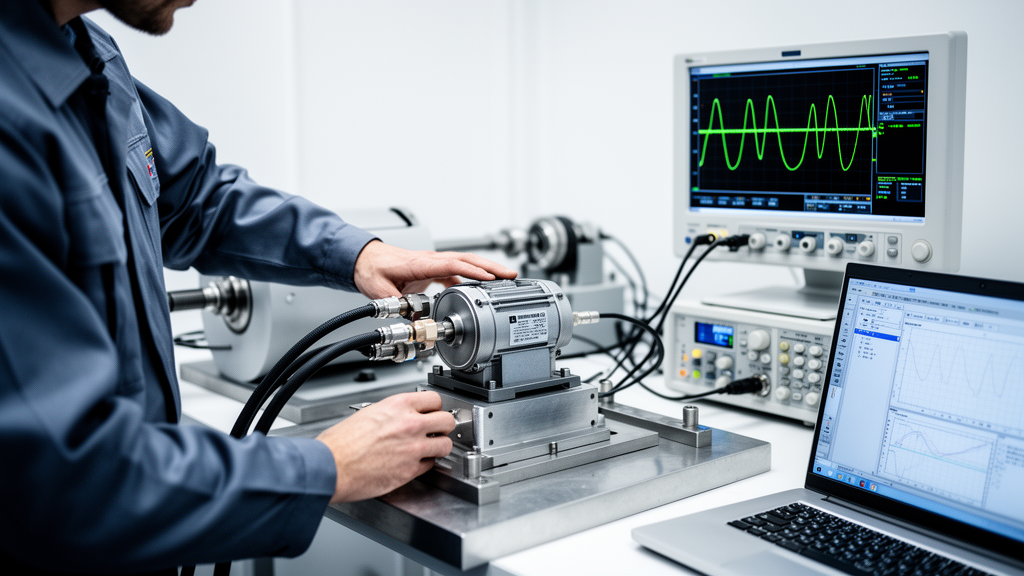
Electric vehicles depend on how precisely their motors respond, and a new control study published in Scientific Reports proposes a hybrid controller that blends fractional calculus with artificial neural networks to regulate the speed of brushless direct current (BLDC) motors. The work, authored by S. Anish, L. Kebila Anns Subi and M. Suthanthira, reports that the combined KarcıFANN–EEFO controller achieved a settling time of 0.0321 seconds and a rise time of 0.0201 seconds under a high-inertia condition in MATLAB/Simulink simulations, along with low overshoot and accurate tracking of the commanded reference speed.
The brushless DC motor is, in the authors’ assessment, the best motor option for electric vehicles because it combines strong performance, high efficiency and fine-grained speed and position control. Their answer to achieving accurate and adaptive speed regulation is the Karcı Fractional Artificial Neural Network, or KarcıFANN, an architecture that folds fractional calculus into a neural network framework. According to the study, this integration provides enhanced learning adaptability and memory characteristics for controlling dynamic systems.
A neural controller is only as good as its tuning, however. To set the network’s weights and biases, the team employed Electric Eel Foraging Optimization (EEFO), a nature-inspired algorithm. According to the study, EEFO improves convergence speed and prevents premature stagnation during training, ensuring optimal controller performance. The result is a controller whose parameters are optimized by the algorithm rather than hand-tuned.
The reported numbers are the headline of the simulation campaign. Under the high-inertia condition — a demanding scenario because a heavy rotating mass resists rapid speed changes — the hybrid controller settled to its target in 0.0321 seconds and rose to the reference in 0.0201 seconds, which the authors describe as superior performance over conventional controllers. Low overshoot matters in a vehicle context: it means the motor does not briefly spin past its commanded speed, and accurate reference tracking means the drivetrain follows what the vehicle’s control system actually asks for.
The authors position the work as a step toward intelligent EV propulsion, framing the KarcıFANN–EEFO pairing as a robust and efficient solution for BLDC motor speed control that marks a substantial advancement and contributes to sustainable and responsive transportation technologies. The broader motivation is the central trade-off of electric mobility: maximizing energy efficiency and increasing driving range, both of which, the study notes, rely significantly on improving motor performance.
Important caveats apply to how far these results can be generalized. The performance figures come entirely from simulation in the MATLAB/Simulink environment, and real-world factors would need to be addressed before such a controller could be validated in a production drivetrain. The paper is also being shared as an accepted manuscript under Scientific Reports’ early-release process, meaning the citable version of record will follow with final edits. Even so, the combination of fractional-order memory, neural adaptability and bio-inspired optimization offers a concrete, quantified benchmark — sub-40-millisecond settling under high inertia — for what adaptive motor control in electric vehicles might achieve.
Subject of Research: Hybrid fractional neural network and eel-foraging optimization control of BLDC motor speed in electric vehicles
Article Title: Hybrid KarcıFANN–EEFO controller for adaptive speed control of BLDC motors in electric vehicles
Article References: Anish, S., Kebila Anns Subi, L., & Suthanthira, M. (2026). Hybrid KarcıFANN–EEFO controller for adaptive speed control of BLDC motors in electric vehicles. Scientific Reports. https://doi.org/10.1038/s41598-026-73124-3
Image Credits: AI Generated
DOI: 10.1038/s41598-026-73124-3
Keywords: BLDC motor, electric vehicles, KarcıFANN, fractional calculus, artificial neural networks, Electric Eel Foraging Optimization, speed control, MATLAB Simulink, adaptive control, settling time, propulsion systems, Hybrid
News Source: Cassandra Pierce. (October 26, 2026). Hybrid neural-fractional controller with eel-inspired optimizer sharpens electric vehicle motor speed control. Scienmag.