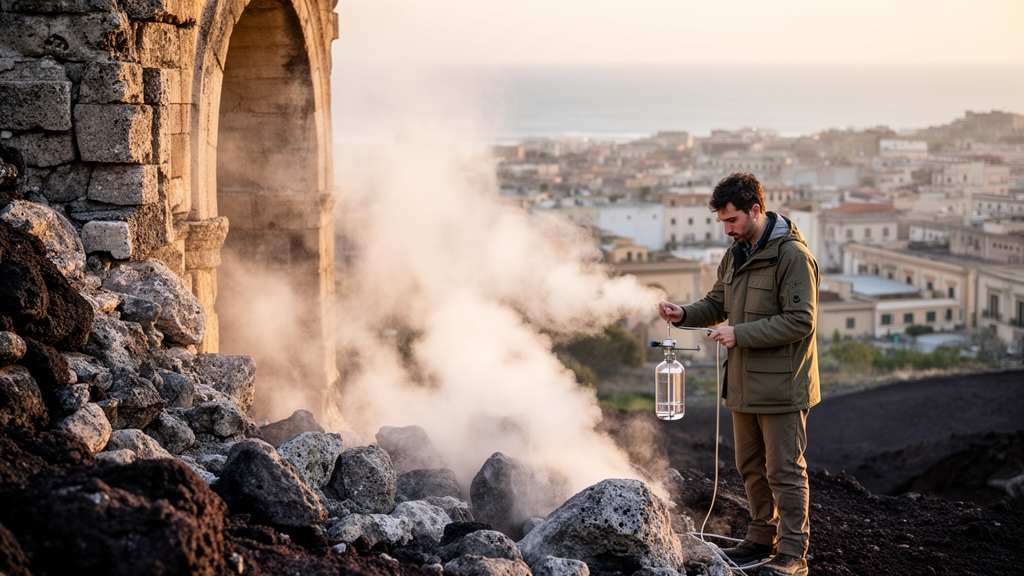
Scientists have traced the invisible mixture of gases drifting through the streets of Pozzuoli, a densely inhabited town perched on the Campi Flegrei caldera in southern Italy, by reading the isotopic fingerprints of the carbon dioxide in its urban air. The new study, published in Scientific Reports, was prompted by recent reports of elevated indoor CO2 concentrations in the town and by the caldera’s own restless geology. Since renewed bradyseismic activity began at Campi Flegrei in 2005, the Solfatara area has released roughly 5,000 tons of CO2 per day, a natural flux large enough to locally modify the composition of the atmosphere above a populated volcanic zone.
The research team, including Roberto M. R. Di Martino, Sergio Gurrieri, Stefano Caliro and Alessandro Santi, carried out an in situ survey using a portable laser-based spectrophotometer, measuring stable isotope compositions of atmospheric CO2 alongside concentrations of ammonia and water vapor. The measurements covered the carbon isotope ratio δ13C-CO2 and the triple oxygen isotope composition, δ18O-CO2 and δ17O-CO2. Although CO2 concentrations themselves showed limited spatial variability along the survey transect, the isotope data told a far richer story, allowing the researchers to separate distinct atmospheric contributions that a concentration measurement alone could never disentangle.
The isotopic signatures in Pozzuoli’s air proved consistent with three overlapping sources: soil degassing, the dispersal of volcanic CO2 from the Solfatara area, and fossil fuel combustion. In particular, the atmospheric CO2 displayed a measurable enrichment in the heavy isotope carbon-13 relative to the atmospheric background. The team showed that this isotopic shift is incompatible with a simple dilution process, in which background air would merely be thinned by added gas. Instead, it indicates admixture with an isotopically heavier geogenic CO2 endmember, characterized by a δ13C-CO2 value of approximately −1.8 per mil versus VPDB.
The survey also separated volcanic signals from everyday urban ones. Spatial variations in water vapor were related to distance from the marine shoreline. Ammonia concentrations, by contrast, provided evidence of an anthropogenic influence on the atmosphere within the densely inhabited area, marking human activity as a distinct contributor to local air chemistry. By combining carbon and triple oxygen isotope characterization in a single portable measurement campaign, the study demonstrates a practical approach to volcanic source attribution in environments where natural and human emissions are thoroughly mixed.
Reassuringly for residents, concentrations of CO2 in the air remained well below short-term exposure limits along the entire survey transect, although the researchers note that these thresholds are primarily intended for indoor environments rather than open-air settings. The study’s significance extends beyond Pozzuoli. The authors argue that continuous surveillance integrating CO2 concentration with isotope compositions could complement existing volcano monitoring approaches and strengthen environmental monitoring in densely populated volcanic areas, establishing a basis for future high-resolution monitoring strategies that track how volcanic gases disperse through the streets of towns built on active calderas.
Subject of Research: Tracking spatial variations of CO2 isotopologues, NH3 and H2O in urban air: a case study from the Campi Flegrei Caldera
Article Title: Tracking spatial variations of CO2 isotopologues, NH3 and H2O in urban air: a case study from the Campi Flegrei Caldera
Article References: Di Martino, R. M. R., Gurrieri, S., Caliro, S., & Santi, A. (2026). Tracking spatial variations of CO2 isotopologues, NH3 and H2O in urban air: a case study from the Campi Flegrei Caldera. Scientific Reports. https://doi.org/10.1038/s41598-026-77432-6
Image Credits: AI Generated
DOI: 10.1038/s41598-026-77432-6
Keywords: Tracking, spatial, variations, isotopologues, urban, case, Campi, Flegrei, Caldera, scientific research
News Source: Russell Cooper. (October 26, 2026). Volcanic carbon isotope fingerprints reveal hidden gas sources in Pozzuoli’s urban air. Scienmag.