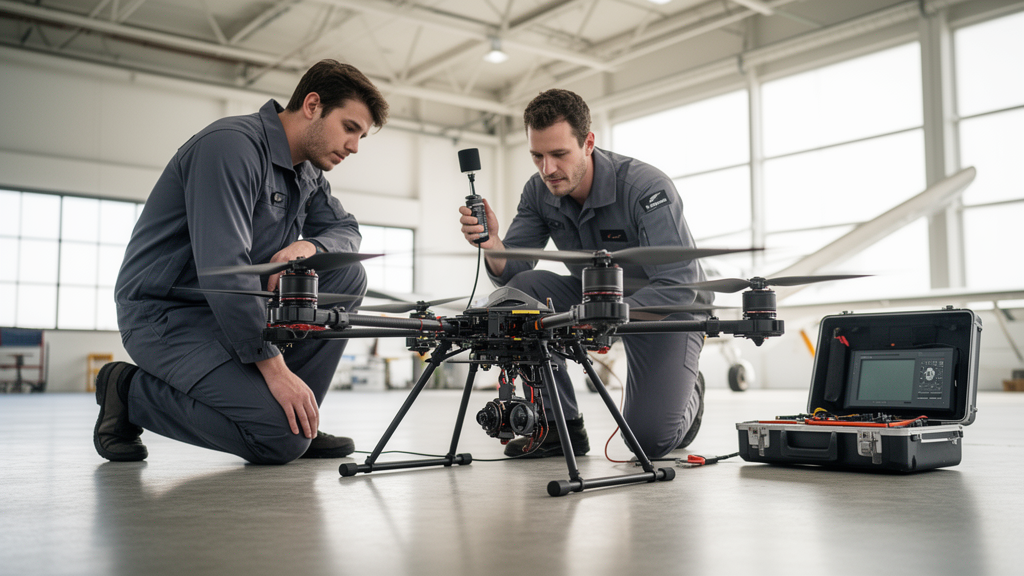
University of Cincinnati engineers are developing an acoustic system that could use recordings of damaged drone propellers and motors to identify potential mechanical failures before a flight. The project began in 2024 with NASA interest in detecting motor problems before a drone takes off, according to College of Engineering and Applied Science doctoral student Prissha Chawla. The goal is to help an operator determine whether a drone is airworthy before deployment.
Chawla said the team is focusing on pre-flight tests that NASA already runs, rather than on diagnosing aircraft during flight. In principle, a computer at the ground station would analyze the drone’s sounds and alert the operator when the available evidence indicates that it may not be airworthy. The supplied report does not provide performance measures, sample sizes, deployment-trial results or rates of successful damage identification, so the system’s detection accuracy has not been established in the material available.
“The project started in 2024 with interest by NASA in detecting problems with motors before a drone took off,” Chawla said. “More and more, drones are being used for public safety. You don’t want them to crash.” The researchers presented their project at the Modelling, Estimation and Control Conference on Oct.
25 in Phoenix, Arizona. The team eventually envisions extending the approach to an autonomous drone that listens to its own propellers and other mechanical systems while in flight, allowing it to return to base before a developing failure leads to a catastrophic crash. That flight-monitoring capability remains a future aim.
The current project described in the report is centered on pre-flight damage detection for the mechanical systems involved in drone propulsion. UC student Luke Busse said the pre-flight system could be incorporated into fully autonomous “drone-in-a-box” operations. In that arrangement, a drone launches from and lands inside a weatherproof docking station that handles charging, data uploads and mission scheduling without an on-site operator.
Sensors installed in the box could provide pre-flight checks before a mission. The engineering challenge is to turn recordings of different damage modes into acoustic data that a ground-station computer can evaluate, potentially supporting an operator’s airworthiness assessment before a drone is sent into the air. Researchers involved in the project reported no competing interests.
Subject of Research: Acoustic identification of drone propeller and motor damage before flight
Article Title: What does a damaged drone sound like?
Article References: What does a damaged drone sound like?. Original publication (Bibliographic details unavailable.)
Image Credits: AI Generated
DOI: Not provided
Keywords: drones, acoustic damage detection, propeller damage, motor failure, pre-flight safety, NASA, autonomous aircraft, University of Cincinnati, does, damaged, drone, sound
News Source: Denise Maddox. (October 26, 2026). Engineers use drone sounds to identify pre-flight mechanical damage. Scienmag.