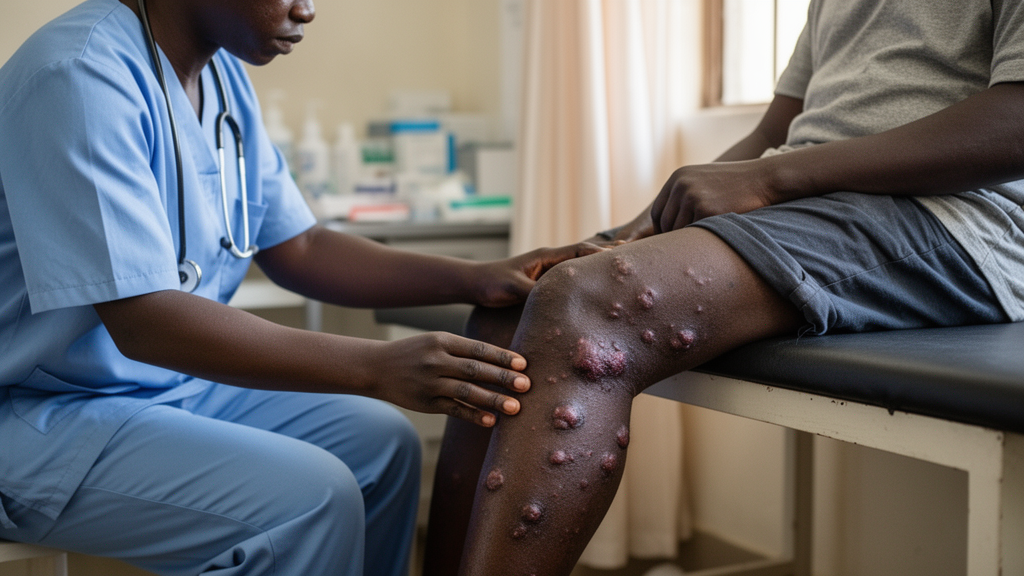
Adults living with HIV in East Africa continued to present with advanced HIV-associated Kaposi sarcoma and experienced high mortality after diagnosis during 2021–2024, a prospective cohort study in Kenya, Tanzania, and Uganda found. Among 493 participants with a new diagnosis, 91% had tumors classified as T1 under AIDS Clinical Trials Group criteria, indicating advanced disease. During a median follow-up of 11 months, 209 participants died, while the cumulative incidence of death reached 45% at 18 months after diagnosis with a 95% confidence interval of 40% to 51%.
Researchers enrolled adults living with HIV whose Kaposi sarcoma was newly diagnosed between September 2021 and April 2024. Patients were identified in ambulatory and inpatient settings across four regions in the three countries. At biopsy, investigators examined participants to document the anatomical extent of their lesions and assigned stage using the AIDS Clinical Trials Group criteria.
The median number of anatomical sites with Kaposi sarcoma lesions was nine, with an interquartile range of four to 12, indicating that disease was commonly widespread at the point of diagnosis. The cohort then entered prospective follow-up to monitor vital status. During a median follow-up of 11 months, with an interquartile range of 2.2 to 20 months, 209 participants died and three were lost to follow-up.
Cumulative incidence of death was 26% at three months, with a 95% confidence interval of 22% to 30%; 32% at six months, with a 95% confidence interval of 28% to 36%; 39% at 12 months, with a 95% confidence interval of 34% to 43%; and 45% at 18 months, with a 95% confidence interval of 40% to 51%. Cumulative incidence of death was similar among participants in Kenya, Tanzania and Uganda, as well as across the years in which Kaposi sarcoma was diagnosed. The researchers compared these observations with their earlier study of the initial “Treat All” era from 2016 to 2019.
In both periods, most people were diagnosed with advanced Kaposi sarcoma and survival after diagnosis was poor. The 2021–2024 cohort therefore showed no clear change in these two measured outcomes, although it was not designed to determine the effects of antiretroviral therapy, cancer-treatment guidance, COVID-19 conditions or any other individual factor on disease stage or survival. The authors called for better Kaposi sarcoma control strategies in the region, including primary prevention, approaches to earlier detection, more timely linkage to care, and more accessible and potent anti-Kaposi sarcoma therapy.
The findings are based on newly diagnosed adults recruited from multiple ambulatory and inpatient settings and describe stage and subsequent survival under study conditions. Because the research did not test a particular prevention, screening, referral or treatment strategy, it cannot establish which intervention would change the observed outcomes. It nevertheless documents a persistent clinical problem: by the time HIV-associated Kaposi sarcoma was diagnosed in this cohort, extensive disease was usual and the risk of death was substantial.
Subject of Research: Disease stage and survival after HIV-associated Kaposi sarcoma diagnosis in East Africa
Article Title: Continued high mortality following diagnosis of HIV-associated Kaposi sarcoma in East Africa in the “Treat All” antiretroviral therapy era ― 2021-2024
Article References: Byakwaga, H., Semeere, A., Wenger, M., Freeman, E., Laker-Oketta, M., Rotich, E., Mushi, B. P., Ssemakadde, M., Muwando, H., Mwine, B., Ayanga, R., Lagat, C., Collier, S., Illonga, Z., Lukande, R., Kadama-Makanga, P., Ibrahim, P., Chemutai, L., Maurer, T., … Martin, J. (2026). Continued high mortality following diagnosis of HIV-associated Kaposi sarcoma in East Africa in the “Treat All” antiretroviral therapy era ― 2021-2024. BMC Cancer. https://doi.org/10.1186/s12885-026-16823-4
Image Credits: AI Generated
DOI: 10.1186/s12885-026-16823-4
Keywords: HIV-associated Kaposi sarcoma, East Africa, advanced cancer, cancer mortality, antiretroviral therapy, Kenya, Tanzania, Uganda, prospective cohort, survival, Continued, high
News Source: Nathaniel Bowman. (October 26, 2026). Prospective East Africa cohort finds advanced HIV-associated Kaposi sarcoma and high mortality. Scienmag.