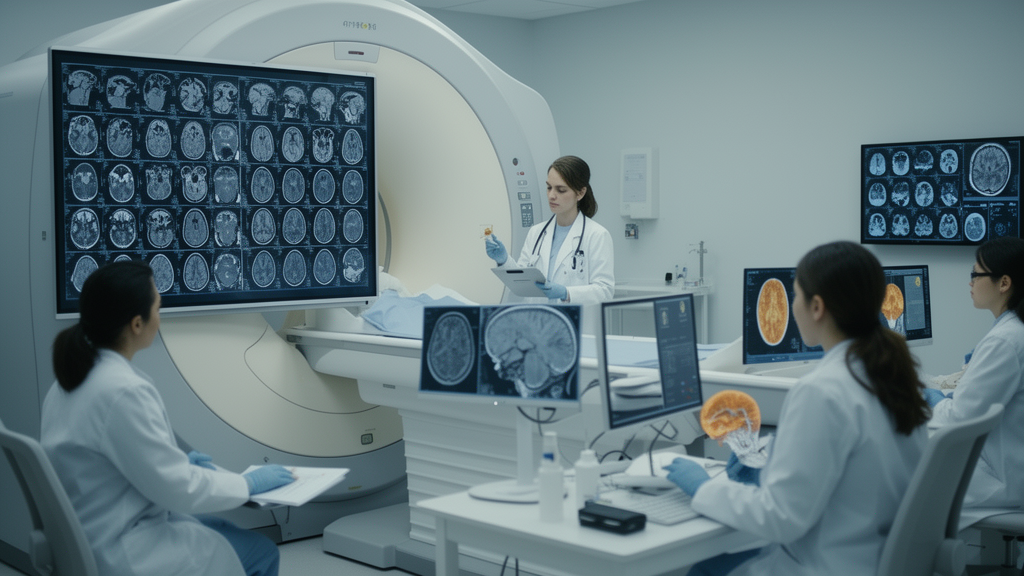
A five-year, $3.2 million National Institutes of Health grant will support an international effort to compare brain function across eight psychiatric disorders using one standardized analysis method. Researchers at the Mark and Mary Stevens Neuroimaging and Informatics Institute at the Keck School of Medicine of USC will lead the Global Initiative for Harmonized Functional MRI in Psychiatry. The planned project will analyze more than 94,000 brain scans collected at 257 research sites in 27 countries from participants ranging from 4 to 95 years old.
The investigators describe it as the largest functional MRI study conducted in psychiatry, both in the number of people scanned and the number of laboratories taking part. The initiative is intended to identify functional brain signatures that are shared among the disorders or specific to individual conditions. Its eight clinical groups are schizophrenia, bipolar disorder, major depressive disorder, post-traumatic stress disorder, obsessive-compulsive disorder, attention-deficit/hyperactivity disorder, autism spectrum disorder and anorexia nervosa.
Eight international research teams, each focused on one disorder, have agreed to process their functional scans with a shared pipeline of standardized software steps. The project expands the ENIGMA Consortium, a global network of more than 2,500 scientists in 47 countries that conducts large brain-imaging studies of neurological and psychiatric disease. At the center of the effort is resting-state functional MRI, which records brain activity while a participant lies quietly in a scanner.
The technique tracks small changes in blood oxygen that rise and fall as different brain regions become active. When two regions show these fluctuations in step, researchers characterize them as functionally connected. Functional brain networks have been associated with attention, rumination and planning, while the pattern of switching and interaction among networks may be disturbed in mental illness.
Smaller studies have reported differences in these connection patterns in people with psychiatric conditions, but their results have been difficult to compare across research groups. Variations in scanners and analysis procedures are a central problem the project is designed to address. Laboratories have often studied individual conditions with their own tools and processing choices, making it difficult to determine whether results reflect a disorder, a disorder-specific brain pattern or differences in methodology.
A finding about autism, for example, could previously have emerged from analytical choices that differed from those used in a schizophrenia study. Paul M. Thompson, the project’s principal investigator and director of the ENIGMA Consortium, said processing every scan in the same way should allow investigators to distinguish abnormalities shared across disorders from those specific to particular illnesses. Frank Hillary of Pennsylvania State University said the broader need is for shared methods that allow different areas of psychiatry to be examined side by side.
Much psychiatric research remains organized around individual diagnoses, even though many of the conditions under investigation may share common roots in the brain. The standardized approach is intended to make it possible to compare similarities and differences while limiting inconsistencies introduced by separate workflows. The leadership team includes 17 institutions in the United States, Canada, Germany, the Netherlands, Switzerland, France and Australia, with Stevens INI researchers and ENIGMA consortium personnel among those contributing to the project.
The investigators will also use what they call a targeted multiverse approach. Clara Moreau, co-chair of the ENIGMA functional MRI working group, said agreeing on this approach across disorders would help reveal distinctive features that might be obscured when analytical decisions are not applied consistently. The shared pipeline is designed to clean each scan and measure brain connections and dynamic brain changes identically.
This is a planned research protocol: the scale and standardization of the data make possible comparisons that cannot yet be treated as demonstrated clinical tools or proof that a biomarker will be reliable. One question for the combined analysis is whether functional brain data produce groupings that correspond to three broad families suggested by earlier genetic studies: mood and psychotic disorders, developmental disorders and compulsive disorders. The team will test whether measures of connectivity and dynamic brain activity reveal comparable organization across the eight conditions.
A correspondence between the proposed groupings and functional imaging patterns would support the presence of shared organizational features, but it would not establish that the conditions have a single cause. If the imaging results showed different patterns, that alone would not rule out biological overlap. The comparison is therefore designed to identify shared and condition-specific features and generate testable questions about brain biology.
Another planned objective is to examine how medications such as lithium and antipsychotics relate to differences in functional connectivity and brain dynamics. The large dataset will also be used to search for markers of illness that may be too subtle to detect reliably in smaller studies. Investigators plan to apply artificial-intelligence methods to the standardized data to identify patterns for further evaluation.
These computational approaches are components of the study plan rather than validated clinical applications. Any proposed marker or treatment-related measure will require additional testing before it could guide diagnosis, influence the selection of therapy or determine whether an intervention is working. The project’s broader aims include improving understanding of how the eight disorders affect the brain and identifying measures that could eventually be evaluated in drug trials as indicators of treatment response.
Arthur W. Toga, director of Stevens INI, said studies of this scale depend on researchers around the world agreeing to share methods and pursue common questions. Bringing together data from tens of thousands of people across eight conditions could move psychiatry toward measures grounded more directly in brain biology, he said. The award is funded by the National Institute of Mental Health, part of the National Institutes of Health, under award number R01MH142539, and the funded period extends across five years.
The launch marks a shift from investigating psychiatric conditions largely in isolation toward comparing them within a common technical framework. The project is planned to use a shared pipeline, a targeted multiverse approach and a dataset spanning 27 countries to examine condition-specific and common functional signatures. Its findings will determine whether the harmonized analysis produces reproducible and clinically meaningful measures, a question that cannot be answered at launch.
The investigators say the aim is to find signals sensitive to each illness and shared across diagnoses, potentially offering measures for later testing in diagnosis and treatment studies. Until those analyses and subsequent validation are complete, the initiative represents a large-scale coordinated research effort rather than a demonstrated advance in patient care.
Subject of Research: A global functional MRI project comparing brain-function patterns across eight psychiatric disorders.
Article Title: Global team launches largest-ever study of brain function across eight mental illnesses
Article References: Global team launches largest-ever study of brain function across eight mental illnesses. Original publication (Bibliographic details unavailable.)
Image Credits: AI Generated
DOI: Not provided
Keywords: functional MRI, psychiatry, brain networks, schizophrenia, bipolar disorder, major depression, autism, ADHD, OCD, PTSD, ENIGMA, Global
News Source: Glenn Wilkins. (October 26, 2026). Global project to analyze 94,000 brain scans across eight disorders. Scienmag.