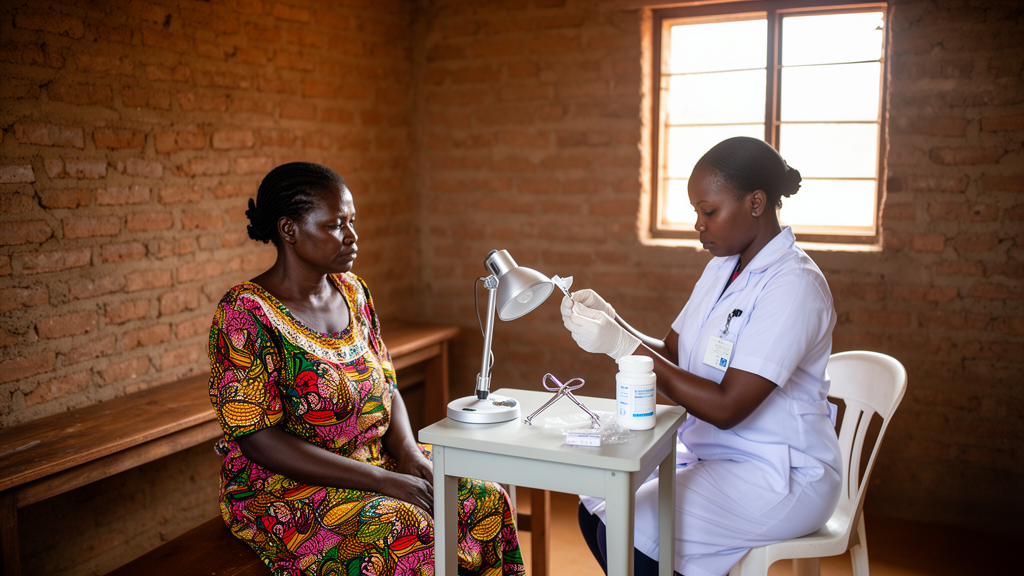
A cross-sectional study of 7,126 women aged 30–49 years in rural Uganda found that 1,800, or 25.3%, tested positive for high-risk human papillomavirus (hrHPV). Among the positive women with complete genotype data, infections outside the HPV16 and HPV18 groups were common, while a comparison of genotype groups with clinical assessment found no statistically significant relationship with visual inspection with acetic acid (VIA) outcome.
The study focused on asymptomatic women who self-collected vaginal samples for testing with the GeneXpert HPV assay. The investigators recorded the presence or absence of specific hrHPV genotypes and used the results to describe genotype distribution in this rural population. All hrHPV-positive participants were invited to receive visual assessment for treatment, with or without VIA, and were treated according to the assessment. No histopathology was performed, so the clinical observations were not accompanied by a histological characterization of cervical lesions.
Complete genotype information was available for 1,422 of the 1,800 hrHPV-positive participants. The largest individual genotype group was HPV31/33/35/52/58, detected in 324 women, or 22.8% of those with complete results. Multiple genotypes were the most frequent category, occurring in 397 women, or 27.9%. The remaining distribution consisted of HPV39/56/66/68 in 243 women, or 17.1%; HPV16 in 183, or 12.9%; HPV18/45 in 161, or 11.3%; and HPV51/59 in 114, or 8.0%. These figures show that the detected infections were not confined to HPV16 and HPV18 and that multiple hrHPV genotypes were frequently present.
Of the 1,121 hrHPV-positive women who underwent VIA, irrespective of genotype, 159, or 14.2%, had a positive inspection. Eight women, equal to 0.7% of those inspected, were identified as having cervical cancer. Six of these women were positive for HPV31/33/35/52/58, with three also positive for HPV16, HPV51/59, or HPV39/56/66/68. One woman was positive for HPV18/45, and one was HPV16-positive with an unknown additional genotype. The analysis found no statistically significant relationship between genotype and VIA outcome, meaning the study did not establish a statistical association between the genotype categories and the result of the inspection in the population examined.
The findings support the authors’ conclusion that the study population had a high prevalence of non-16/18 hrHPV and that extended genotyping may be relevant to managing women at risk for cervical cancer in Uganda. The eight cervical cancers were identified within the smaller group of hrHPV-positive women who underwent VIA; the figures therefore describe findings in that clinical subgroup and should not be read as population-wide cervical-cancer incidence or direct estimates of genotype-specific risk. The authors call for additional research on the possible role of HPV31/33/35/52/58 in cervical carcinogenesis and on whether available vaccines protect the population against the broader range of hrHPV genotypes found in the study.
Subject of Research: Prevalence of high-risk HPV genotypes and clinical findings among asymptomatic rural Ugandan women
Article Title: Prevalence and distribution of high risk human papillomavirus genotypes among asymptomatic women in rural Uganda and the association of these genotypes with clinical outcomes: a cross-sectional study
Article References: Nakisige, C., Pan, F., de Fouw, M., Cubie, H., Namagembe, S., Atukonyera, D., Orem, J., Koot, J., de Zeeuw, J., Stekelenburg, J., van den Akker, T., de Bock, G. H., van de Schans, J., & Beltman, J. (2026). Prevalence and distribution of high risk human papillomavirus genotypes among asymptomatic women in rural Uganda and the association of these genotypes with clinical outcomes: a cross-sectional study. BMC Cancer. https://doi.org/10.1186/s12885-026-16894-3
Image Credits: AI Generated
DOI: 10.1186/s12885-026-16894-3
Keywords: high-risk HPV, rural Uganda, cervical cancer, HPV genotyping, asymptomatic women, HPV16, HPV18, multiple HPV infections, visual inspection, cross-sectional study, Prevalence, distribution
News Source: Nathaniel Bowman. (October 26, 2026). High-risk HPV common among asymptomatic rural Ugandan women. Scienmag.