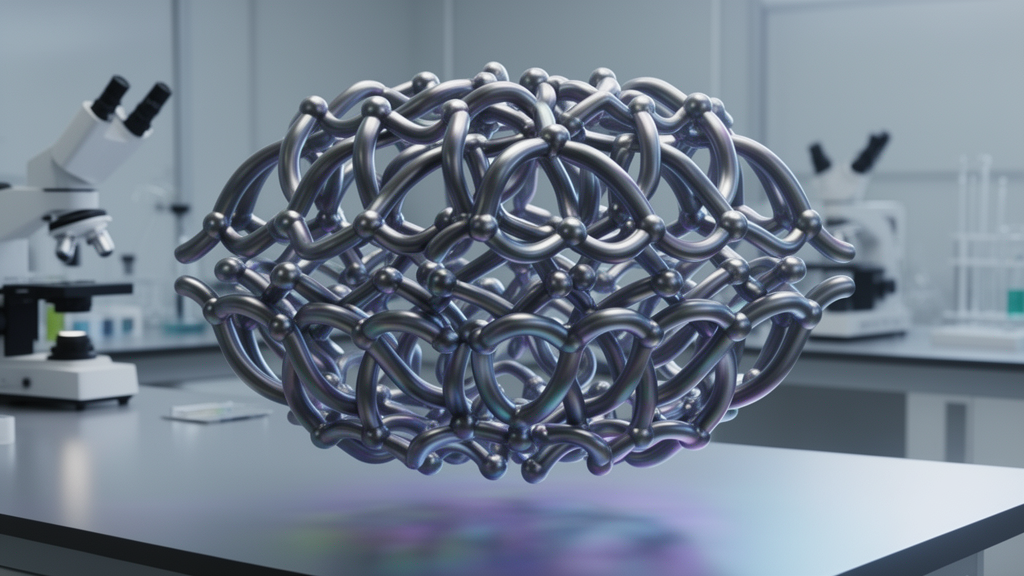
Researchers at the University of Gothenburg have created diamondiyne, a new carbon allotrope with a three-dimensional structure that the team describes as a porous diamond. The material forms as a thin film where two liquids meet, using relatively inexpensive equipment. Carbon atoms are connected by triple bonds and arranged as tetrahedra joined corner to corner in all three dimensions, producing a repeating structure with voids between the tetrahedra. The work was published in Angewandte Chemie under the title “Diamondiyne: A 3D Carbon Allotrope With Mixed sp–sp3 Hybridization.”
Diamondiyne was first described theoretically 35 years ago, and the University of Gothenburg team’s experimental study marks the first reported creation of the allotrope. Professor Karl Börjesson said the result followed years of work on porous materials made from carbon-based molecules without metal ions. “It has taken us an incredibly long time, but we finally succeeded,” he said. The broader project concerns carbon-based frameworks, or COFs, and the team’s achievement was to establish the proposed carbon structure experimentally rather than only on paper.
Electron microscopy at Stockholm University confirmed the crystal structure in patches on the surface of the film. The researchers also observed repeating diamondiyne patterns in a volume measuring 10 nanometres on each side, and said the images corresponded well with theoretical models. Because formation can fail in several ways, the study’s evidence is based on localized structural confirmation rather than a demonstration that the entire film consists of a single continuous crystal. The work was a collaboration between Börjesson’s research group and colleagues at Stockholm University and Chalmers University of Technology.
The new material differs from conventional diamond in the conditions used to bond its carbon atoms. In diamondiyne, the atoms can bond without the high pressure required to form ordinary diamond, according to the research team. Its three-dimensional arrangement also distinguishes it from familiar carbon allotropes. For much of modern physical chemistry, carbon allotropes were largely represented by diamond, graphite, fullerene, carbon nanotubes and graphene; more recent years have brought numerous additional allotropes, but the team said none had previously been created with a three-dimensional structure. The porous architecture may allow several diamondiyne structures to interweave through one another’s voids, a possibility the researchers said they will investigate along with the material’s other properties and potential applications.
Subject of Research: Experimental creation and structural characterization of a three-dimensional porous carbon allotrope
Article Title: New porous diamond created by researchers
Article References: New porous diamond created by researchers. Original publication (Bibliographic details unavailable.)
Image Credits: AI Generated
DOI: Not provided
Keywords: diamondiyne, carbon allotropes, porous materials, crystal structure, electron microscopy, carbon chemistry, University of Gothenburg, Angewandte Chemie, COFs, tetrahedral frameworks, porous, diamond
News Source: Bethany Barker. (October 26, 2026). Researchers Create First Three-Dimensional Carbon Allotrope. Scienmag.