Credit: Martin Kapun
The genome of a typical organism consists of many genes that are stringed like beads. This alignment has been surprisingly stable even over very long evolutionary periods. In addition to these genes, there are also many mobile elements, referred to as parasitic, that are spread across the whole genome and aggregated into different families according to their relatedness. These jumping genes, the transposons, can easily change their position. Therefore, their position has not been evolutionarily conserved. When they change their position, they can, for instance, jump directly into functional genes, which changes the function of these genes or even inactivates them completely. Thus, host organisms have learned to control and reduce jumping.
However, despite all protective measures, there can be massive mobilisations of transposon families in stress situations. They have to provide specific tools (RNAs) for these situations. But what is the decisive information to produce these tools? Researchers from the Institute of Population Genetics of the University of Veterinary Medicine, Vienna have now shown for the first time that each transposon family interprets the signals in a cell in a different way and uses different strategies to decide about when to activate the tools for jumping in the genome.
Jumping genes are parasites
Although the share of transposon sequences in the genome of organisms may be high – about 45 per cent in humans -, they are discredited. Their jumping behaviour mostly damages the structure of the genome. Uncontrolled spread would result in the death of the cell. Therefore, the focus of transposon research was on strategies organisms use to suppress jumping. Despite these protective measures, transposons jump under specific environmental conditions or stress. This observation shows that transposons must have mechanisms to avoid this control. Transposons need suitable tools for jumping. But it has not yet been understood, nor investigated in all transposon families how the production of these tools is regulated.
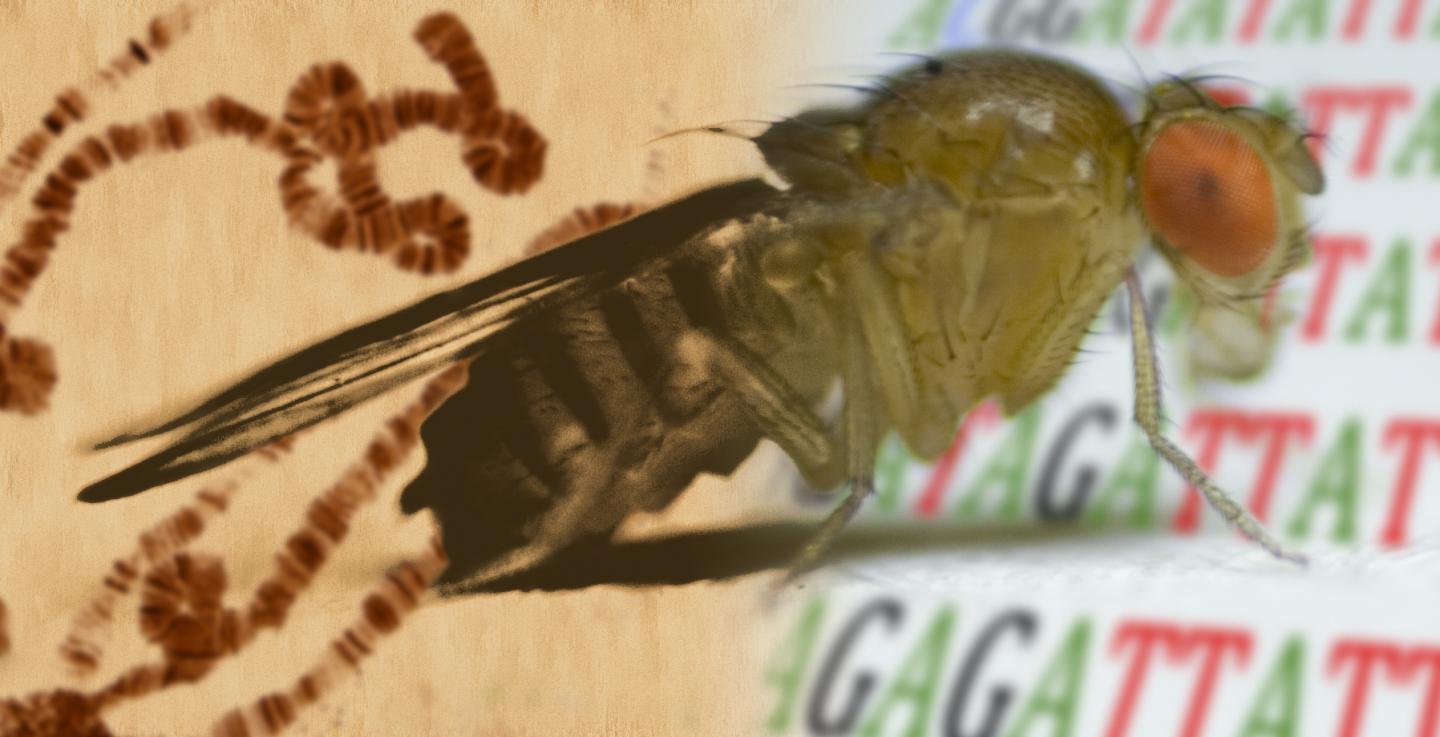
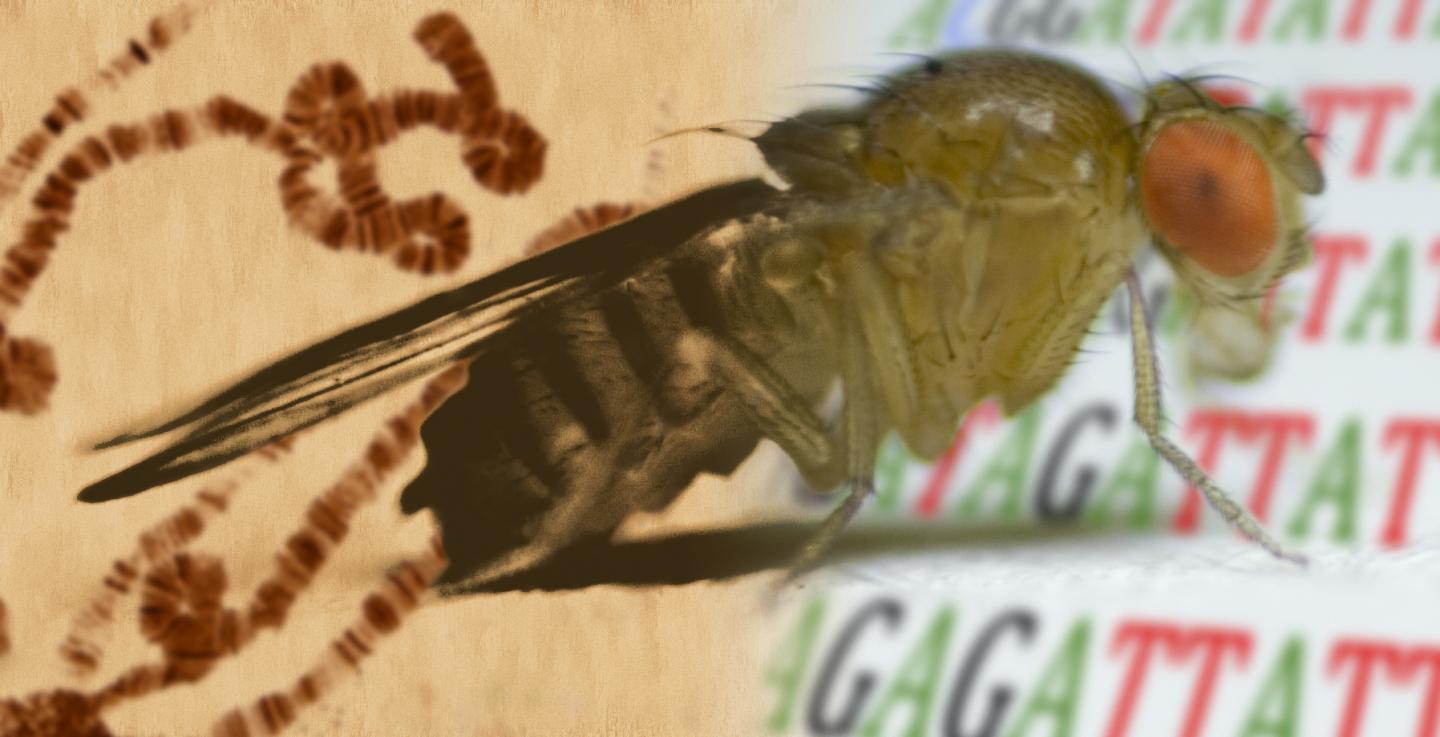
Therefore, the study by Ana Marija Jakšic investigated in a genome-wide analysis how transposons get prepared for jumping. For this purpose, the researchers exposed two different fruit fly populations to different temperatures. Then they mapped out the sequences of the jumping genes, using the "next generation sequencing" methods. They could show that almost all families produce tools that enable jumping, but the extent depends on two different factors.
"Our study has shown that the activity of transposons does not only depend on themselves but also on factors which the host cells produce," explained Jakšic. In the gene sequence of transposons there is a binding site for host-specific factors which positively regulate the transcription of genes in the cells. Thus, two factors cooperate – the family-specific binding site and the host factors that are regulated through the environment and genetic background. "As all members of a family have the same binding sequences, all copies of the family members, spread across the genome, react in the same way to environmental influences," said the lead author.
Party discipline for related transposable elements
"It was important for us to see that the position in the genome does not have a strong influence on the activity of a transposon," said last author Christian Schlötterer. "As the members of a transposon family strongly resemble each other, they also share most of the binding sites. This means: When the signal for jumping is given, this affects the whole family – party discipline in a certain sense."
Preparation for jumping can provide valuable information, not only about the transposons themselves but also about the effects of the change in position. The insertion of jumping genes is not necessarily bad for the structure of the genome. "Although transposons are discredited due to their mainly harmful mutagenic effect, their new position can have a positive influence on neighbouring genes. This can quickly lead to functional innovations. A very good example is resistance against insecticides in fruit flies: They became resistant to DDT because of a jumping transposon," said Jakšic.
###
Service: The article „Regulation of transposable elements: Interplay between TE-encoded regulatory sequences and host-specific trans-acting factors in Drosophila melanogaster" by Ana Marija Jakšic, Robert Kofler and Christian Schlötterer was published in Molecular Ecology. http://onlinelibrary.wiley.com/doi/10.1111/mec.14259/abstract
About the University of Veterinary Medicine, Vienna
The University of Veterinary Medicine, Vienna in Austria is one of the leading academic and research institutions in the field of Veterinary Sciences in Europe. About 1,300 employees and 2,300 students work on the campus in the north of Vienna which also houses five university clinics and various research sites. Outside of Vienna the university operates Teaching and Research Farms. http://www.vetmeduni.ac.at
Scientific Contact:
Ana Marija Jakšic
Institute of Population Genetics
University of Veterinary Medicine Vienna (Vetmeduni Vienna)
[email protected]
and
Christian Schlötterer
Institute of Population Genetics
University of Veterinary Medicine Vienna (Vetmeduni Vienna)
T +43 1 25077-4300
[email protected]
Released by:
Georg Mair
Science Communication / Corporate Communications
University of Veterinary Medicine Vienna (Vetmeduni Vienna)
T +43 1 25077-1165
[email protected]
Media Contact
Christian Schlötterer
[email protected]
43-125-077-4300
http://www.vetmeduni.ac.at
Original Source
http://www.vetmeduni.ac.at/en/infoservice/presseinformation/press-releases-2017/party-discipline-for-jumping-genes/