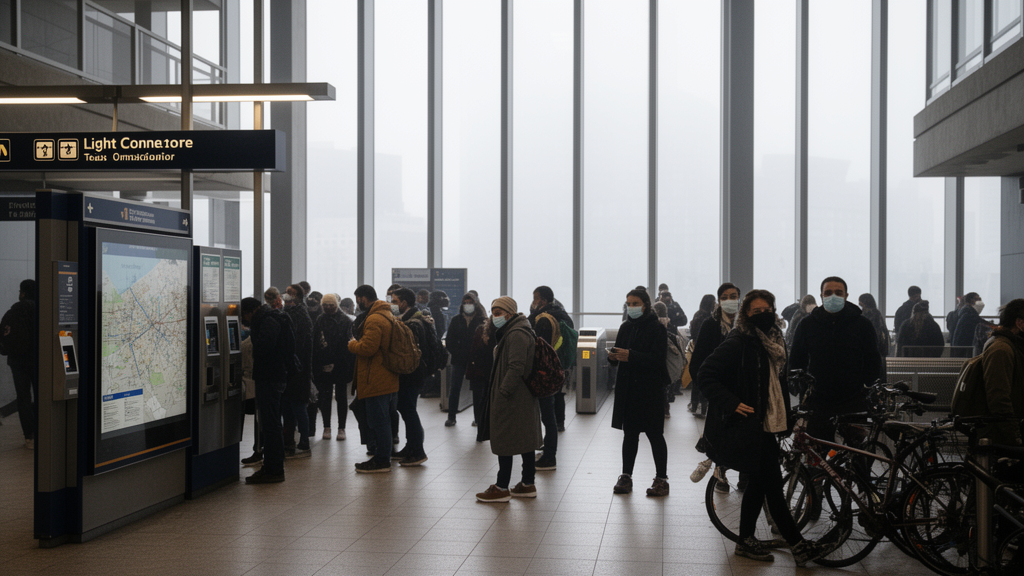
Wildfire smoke air-quality advisories were associated with modest changes in how Montrealers traveled, according to a peer-reviewed study of 27 advisory days from 2022 through 2025. On those days, BIXI bikeshare trips fell by an estimated 5.8%, while bus ridership increased by 6.7% and metro use rose by 4.7%. The pattern was consistent with some travelers shifting from open-air travel to enclosed transit, but the study found relatively limited changes in other measured activities.
Researchers from McGill University’s Platial Analysis Lab analyzed daily movement data from Montreal’s bikeshare system, public transit network and the Strava running app. The study population and setting were Montreal and its travel network during smoke-related advisories issued by Environment and Climate Change Canada. Rather than simply comparing advisory days with other dates, the team built a separate forecasting model for each travel mode. These models estimated how much travel would have occurred on a given date if no advisory had been issued, while accounting for weather, day of the week, season, holidays and major public events. The researchers used the difference between model predictions and observed travel to estimate the advisories’ effects.
The aggregate findings showed lower use of open-air mobility and higher use of buses and the metro on advisory days. BIXI trip counts declined by 5.8%, while bus and metro ridership increased by 6.7% and 4.7%, respectively. Study co-author Daniel Romm, a PhD candidate in McGill’s Department of Geography, said the shift in travel modes was what the bulletins were intended to encourage, but that its size was small. Recreational running showed no statistically significant change. That finding was based on Strava data, and the researchers cautioned that limitations of the dataset may have affected the result; the analysis therefore does not show that running was broadly reduced during advisories.
Travel responses also varied among parts of the city. The steepest reductions in bikeshare use were found in outlying boroughs rather than downtown. Most metro stations gained riders on advisory days, but Place-d’Armes in the downtown core lost an estimated 6.2% of its traffic, while the Université-de-Montréal station gained 24.8%. The researchers suggested that students and staff who would normally cycle to campus may have switched to public transit, while some downtown trips may have been skipped. These are possible interpretations of the station-level pattern; the study did not directly establish the motivations of individual travelers.
The research was a statistical analysis using four sources of daily movement data, with air-quality bulletin records supplied by Environment and Climate Change Canada. The study, “Urban Mobility Responses to Wildfire Smoke-Related Air Quality Advisories in Montréal, Canada,” was published in Health & Place. Its scope was limited to measured mobility responses during selected advisory days in one city, and the authors identified data constraints affecting the running analysis. Romm said the results offer an opportunity to develop practical strategies that make adherence easier, including temporarily reduced transit fares during smoke episodes or employer support for remote work. These were proposed possibilities, not measures tested in the study, and no clinical recommendation or outcome was evaluated.
Subject of Research: Changes in Montreal travel behavior during wildfire smoke air-quality advisories
Article Title: Wildfire smoke warnings had only a modest impact on Montrealers' movements, study finds
Article References: Wildfire smoke warnings had only a modest impact on Montrealers' movements, study finds. Original publication (Bibliographic details unavailable.)
Image Credits: AI Generated
DOI: Not provided
Keywords: wildfire smoke, air-quality advisories, Montreal, urban mobility, public transit, bikeshare, recreational running, behavioral response, climate health, Wildfire, smoke, warnings
News Source: Ophelia Keating. (October 26, 2026). Montreal travel shifted modestly during wildfire smoke advisories. Scienmag.