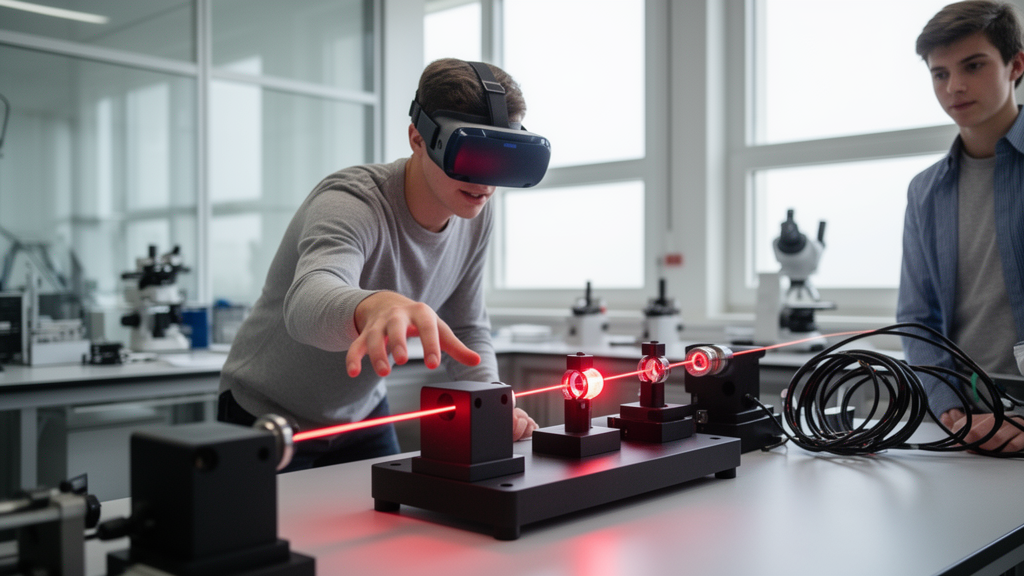
Researchers at the University of Würzburg have received the 2026 Teaching Prize from the German Physical Society’s Working Group on Physics Practical Classes for developing femtoPro, a virtual-reality laboratory that teaches students how to handle laser radiation safely. The award was presented at the Society’s annual conference, held from 13 to 16 September 2026 at Otto von Guericke University Magdeburg. Physicist Tobias Brixner, physical chemist Stefan Müller and computer scientist Sebastian von Mammen, together with their teams, began developing the simulation in 2020 through cooperation between Würzburg’s Institute of Physical and Theoretical Chemistry and its Institute of Computer Science.
The announcement says universities, schools and industrial companies are now using the software at numerous locations worldwide. Laser safety instruction poses a difficult practical challenge because improper use can cause serious injury, particularly to the eye, even when a laser beam is only diffusely reflected. Lasers are used in scanners, printers, entertainment devices, industrial manufacturing, medical diagnostics and eye surgery, while their underlying optical principles are taught in physics, chemistry, biology and materials science.
Access to suitable equipment can also be limited: large femtosecond lasers, which generate extremely short flashes of light, are often fully occupied by research and therefore unavailable for teaching. Scientific laser experiments additionally require substantial experience with alignment. Brixner described the resulting problem as a vicious circle: without practical experience, people cannot work safely with a laser, and without experience working with the laser, they cannot acquire the necessary practical knowledge.
FemtoPro addresses that teaching problem with a virtual simulation built around a physical model of laser-beam propagation. The software runs on consumer-grade virtual-reality headsets, including devices available from about 500 euros, and does not require an additional computer. The developers make the program available free of charge.
One technical challenge was maintaining the desired 90-hertz refresh rate, which studies cited by the team indicated would avoid perceptible stuttering. To achieve this, the simulation and visualization had to display all optical paths 90 times per second while responding quickly to user input. Because the project is intended to represent complex laser configurations, femtoPro goes beyond geometric light rays: it simulates aspects of wave optics, including interference, spatial beam profiles and short laser pulses.
The educational material was implemented by physical chemist Stefan Müller. More than 20 predefined exercise units guide users step by step from simple principles through to complex spectroscopic experiments. The project has received two earlier teaching recognitions.
In 2021, the Chemical Industry Fund recognized femtoPro within a programme supporting the development of digital teaching concepts in chemistry degree programmes. The team used the funding to purchase 20 virtual-reality headsets, which it now lends to students at the University of Würzburg on a semester-by-semester basis. In 2023, the German Informatics Society awarded femtoPro the AVRiL 2023 Silver Award in a competition for successful virtual- and augmented-reality learning scenarios.
The 2026 German Physical Society award means that organizations representing chemistry, computer science and physics have now recognized the project’s work, according to the university’s announcement. FemtoPro is also contributing to two doctoral theses by Andreas Müller and Samuel Truman that are nearing completion, while the team’s publications are freely available. The developers are planning additional functions, including a multiplayer mode designed to support collaborative work and learning within the same virtual laboratory.
Its stated educational role is to guide users through laser handling and optical concepts through guided virtual exercises, including complex spectroscopic arrangements.
Subject of Research: Award for a virtual-reality simulation used to teach practical laser safety and laser physics.
Article Title: German Physical Society teaching award for Würzburg researchers
Article References: German Physical Society teaching award for Würzburg researchers. Original publication (Bibliographic details unavailable.)
Image Credits: AI Generated
DOI: Not provided
Keywords: virtual reality, laser safety, physics education, femtosecond lasers, wave optics, virtual laboratories, immersive learning, University of Würzburg, German Physical Society, spectroscopy, German, Physical
News Source: Bethany Barker. (October 26, 2026). Würzburg VR laser lab wins German Physical Society teaching prize. Scienmag.