• HOME
  • NEWS
  • EXPLORE
    • CAREER
      • Companies
      • Jobs
    • EVENTS
    • iGEM
      • News
      • Team
    • PHOTOS
    • VIDEO
    • WIKI
  • BLOG
  • COMMUNITY
    • FACEBOOK
    • INSTAGRAM
    • TWITTER
Monday, October 26, 2026
BIOENGINEER.ORG
No Result
View All Result
  • Login
  • HOME
  • NEWS
  • EXPLORE
    • CAREER
      • Companies
      • Jobs
        • Lecturer
        • PhD Studentship
        • Postdoc
        • Research Assistant
    • EVENTS
    • iGEM
      • News
      • Team
    • PHOTOS
    • VIDEO
    • WIKI
  • BLOG
  • COMMUNITY
    • FACEBOOK
    • INSTAGRAM
    • TWITTER
No Result
View All Result
Bioengineer.org
No Result
View All Result
Home NEWS Science News Technology

Deeper Foundation Treatment Increases Uneven Settlement in Coastal Soil Model

by
October 26, 2026
in Technology
Reading Time: 2 mins read
0
Deeper Foundation Treatment Increases Uneven Settlement in Coastal Soil Model

Deeper Foundation Treatment Increases Uneven Settlement in Coastal Soil Model

Share on FacebookShare on TwitterShare on LinkedinShare on RedditShare on Telegram

A finite-element study of a coastal soft-soil foundation found that increasing the depth of dynamic compaction replacement from 3.0 to 6.0 m changed settlement within the treated area only slightly, while settlement in adjacent untreated ground increased from 0.252 to 0.350 m. The modeled differential settlement rose from 0.052 to 0.132 m, and the differential settlement ratio increased from 20.8% to 37.8%. The results indicate that greater treatment depth can create a larger deformation mismatch between improved and untreated ground, although the authors caution that the findings have not been validated as a field design recommendation.

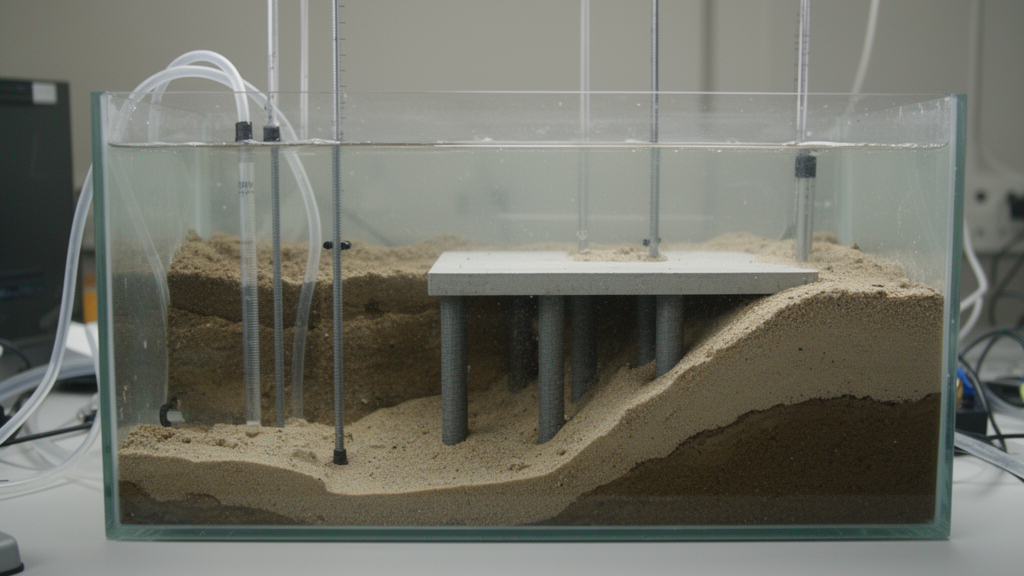
The investigation modeled the Huanhu Road section in Dongfang City using a two-dimensional axisymmetric finite-element approach. The dynamic compaction replacement region was represented as an equivalent linear-elastic improved zone within a total-stress framework. This numerical representation allowed the researchers to assess how different treatment depths influenced settlement in the treated and untreated areas, differential settlement between them, and the distribution of stress and strain through the soil profile. The study examined model-based behavior rather than measurements from a construction site.

As the treatment depth increased from 3.0 to 6.0 m, the strongest numerical change occurred outside the treated region. Settlement in the adjacent untreated area increased by 0.098 m, whereas settlement in the treated area changed only slightly. The widening difference between the two areas was associated in the stress- and strain-response analyses with vertical stress redistribution and an increasing mismatch in compressive deformation between treated and untreated ground. Thus, deeper replacement was associated in the model with greater unevenness at the boundary between the improved zone and the surrounding soil.

Among the modeled depths, cases of 3.5–4.0 m showed a relatively balanced response between settlement control and deformation compatibility within the investigated range. The researchers also examined two prescribed groundwater-depth situations as auxiliary sensitivity checks for the adopted density-based representation of improved ground. These checks did not turn the model into a field-verified design method; the authors explicitly described the 3.5–4.0 m range as a model-based reference. The study’s scope is therefore limited to a numerical assessment of treatment-depth effects for the modeled coastal soft-soil foundation, and its conclusions should not be read as a universally applicable construction specification.

Subject of Research: Finite-element analysis of treatment-depth effects on settlement compatibility in dynamic compaction replacement foundations

Article Title: Treatment depth effects on settlement and deformation compatibility of dynamic compaction replacement foundations in coastal soft soil

Article References: Hong, K., Hu, J., Zhao, S. J., Xiao, M., Yang, L., & Zhou, J. H. (2026). Treatment depth effects on settlement and deformation compatibility of dynamic compaction replacement foundations in coastal soft soil. Scientific Reports. https://doi.org/10.1038/s41598-026-76337-8

Image Credits: AI Generated

DOI: 10.1038/s41598-026-76337-8

Keywords: coastal soft soil, dynamic compaction replacement, foundation engineering, differential settlement, finite-element modeling, ground improvement, stress redistribution, deformation compatibility, geotechnical engineering, Treatment, depth, effects

News Source: Denise Maddox. (October 26, 2026). Deeper Foundation Treatment Increases Uneven Settlement in Coastal Soil Model. Scienmag.

Tags: coastal soft soildeformation compatibilitydepthdifferential settlementdynamic compaction replacementeffectsFinite Element Modelingfoundation engineeringgeotechnical engineeringground improvementstress redistributiontreatment
Share12Tweet7Share2ShareShareShare1

Related Posts

Clay Strength With Polyester Resin Depends Strongly on Initial Moisture

Clay Strength With Polyester Resin Depends Strongly on Initial Moisture

October 26, 2026
AI model sharpens entrepreneurial project recommendations from sparse user data

AI model sharpens entrepreneurial project recommendations from sparse user data

October 26, 2026

Fireworks-Optimized Clustering and SVM Tested for Enterprise Budget Control

October 26, 2026

MCGE-Net joins image, text and labels to enhance imaging

October 26, 2026

POPULAR NEWS

  • Clay Strength With Polyester Resin Depends Strongly on Initial Moisture

    Clay Strength With Polyester Resin Depends Strongly on Initial Moisture

    29 shares
    Share 12 Tweet 7
  • Multidisciplinary program linked to fewer neonatal PICC bloodstream infections

    29 shares
    Share 12 Tweet 7
  • Deeper Foundation Treatment Increases Uneven Settlement in Coastal Soil Model

    29 shares
    Share 12 Tweet 7
  • Würzburg VR laser lab wins German Physical Society teaching prize

    29 shares
    Share 12 Tweet 7

About

We bring you the latest biotechnology news from best research centers and universities around the world. Check our website.

Follow us

Recent News

Clay Strength With Polyester Resin Depends Strongly on Initial Moisture

Multidisciplinary program linked to fewer neonatal PICC bloodstream infections

Deeper Foundation Treatment Increases Uneven Settlement in Coastal Soil Model

Subscribe to Blog via Email

Enter your email address to subscribe to this blog and receive notifications of new posts by email.

Join 85 other subscribers
  • Contact Us

Bioengineer.org © Copyright 2023 All Rights Reserved.

Welcome Back!

Login to your account below

Forgotten Password?

Retrieve your password

Please enter your username or email address to reset your password.

Log In
No Result
View All Result
  • Homepages
    • Home Page 1
    • Home Page 2
  • News
  • National
  • Business
  • Health
  • Lifestyle
  • Science

Bioengineer.org © Copyright 2023 All Rights Reserved.