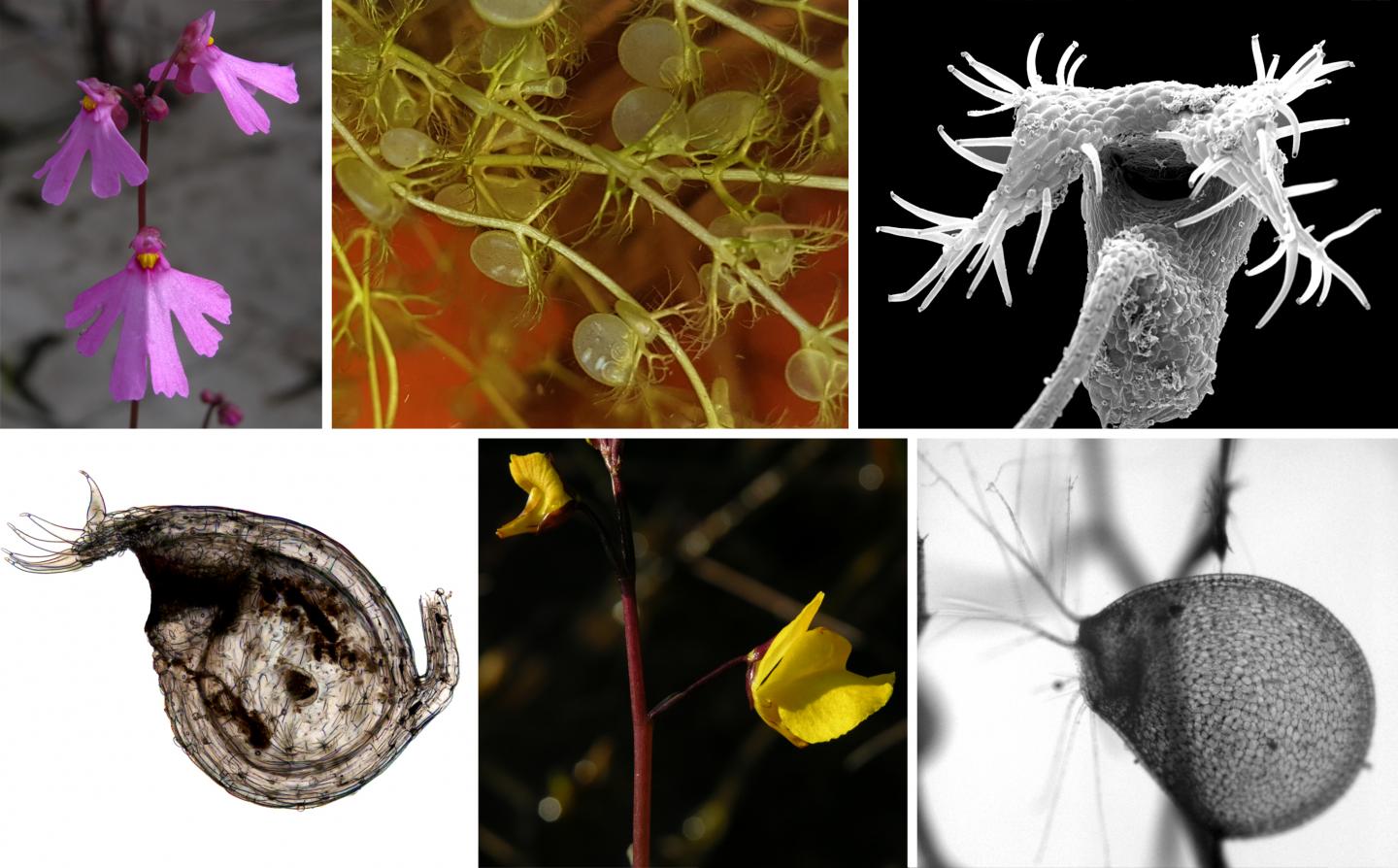
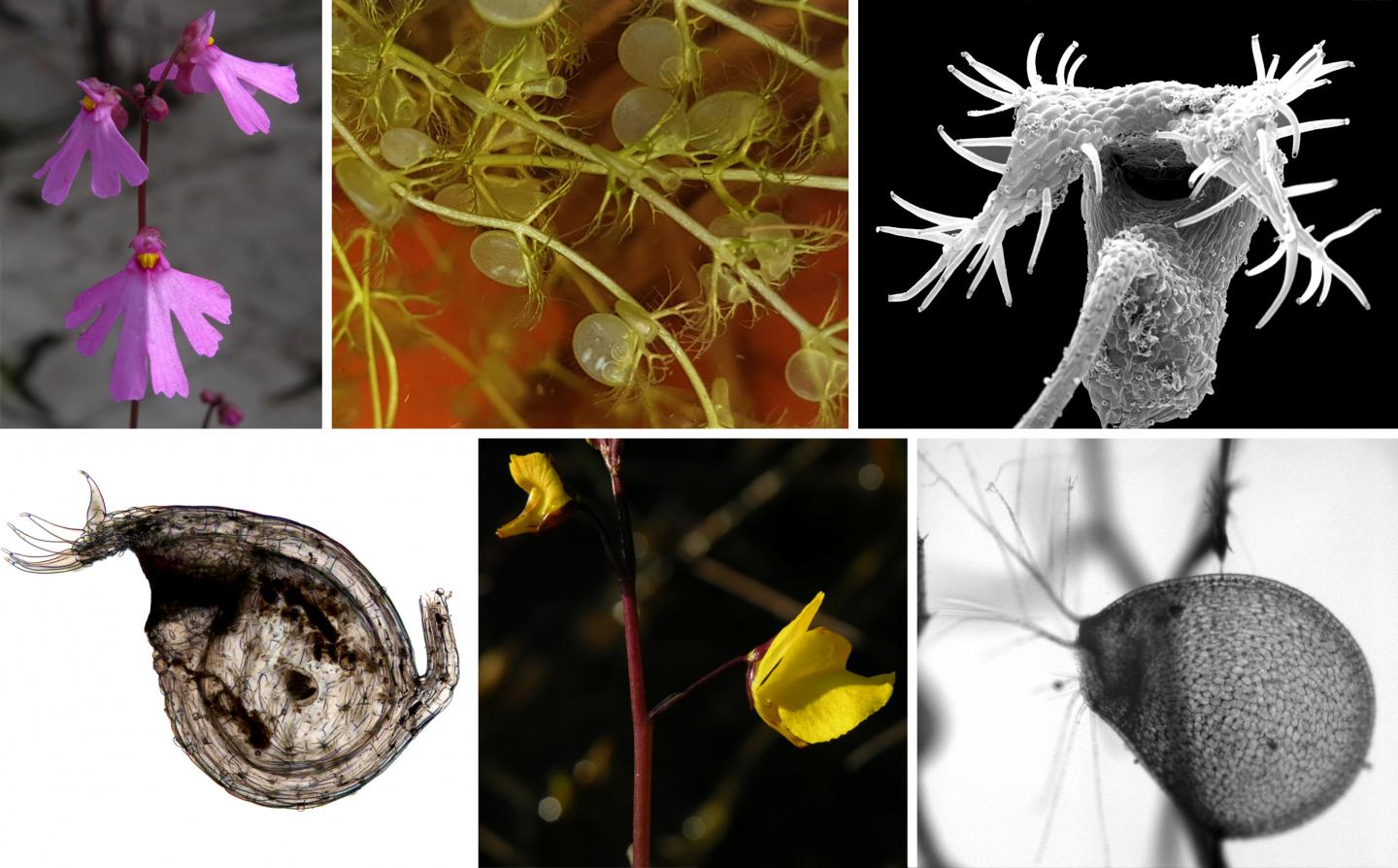
Credit: Flower images: Andreas Fleischmann, Trap images: Plant Biomechanics Group Freiburg
Bladderworts (Utricularia spp. Lentibulariaceae) are plants with many superlatives: They belong to the most recently evolved and also the largest genus of carnivorous flowering plants, encompassing more than 240 species. They have one of the smallest genomes known in flowering plants, have the fastest traps, are completely rootless, are distributed almost worldwide, and possess a great variety of different life forms. A team in the Plant Biomechanics Group at the Botanical Garden of the University of Freiburg led by Prof. Dr. Thomas Speck and Dr. Simon Poppinga is conducting comparative morphological and biomechanical analyses on these ultra-fast traps, which capture prey by means of underpressure-induced suction. The journal Scientific Reports has now published two new articles with results from the group.
The experiments described in the first article were conducted in close collaboration with colleagues from the Department of Animal Ecology, Evolution, and Biodiversity at the Ruhr University of Bochum, led by Prof. Dr. Ralph Tollrian. With the help of a high-speed camera, the researchers analyzed the "capture behavior" of the suction trap of Utricularia australis and possible escape attempts of one of its natural prey species, the water flea Ceriodaphnia dubia. They discovered that the fleas are sucked into the traps with 2800 times the acceleration of gravity and are decelerated inside the trap nearly as quickly. All of the trapping processes are too fast to allow the flea to make an attempt at escape.
The team from Freiburg reached the results presented in the second article together with Dr. Andreas Fleischmann from the Botanische Staatssammlung Munich and with colleagues from the Institute for Evolution and Biodiversity, University of Münster, led by Prof. Dr. Kai Müller. Comparative functional-morphological and biomechanical analyses on 19 bladderwort species conducted by the scientists revealed different trap entrance and trapdoor structures as well as several types of movement during suction that may be interpreted as adaptations to the different habitats the species occupy. One species, Utricularia multifida, has a trapdoor that does not move and likely traps prey according to a passive trapping principle instead of sucking it in. In this way, the team revealed various form-structure-function relationships for the first time ever and also put their findings in an evolutionary context: With the help of gene sequences from 105 species, they succeeded in reconstructing the course of evolutionary development of the genus Utricularia.
###
Original publications: S. Poppinga, L. E. Daber, A. S. Westermeier, S. Kruppert, M. Horstmann, R. Tollrian, T. Speck (2017). Biomechanical analysis of prey capture in the carnivorous Southern bladderwort (Utricularia australis). In: Scientific Reports 7, Article number: 1776. doi:10.1038/s41598-017-01954-3
S. Westermeier, A. Fleischmann, K. Müller, B. Schäferhoff, C. Rubach, T. Speck, S. Poppinga (2017) Trap diversity and character evolution in carnivorous bladderworts (Utricularia, Lentibulariaceae). In: Scientific Reports 7, Article number: 12052. doi: 10.1038/s41598-017-12324-4
Contact:
Dr. Simon Poppinga / Prof. Dr. Thomas Speck
Plant Biomechanics Group
University of Freiburg
Phone: +49 (0)761/203-2999 (Poppinga), +49 (0)761/203-2999 (Speck)
Email: [email protected] / [email protected]
Media Contact
Dr. Thomas Speck
[email protected]
49-761-203-2999
Original Source
https://www.pr.uni-freiburg.de/pm-en/2017/lightning-fast-trappers?set_language=en