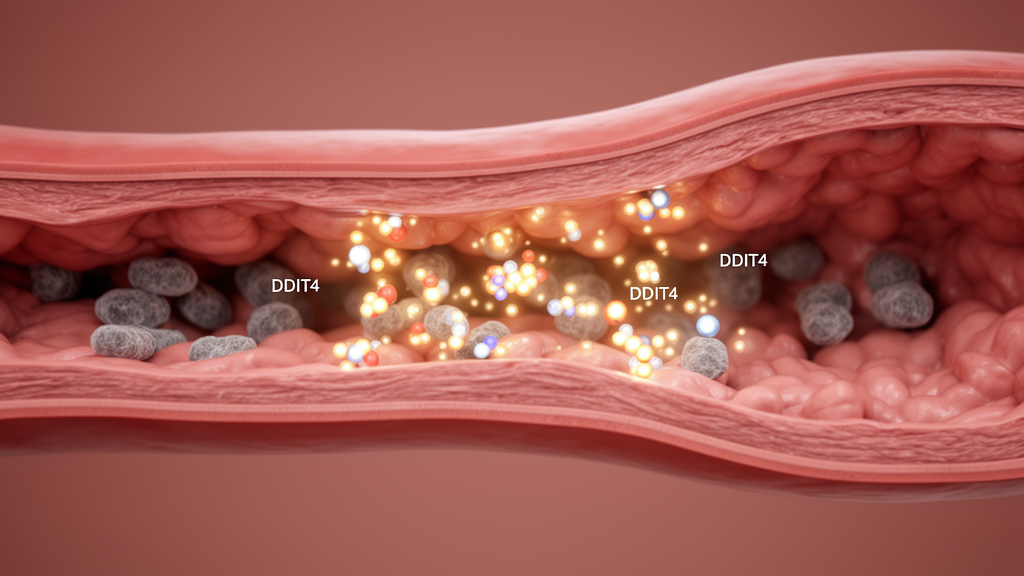
A protein long suspected of involvement in vascular disease has now been shown to actively drive the artery thickening that underlies atherosclerosis and restenosis, the re-narrowing of blood vessels after treatment. In a study published in Nature Communications, researchers report that DNA damage inducible transcript 4, or DDIT4, is markedly elevated in vascular smooth muscle cells that have undergone dedifferentiation after stimulation with PDGF-BB or IL-1β, and reduced in cells retaining their differentiated state. The protein was also found at higher levels in smooth muscle cells within neointimal tissue and atherosclerotic plaques in both mice and humans, with abundance correlating with disease progression.
Vascular smooth muscle cell phenotypic switching, in which normally contractile cells adopt a proliferative, synthetic state, is considered a central driver of vascular remodeling. Using gain- and loss-of-function approaches, the team showed that DDIT4 overexpression promotes smooth muscle cell proliferation and phenotypic switching, while knockdown suppresses both effects. In animal models, AAV9-mediated overexpression of Ddit4 exacerbated neointimal hyperplasia in atherosclerosis and vascular injury models, whereas deletion of the gene specifically in smooth muscle cells attenuated the remodeling.
The mechanistic explanation centers on cellular metabolism. DDIT4 binds the pyruvate dehydrogenase complex, the enzyme assembly that converts pyruvate into acetyl-CoA, and destabilizes interactions between its subunits, impairing its activity. The resulting decline in acetyl-CoA reduces histone acetylation across the genome, with particularly pronounced losses at the promoters of contractile genes. Acetylation of histone H3 at lysines 9 and 27 diminished, chromatin accessibility at those sites fell, and contractile gene expression was repressed, locking the cells into their proliferative phenotype.
The findings position DDIT4 as a molecular link between metabolic regulation and epigenetic control of smooth muscle cell identity. Because the protein sits upstream of both the enzymatic defect and the chromatin changes, the authors suggest that targeting DDIT4 represents a promising therapeutic strategy for restenosis and atherosclerosis. The evidence so far comes from cell culture experiments and mouse models of vascular injury and atherosclerosis, together with human tissue observations, so clinical translation will require further validation in patient studies.
Subject of Research: The role of the protein DDIT4 in vascular smooth muscle cell phenotypic switching, atherosclerosis and restenosis
Article Title: Smooth muscle DDIT4 exacerbates vascular remodeling in atherosclerosis and vascular injury by impairing PDC activity
Article References: Li, F., Yue, B., Xia, L., Liao, Y., Long, Y., Zhao, C., Yang, C., Qiu, M., Tao, J., Song, Z., Yan, J., Liu, C., Li, F., Liu, R., Wen, X., Liu, Y., Wang, X., Tang, W. H., & Zeng, Z. (2026). Smooth muscle DDIT4 exacerbates vascular remodeling in atherosclerosis and vascular injury by impairing PDC activity. Nature Communications. https://doi.org/10.1038/s41467-026-79145-w
Image Credits: AI Generated
DOI: 10.1038/s41467-026-79145-w
Keywords: atherosclerosis, restenosis, vascular smooth muscle cells, DDIT4, pyruvate dehydrogenase complex, histone acetylation, neointimal hyperplasia, phenotypic switching, metabolism, epigenetics, Smooth, muscle
News Source: Daisy Hatcher. (October 26, 2026). DDIT4 protein worsens artery narrowing by disrupting smooth muscle cell metabolism. Scienmag.