Encapsulating human Wharton’s jelly-derived mesenchymal stem cells in an alginate-gelatin hydrogel improved ovarian structure and dampened inflammation in a rat model of polycystic ovary syndrome, according to an open-access research article published in the Journal of Ovarian Research. In the study, adult female Wistar rats with experimentally induced PCOS received an intraovarian subcapsular injection of the stem-cell-laden hydrogel. One month after transplantation, the treated ovaries showed more growing follicles, fewer cystic follicles, and the reappearance of corpus luteum structures, alongside significant drops in two pro-inflammatory cytokines and in apoptotic cell counts.
Polycystic ovary syndrome is one of the most common endocrinopathies in young women and often leads to menstrual dysfunction and infertility. The researchers note that recent advances suggest mesenchymal stem cells, particularly those derived from human Wharton’s jelly, the gelatinous tissue inside the umbilical cord, may offer regenerative and immunomodulatory benefits for restoring ovarian function. The team set out to evaluate the therapeutic effects of human Wharton’s jelly-derived mesenchymal stem cells encapsulated in an alginate-gelatin hydrogel in an experimentally induced model of the syndrome.
To build the model, the researchers induced PCOS in adult female Wistar rats with a single intramuscular injection of estradiol valerate. Forty-five days after induction, animals in the treatment groups received intraovarian subcapsular injections of either the alginate-gelatin hydrogel alone or hydrogel containing the human Wharton’s jelly-derived mesenchymal stem cells. Each group contained five animals, a small design the authors describe as preliminary. One month after transplantation, ovarian tissues were evaluated for histopathological changes, follicular development, corpus luteum formation, tissue levels of the inflammatory cytokines IL-6 and TNF-α, and apoptotic activity measured with a TUNEL assay.
The results pointed to the stem cells as the active component. Ovaries treated with the encapsulated cells showed significantly improved morphology, with increased numbers of growing follicles and the reappearance of corpus luteum. Treatment markedly reduced cystic follicles and restored the structural integrity of the ovarian tissue. At the molecular level, the therapy produced significant declines in the pro-inflammatory cytokines IL-6 and TNF-α, with reported P values of 0.00012 and 0.00044 respectively, and a significant reduction in apoptotic cell numbers, reported at P = 0.0020.
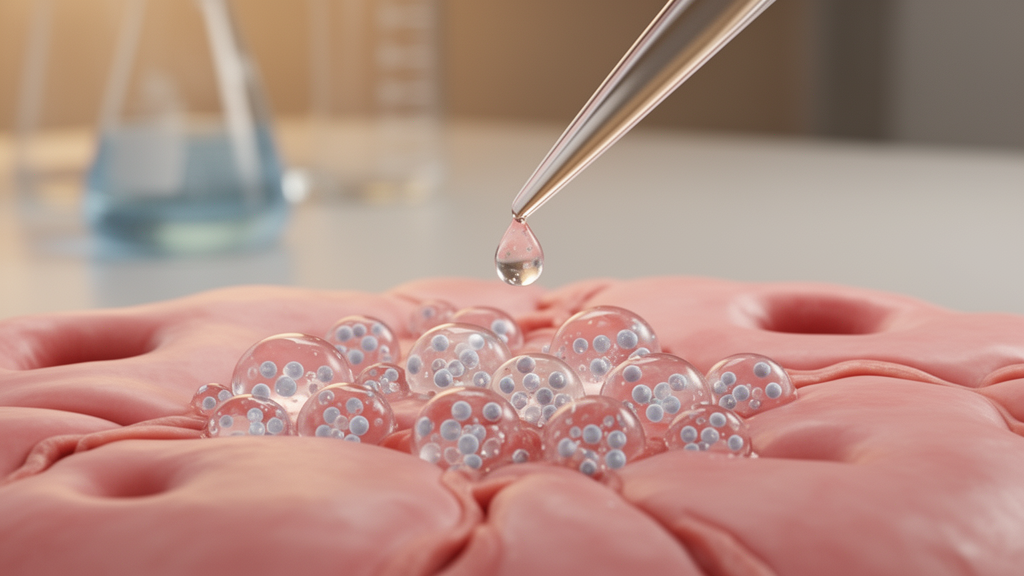
The hydrogel carrier itself showed no therapeutic effect of its own. Rats that received the alginate-gelatin hydrogel without cells exhibited only marginal, non-significant changes in these parameters relative to the group that received cells embedded in the hydrogel. The authors interpret this as confirmation that the carrier lacked intrinsic therapeutic or synergistic effects, meaning the improvements could be attributed to the mesenchymal stem cells rather than to the delivery material. Taken together, the findings indicate that the encapsulated cells effectively modulated the inflammatory microenvironment of the ovary and supported follicular recovery in PCOS-induced ovaries.
The authors place their caveats squarely on the preliminary nature of the work. The study was conducted in a rat model with five animals per group, and the conclusion states explicitly that these preliminary findings suggest hWJMSC-based interventions may help modulate the ovarian microenvironment, but that studies with larger sample sizes and functional reproductive outcomes are needed to further evaluate their therapeutic potential. In other words, the paper reports improved ovarian morphology, reduced local inflammation, and reduced apoptosis in rats, not restored fertility, not safety in humans, and not a validated clinical therapy. For now, the study stands as a carefully controlled animal experiment with clearly reported statistical outcomes and an honest accounting of its limits, showing that wrapping human Wharton’s jelly-derived mesenchymal stem cells in an alginate-gelatin hydrogel and injecting them into PCOS-induced rat ovaries improved follicular architecture, lowered IL-6 and TNF-α, and reduced apoptosis, while the hydrogel alone did little.
Subject of Research: Stem cell therapy for polycystic ovary syndrome in a rat model
Article Title: Alginate-gelatin hydrogel-encapsulated Wharton’s Jelly-Derived mesenchymal stem cells improve ovarian morphology and reduce inflammation in a rat model of polycystic ovary syndrome
Article References: Ghasemnejad-Berenji, H., Rezaei, S., & Ahmadpour, S. (2026). Alginate-gelatin hydrogel-encapsulated Wharton’s Jelly-Derived mesenchymal stem cells improve ovarian morphology and reduce inflammation in a rat model of polycystic ovary syndrome. Journal of Ovarian Research. https://doi.org/10.1186/s13048-026-02305-5
Image Credits: AI Generated
DOI: 10.1186/s13048-026-02305-5
Keywords: PCOS, mesenchymal stem cells, Wharton's jelly, alginate-gelatin hydrogel, ovarian morphology, inflammation, IL-6, TNF-alpha, rat model, regenerative medicine, Journal of Ovarian Research, Alginate-gelatin
News Source: Ophelia Keating. (October 26, 2026). Stem cells wrapped in hydrogel restore ovarian structure in PCOS rats. Scienmag.