Two plant-derived compounds may offer a new angle on osteoporosis. In a study published in Frontiers in Pharmacology, researchers at Nanyang Central Hospital in Henan, China, report that esculin and esculetin, two naturally occurring coumarins isolated from the traditional botanical medicine Cortex Fraxini, known in the Chinese pharmacopeia as Qinpi, protect against bone loss in mice by simultaneously boosting the bone-forming activity of osteoblasts and suppressing the bone-destroying activity of osteoclasts. The work, led by Lei Tong and Huaqing Liu, is strictly preclinical, but its scope is unusually broad: the team validated the compounds across cell culture, a postmenopausal osteoporosis model, and a disuse osteoporosis model, then confirmed that the treated bones were not just denser but mechanically stronger. What makes the findings notable is the bidirectional strategy itself, because most existing osteoporosis drugs push on only one side of the remodeling balance, often at the cost of suppressing the other.
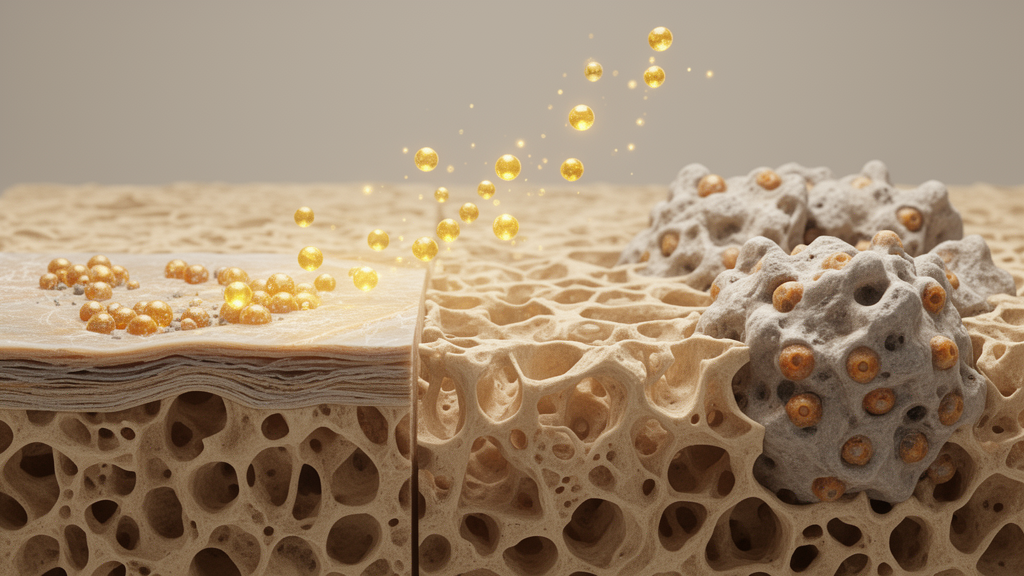
To understand why this dual action matters, it helps to revisit the basic biology of bone. Far from being inert scaffolding, bone is a dynamic tissue in constant renovation, with bone-forming osteoblasts laying down fresh collagen matrix and mineral, while bone-resorbing osteoclasts, giant multinucleated cells derived from macrophages, dissolve old tissue. Under healthy conditions these two processes are tightly coupled, so net bone mass stays constant. Osteoporosis arises when this coupling breaks down. Estrogen deficiency, aging, lack of mechanical loading, and oxidative stress all converge on a common endpoint: osteoclast-mediated resorption dramatically outpaces osteoblast-mediated formation, producing progressive deterioration of bone microarchitecture, reduced bone mineral density, and a rising risk of fragility fractures. Current pharmacological management relies on antiresorptive agents such as bisphosphonates and denosumab, or anabolic agents like teriparatide. These therapies are effective at increasing bone mineral density, but their long-term use is limited by serious adverse effects, including osteonecrosis of the jaw, atypical femoral fractures, and gastrointestinal toxicity, and most drugs target only one arm of remodeling, often secondarily suppressing the opposing process.
Eculin and esculetin enter this picture from an unexpected direction. Both are coumarin derivatives, with esculin being the glycoside and esculetin its aglycone, meaning the sugar-free parent molecule, and both are primarily isolated from Cortex Fraxini, a botanical medicine valued for anti-inflammatory, antioxidant, and immunomodulatory properties. Recent pharmacological investigations have highlighted protective effects of coumarin derivatives in metabolic and degenerative diseases, and earlier work had suggested that esculetin promotes new bone formation and inhibits osteoclastogenesis in ovariectomized rats, while metabolomics analysis identified esculin as a key metabolite contributing to the amelioration of glucocorticoid-induced bone loss. Yet a systematic comparison of the two compounds’ therapeutic efficacies, optimal concentrations, and dual actions on both osteoblast and osteoclast lineages had not been carried out, and their osteoprotective efficacy had not been tested across experimental models simulating different clinical etiologies of bone loss. The new study was designed to fill precisely that gap.
The in vitro phase of the investigation was methodical. Primary mouse calvarial osteoblasts were isolated from neonatal C57BL/6J mice using sequential collagenase digestion, with cells from passages two to three used to preserve primary characteristics. Osteoclasts were differentiated from the RAW264.7 murine macrophage cell line by stimulation with 50 nanograms per milliliter of RANKL, receptor activator of nuclear factor-kappaB ligand, for four to six days, with mature osteoclast formation confirmed by the presence of large, multinucleated tartrate-resistant acid phosphatase, or TRAP, positive cells. Both cell lineages were then treated with a concentration gradient of esculin and esculetin ranging from 1 to 100 micromolar. The screening revealed distinct pharmacological optima: 50 micromolar for esculin and a strikingly lower 10 micromolar for esculetin, a sharper optimum the authors attribute to the aglycone structure, which likely achieves maximal osteogenic activity at a lower concentration than its glycoside parent. At 100 micromolar, several assays showed plateaus or slight declines, which the researchers interpret as possible early cytotoxic stress at suprapharmacological concentrations.
At those optimal doses, the cellular readouts were consistent. In primary osteoblasts, both compounds dose-dependently upregulated the mRNA expression of key osteogenic marker genes, including Alp, Col1a, Ocn, and Runx2, the master transcription factor governing osteoblast lineage commitment. This transcriptional activation translated into function: Alizarin Red S staining after 21 days in osteogenic induction medium showed enhanced extracellular matrix mineralization and calcium nodule formation, while EdU incorporation assays quantified by flow cytometry demonstrated stimulated osteoblast proliferation, and MTT viability assays confirmed the compounds were not cytotoxic within the tested range. On the opposite side of the balance, both compounds induced osteoclast apoptosis, measured by Annexin V/propidium iodide double staining, and downregulated pivotal osteoclastogenic markers, including Acp5, Calcr, Ctsk, and Nfatc1. The parallel induction of apoptosis and suppression of osteoclastogenic transcription suggests the compounds restrain the resorptive arm of remodeling at both the survival and the differentiation levels of the osteoclast lineage.
The most intriguing in vitro result, however, came from combining the two compounds. When esculin and esculetin were co-administered at their respective optima, the dual treatment produced the highest osteoblast viability among the groups, robustly upregulated bone-forming genes, with Alp and Ocn significantly higher than either monotherapy, elicited extensive calcium nodule deposition, and propelled osteoblast proliferation to its highest rate. On the catabolic side, the combination severely exacerbated osteoclast cell death and most potently impaired the essential transcriptional machinery of the osteoclast lineage. The authors are careful with their language here: because a formal factorial interaction model was not pre-specified, the effects are described as combined or enhanced rather than synergistic, and some numerical improvements over monotherapy, such as the increases in Col1a and Runx2, did not reach statistical significance. Still, the pattern across several key functional readouts was clear enough to justify moving the combination into living animals.
For the in vivo phase, the team employed two distinct murine models representing different clinical triggers of osteoporosis. To simulate postmenopausal osteoporosis, eight-week-old female C57BL/6J mice underwent bilateral ovariectomy, or OVX, which removes endogenous estrogen. To simulate disuse osteoporosis, a denervation, or DEN, model was established by excising a five-millimeter segment of the right sciatic nerve, eliminating mechanical stimulation of the hindlimb. Two weeks after surgery, the mice were randomly allocated by computer-generated sequence into vehicle, esculin, esculetin, and combination groups, with treatment administration, histological evaluation, micro-CT scanning, and statistical analysis conducted by investigators blinded to group allocation. Esculin was administered at 40 milligrams per kilogram once daily, esculetin at 10 milligrams per kilogram once every three days, and the combination group received both, all for eight continuous weeks. Notably, no animals were excluded and no unexpected mortality occurred, and all initial animals were included in the downstream analyses.
The systemic results in both models were remarkably parallel. Serum ELISA analyses revealed that ovariectomy triggered a profound inflammatory response, with drastically elevated circulating levels of the pro-inflammatory cytokines IL-6, IL-1beta, and TNF-alpha, and a concurrent reduction in the anti-inflammatory cytokine IL-10. Concomitantly, the OVX mice exhibited severe oxidative stress, characterized by increased malondialdehyde, or MDA, accumulation and depleted superoxide dismutase, or SOD, activity. The denervation model produced a strikingly analogous catabolic cascade. While monotherapy with either compound significantly mitigated these pathological shifts, the combinatorial regimen achieved a superior rescue, largely normalizing the inflammatory and oxidative profiles to levels closely approximating healthy controls. Because pro-inflammatory cytokines both stimulate osteoclastogenesis and suppress osteoblast activity, this attenuation provides a plausible upstream mechanism through which the compounds rebalance bone turnover. The serum bone turnover markers moved in concordance: formation indices, including PICP, PINP, and bone alkaline phosphatase, which had been profoundly diminished, were restored, while resorption markers, including CTX-I, NTX-I, and TRAP, which had surged, were suppressed to the greatest extent by the dual therapy, indicating a genuine shift in the remodeling balance rather than selective suppression of a single arm.
The structural and functional confirmation followed. Masson’s trichrome and Toluidine blue staining showed that the dual therapy maintained a dense, well-connected trabecular architecture and a rich collagen network closely resembling the healthy sham groups in both models. Immunofluorescence for Collagen Type I and Osteocalcin, the latter marking the mature, mineralization-competent osteoblast, was most effectively restored by the combination, driving expression remarkably close to baseline, while TRAP staining revealed the most pronounced reduction in hyperactive, multinucleated osteoclasts lining eroded trabecular surfaces. High-resolution micro-CT at a voxel size of 10 micrometers quantified the preservation: vehicle-treated OVX and DEN mice had suffered severe declines in bone volume fraction, trabecular number, trabecular thickness, connectivity density, and cortical bone thickness, with pathological expansion of trabecular separation, and the dual therapy returned most parameters toward sham levels, though in the DEN model several remained significantly lower than sham. Critically, three-point bending tests on an Instron system showed the combination most consistently rescued maximum force, stiffness, elastic modulus, and ultimate stress, confirming the treated bones were functionally stronger, not merely radiographically denser.
The authors are candid about the boundaries of their evidence, and readers should be equally sober. The precise molecular targets and intracellular signaling crosstalk underlying the interaction between the two compounds remain to be fully elucidated, the cellular mechanistic evidence is largely transcriptional, and protein- or pathway-level validation will be required. No treatment-only healthy animal groups or systematic toxicity assessments were included, no resorption-pit assay directly measured osteoclast resorptive function, and pharmacokinetics, bioavailability, long-term toxicity, fracture outcomes, and head-to-head comparisons with established osteoporosis therapies were not evaluated. There is also a pharmacokinetic wrinkle worth watching: esculin can be hydrolyzed to esculetin by the gut microbiota and intestinal enzymes, so concurrent oral administration may in principle alter systemic exposure to the aglycone, warranting dedicated pharmacokinetic evaluation of the combination. Natural coumarins face known translational challenges from poor aqueous solubility, rapid phase II metabolism, and characteristically low oral bioavailability. Accordingly, the findings should be interpreted as preclinical proof of concept rather than evidence of clinical efficacy. Even so, the convergence of cellular, systemic, structural, and biomechanical outcomes across two distinct etiologies of bone loss establishes a credible rationale for pushing these plant-derived coumarins toward the rigorous pharmacokinetic and toxicological testing that will decide whether they ever reach the clinic.
Subject of Research: Eculin and esculetin as bidirectional modulators of osteoblast and osteoclast function in mouse models of osteoporosis
Article Title: Esculin and esculetin protect against bone loss in osteoporosis by rebalancing osteoblast and osteoclast functions
Article References: Tong, L., Lv, W., & Liu, H. (2026). Esculin and esculetin protect against bone loss in osteoporosis by rebalancing osteoblast and osteoclast functions. Frontiers in Pharmacology, 17, Article 1961311. https://doi.org/10.3389/fphar.2026.1961311
Image Credits: AI Generated
DOI: 10.3389/fphar.2026.1961311
Keywords: osteoporosis, bone remodeling, esculin, esculetin, coumarins, osteoblasts, osteoclasts, preclinical research, ovariectomy model, denervation model, micro-CT, biomechanics
News Source: Ophelia Keating. (October 26, 2026). Natural coumarins from Qinpi rebalance bone cells to fight osteoporosis in mice. Scienmag.