• HOME
  • NEWS
  • EXPLORE
    • CAREER
      • Companies
      • Jobs
    • EVENTS
    • iGEM
      • News
      • Team
    • PHOTOS
    • VIDEO
    • WIKI
  • BLOG
  • COMMUNITY
    • FACEBOOK
    • INSTAGRAM
    • TWITTER
Monday, October 26, 2026
BIOENGINEER.ORG
No Result
View All Result
  • Login
  • HOME
  • NEWS
  • EXPLORE
    • CAREER
      • Companies
      • Jobs
        • Lecturer
        • PhD Studentship
        • Postdoc
        • Research Assistant
    • EVENTS
    • iGEM
      • News
      • Team
    • PHOTOS
    • VIDEO
    • WIKI
  • BLOG
  • COMMUNITY
    • FACEBOOK
    • INSTAGRAM
    • TWITTER
No Result
View All Result
Bioengineer.org
No Result
View All Result
Home NEWS Science News Technology

Research report: Hot deformation behavior and microstructure evolution of 3003 aluminum alloy at low strain rate

by
October 26, 2026
in Technology
Reading Time: 2 mins read
0
Research report: Hot deformation behavior and microstructure evolution of 3003 aluminum alloy at low strain rate

Research report: Hot deformation behavior and microstructure evolution of 3003 aluminum alloy at low strain rate

Share on FacebookShare on TwitterShare on LinkedinShare on RedditShare on Telegram

Hot compression testing of 3003 aluminum alloy (AA3003) identified a comparatively stable deformation window at 550–600 °C and strain rates of 0.0001–0.0005 s−1. The experiments covered temperatures from 400 to 600 °C and strain rates from 0.0001 to 0.005 s−1, conditions intended to characterize the alloy’s low-strain-rate thermomechanical response. Across the tested range, flow stress decreased as temperature increased and strain rate decreased, a result the researchers associated with a stronger contribution from time-dependent dynamic softening.

To quantify this behavior, the research team corrected the measured compression curves for interfacial friction and deformation heating. It then developed a strain-compensated Arrhenius constitutive model. The model’s apparent deformation activation energy varied with strain, ranging from 156.4 to 273.5 kJ/mol and reaching a maximum near a true strain of 0.15.

It subsequently decreased as dynamic recovery and recrystallization progressively reduced the additional resistance to deformation. The fitted model achieved an average absolute relative error of 11.15% and a correlation coefficient of 0.966, indicating acceptable predictive capability for the investigated temperature and strain-rate conditions rather than universal accuracy. Murty processing maps identified two flow-instability domains: one at 400–450 °C with strain rates of 0.0005–0.005 s−1, and another at 550–600 °C with strain rates of 0.001–0.005 s−1.

These maps classify combinations of processing conditions associated with less stable flow behavior. Electron backscatter diffraction analysis showed distinct microstructural patterns in the two domains. The lower-temperature region retained a comparatively large fraction of deformed grains, while the high-temperature, higher-rate region displayed strong but less homogeneous recrystallization.

These observations characterize differences within the tested domains without establishing the behavior of every individual condition inside them. By contrast, deformation at 550–600 °C and 0.0001–0.0005 s−1 produced a more uniform coexistence of recrystallized, recovered, and deformed grains. This region also had relatively high power-dissipation efficiency.

Based on the combined processing-map and grain-scale observations, the study recommends the high-temperature, low-rate range as the stable processing window for AA3003 under the investigated laboratory compression conditions. The corrected low-rate constitutive data may support control of pressure-induced deformation and dimensional accuracy in slow forming and diffusion bonding operations, which the authors identify as practical applications of the findings. Instead, it provides experimental flow-stress measurements, a fitted constitutive model, processing maps, and electron backscatter diffraction observations for a defined range of hot-deformation conditions.

Together, these results show how AA3003 responded in the tested regime and where the researchers located comparatively stable behavior, while leaving performance outside the investigated scope unspecified.

Subject of Research: Low-strain-rate hot-deformation behavior and microstructural evolution in AA3003 aluminum alloy

Article Title: Hot deformation behavior and microstructure evolution of 3003 aluminum alloy at low strain rate

Article References: Liu, Y., Yin, H., Xiong, C., & Wu, Y. (2026). Hot deformation behavior and microstructure evolution of 3003 aluminum alloy at low strain rate. Journal of Materials Science, 61(41), 31946-31965. https://doi.org/10.1007/s10853-026-13635-6

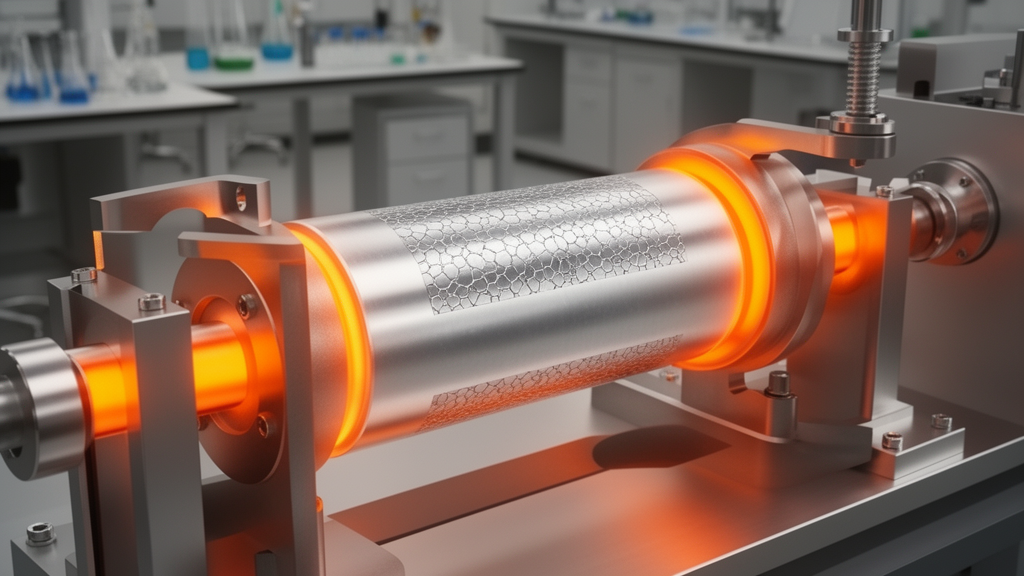
Image Credits: AI Generated

DOI: 10.1007/s10853-026-13635-6

Keywords: AA3003 aluminum, hot compression, low strain rate, flow stress, constitutive modeling, processing maps, dynamic recrystallization, electron backscatter diffraction, metal forming, diffusion bonding, deformation, behavior

News Source: Neil Sanderson. (October 26, 2026). Research report: Hot deformation behavior and microstructure evolution of 3003 aluminum alloy at low strain rate. Scienmag.


Tags: AA3003 aluminumBehaviorconstitutive modelingdeformationdiffusion bondingdynamic recrystallizationelectron backscatter diffractionflow stresshot compressionlow strain ratemetal formingprocessing maps
Share12Tweet7Share2ShareShareShare1

Related Posts

SnSb-silicon oxide anode sustains storage at temperatures down to −40 °C

SnSb-silicon oxide anode sustains storage at temperatures down to −40 °C

October 26, 2026
Research report: Preparation of N,P-synergistic flame-retardant phase change materials and their application for thermal management of lithium-ion batteries

Research report: Preparation of N,P-synergistic flame-retardant phase change materials and their application for thermal management of lithium-ion batteries

October 26, 2026

Research report: External-catalyst-free transcarbamoylation in hydroxyurethane-modified epoxy vitrimer: enabling ultra-tough, rapidly welding, and self-healing carbon fiber/epoxy composites

October 26, 2026

Lab study links XPS charge neutralization to shifts on a graphite anode

October 26, 2026

POPULAR NEWS

  • Research report: Hot deformation behavior and microstructure evolution of 3003 aluminum alloy at low strain rate

    Research report: Hot deformation behavior and microstructure evolution of 3003 aluminum alloy at low strain rate

    29 shares
    Share 12 Tweet 7
  • SnSb-silicon oxide anode sustains storage at temperatures down to −40 °C

    29 shares
    Share 12 Tweet 7
  • Benzo[a]pyrene Damages Mouse Ovaries and Expands Cancer Stem-Like Progenitor Populations

    29 shares
    Share 12 Tweet 7
  • Research report: Preparation of N,P-synergistic flame-retardant phase change materials and their application for thermal management of lithium-ion batteries

    29 shares
    Share 12 Tweet 7

About

We bring you the latest biotechnology news from best research centers and universities around the world. Check our website.

Follow us

Recent News

Research report: Hot deformation behavior and microstructure evolution of 3003 aluminum alloy at low strain rate

SnSb-silicon oxide anode sustains storage at temperatures down to −40 °C

Benzo[a]pyrene Damages Mouse Ovaries and Expands Cancer Stem-Like Progenitor Populations

Subscribe to Blog via Email

Enter your email address to subscribe to this blog and receive notifications of new posts by email.

Join 85 other subscribers
  • Contact Us

Bioengineer.org © Copyright 2023 All Rights Reserved.

Welcome Back!

Login to your account below

Forgotten Password?

Retrieve your password

Please enter your username or email address to reset your password.

Log In
No Result
View All Result
  • Homepages
    • Home Page 1
    • Home Page 2
  • News
  • National
  • Business
  • Health
  • Lifestyle
  • Science

Bioengineer.org © Copyright 2023 All Rights Reserved.