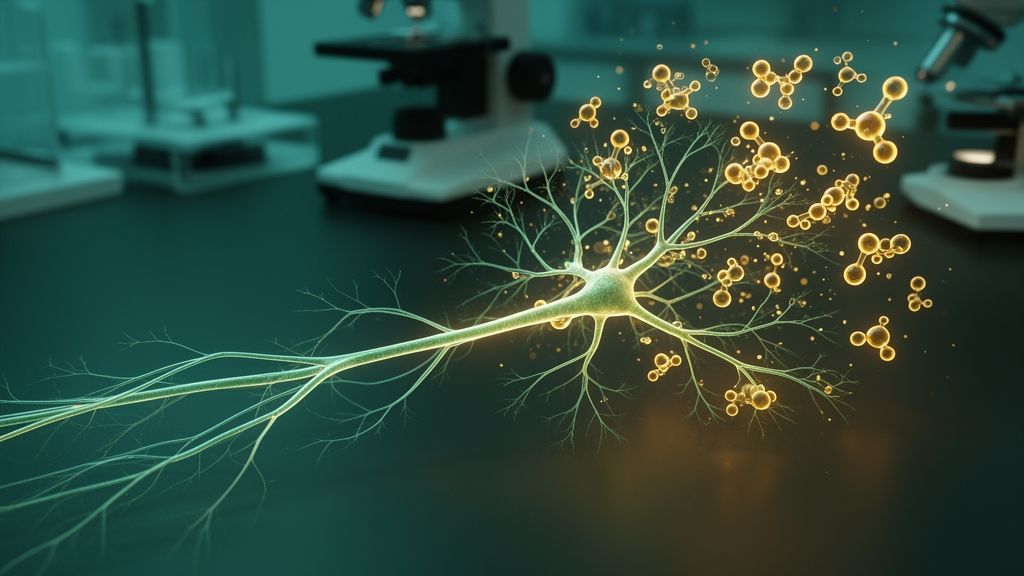
A naturally derived compound called α-Cyperone has shown a striking ability to keep laboratory-grown brain cells alive under severe metabolic stress, according to a study published in Molecular Biology Reports. Researchers exposed primary mouse cortical neurons to 96 hours of nutrient deprivation and found that the treatment restored cell survival from 58.90 percent of control levels to 94.56 percent, with the effect increasing in a concentration-dependent manner. The estimated concentration producing half of the maximal protective response was 17.79 ± 1.24 µM, and the dose-response fit was strong, with an R² of 0.94.
Nutrient deprivation is a model of the metabolic stress that drives neuronal injury through impaired homeostasis, mitochondrial dysfunction, membrane damage, and activation of apoptotic pathways. The team assessed this damage at several levels: cell viability using the MTT assay, membrane integrity through lactate dehydrogenase (LDH) leakage, and expression of apoptosis-related genes by quantitative real-time PCR.
The viability measurements showed the core result. After nearly four days without nutrients, untreated neurons retained just under 59 percent of the survival seen in fed controls. With α-Cyperone present, survival climbed in a dose-dependent fashion to nearly 95 percent, indicating that the compound’s protection was not an all-or-nothing effect but scaled with concentration.
Membrane integrity told a parallel story. LDH release, which rises when the neuronal membrane is compromised, increased from 0.19 in healthy controls to 0.41 under starvation. α-Cyperone suppressed that leakage by 86.4 percent, suggesting the compound helps preserve the physical barrier that keeps neurons functional.
The molecular signature of the protection pointed squarely at apoptotic signaling. Starvation upregulated Bax and Caspase-3, two genes that drive the intrinsic cell-death program, and α-Cyperone treatment silenced them dramatically — by 97.7 percent for Bax and 75.6 percent for Caspase-3. Expression of BDNF, a gene supporting neuronal survival and growth, was also tracked as part of the panel.
One result stood out as mechanistically important: BCL2, the classical anti-apoptotic gene, showed no significant recovery with treatment. According to the authors, this indicates that the compound’s primary mode of action is not boosting conventional survival pathways but rather silencing pro-death transcriptional signaling before it can execute.
The study’s scope is firmly in vitro. The findings come from cultured primary mouse cortical neurons, not living animals or patients, and the authors themselves frame α-Cyperone as a promising natural lead compound that now requires validation in comprehensive in vivo and translational neurodegenerative models. Whether the concentration-dependent protection observed in a dish can be achieved at safe exposures in a living brain remains an open question, as do questions about how the compound reaches neurons and what other targets it may touch.
For now, the evidence rests on viability assays, membrane-integrity measurements, and quantitative gene-expression data from a controlled starvation model — a foundation, but only a first step, toward any therapeutic claim.
Subject of Research: Neuroprotective effects of α-Cyperone against starvation-induced injury in primary mouse cortical neurons
Article Title: Neuroprotective effect of α-Cyperone against starvation-induced neuronal damage in primary cortical neurons: involvement of apoptotic signaling
Article References: Goodarzi, O., Aghababaee, L., Farrokhi, K., Khalili, M. A. N., & Riazi, G. H. (2026). Neuroprotective effect of α-Cyperone against starvation-induced neuronal damage in primary cortical neurons: involvement of apoptotic signaling. Molecular Biology Reports, 53(1), Article 1802. https://doi.org/10.1007/s11033-026-13001-4
Image Credits: AI Generated
DOI: 10.1007/s11033-026-13001-4
Keywords: α-Cyperone, neuroprotection, cortical neurons, starvation, apoptosis, Bax, Caspase-3, BCL2, membrane integrity, metabolic stress, in vitro study, Molecular Biology Reports
News Source: Drew Townsend. (October 26, 2026). Natural Compound α-Cyperone Shields Starved Neurons in Lab Study. Scienmag.