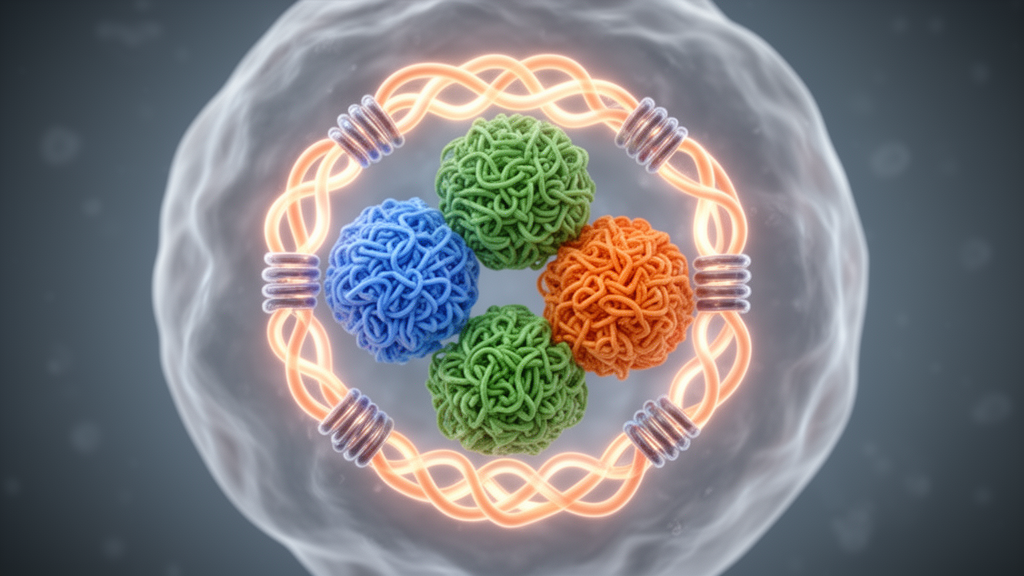
For decades, biology textbooks have drawn a simple line through the cell nucleus: euchromatin, the gene-active portion of the genome, is open and loose, while heterochromatin, the silenced portion, is dense and compact. A new study led by Professor Kazuhiro Maeshima at the National Institute of Genetics, ROIS, and SOKENDAI, published in Nature Genetics on September 8, 2026, argues that this tidy dichotomy is wrong for living cells. Using live-cell super-resolution imaging, the international team showed that active chromatin in human cells is not simply open. Instead, euchromatin forms compact, dynamic domains, and the ring-shaped protein complex cohesin acts as a physical constraint that keeps neighboring domains from locally mixing, a separation that appears essential for proper gene regulation.
The scale of the packing problem makes the finding striking. The human genome, if stretched out, spans roughly two meters, yet it fits inside a nucleus only about 10 micrometers in diameter. DNA is wrapped around histone proteins to form nucleosomes, which are further organized into chromatin. To probe how the active fraction of this chromatin behaves at the finest level, the researchers combined two imaging approaches in living human cells: single-nucleosome imaging and tracking, which follows the movement of individual nucleosomes, and super-resolution 3D-structured illumination microscopy (3D-SIM), which resolves euchromatic domains at approximately 100 nanometers. This pairing let the team measure both the physical properties of individual nucleosomes and the spatial organization of the domains they compose.
The central experiment asked what happens when cohesin, a complex best known for extruding chromatin loops and shaping genome architecture, is removed. The answer was not what the classical model would predict. Rather than opening up or globally decondensing, the euchromatic domains stayed compact, but their internal dynamics changed markedly: removing cohesin increased the mobility of nucleosomes within the domains, making them more fluid-like. At the same time, neighboring condensed domains began to mix locally. Cohesin loss, in other words, did not loosen the genome’s active regions; it dissolved the boundaries between them.
“This was an important point for us,” said Maeshima. “Cohesin loss did not simply make euchromatin open. Rather, it made condensed euchromatic domains more fluid and led to local domain mixing.” The observation reframes cohesin’s role in genome organization. Beyond building loops, the complex appears to control the physical state of active chromatin itself, holding condensed domains in place so that their contents do not intermingle at local scales.
The mixing was not merely a structural curiosity; it carried functional consequences. The team found that euchromatic domains help maintain transcriptional insulation, the separation of transcriptional environments so that genes in one domain are regulated independently of genes in the next. When cohesin was removed, local domain mixing was accompanied by weakened transcriptional insulation: genes in neighboring domains became more likely to switch on together. “Our results suggest that cohesin acts like a constraint that keeps active chromatin domains from mixing too much,” said Shimazoe and Iida. “This provides a physical explanation for how cohesin contributes to transcriptional insulation in living cells.”
Together, the results support a revised view of euchromatin. Rather than being simply open and accessible, active chromatin is better understood as an array of condensed, dynamic, and functionally insulated domains whose local mixing is actively controlled, even while the genes within them remain accessible to the transcription machinery. “Euchromatin is often described as open chromatin,” said Shimazoe and Iida. “But our work suggests that euchromatin is better understood as forming condensed, dynamic, and functionally insulated domains. Cohesin helps maintain this organization.”
The researchers hope this physical picture of active chromatin will deepen understanding of gene regulation, genome organization, development, and disease. Cohesin dysfunction is linked to developmental disorders and cancer, so clarifying how the complex governs the behavior of chromatin domains may offer new insight into how genome regulation fails in disease. The study was conducted in living human cells, and the findings concern the physical organization and transcriptional behavior of euchromatic domains under cohesin loss in that experimental setting; the authors’ broader hopes for disease relevance remain directions for future work rather than demonstrated clinical outcomes.
Subject of Research: Cohesin-dependent physical organization and insulation of condensed euchromatic domains in living human cells
Article Title: Active genome regions are not simply open: they form compact domains that cohesin keeps from mixing
Article References: Active genome regions are not simply open: they form compact domains that cohesin keeps from mixing. Original publication (Bibliographic details unavailable.)
Image Credits: AI Generated
DOI: Not provided
Keywords: cohesin, euchromatin, chromatin domains, genome organization, single-nucleosome imaging, 3D-SIM, transcriptional insulation, nucleosome mobility, gene regulation, Nature Genetics, live-cell imaging, human cells
News Source: Juliet Wilcox. (October 25, 2026). Cohesin keeps compact active genome domains from mixing in living cells. Scienmag.