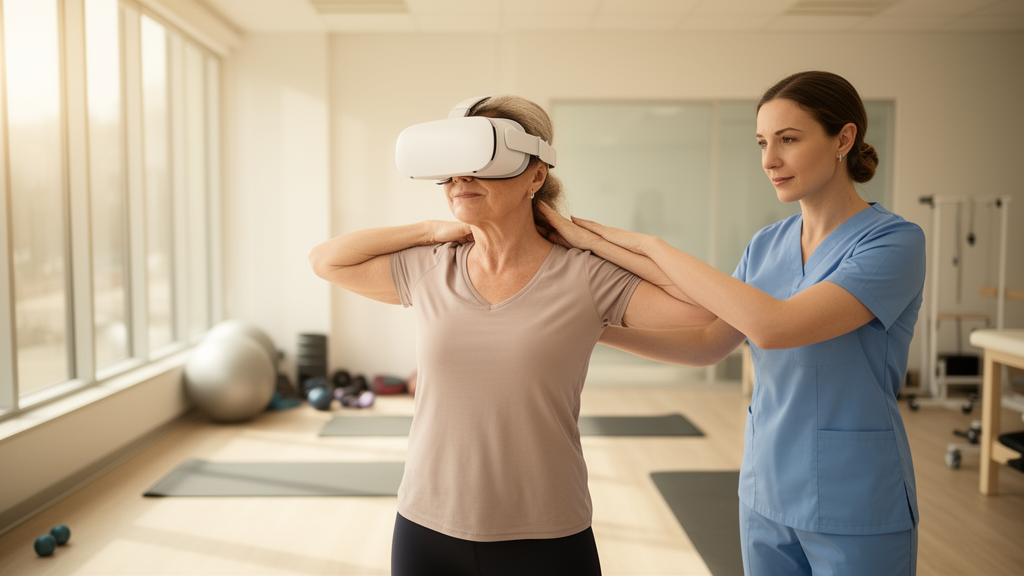
Virtual reality-based rehabilitation significantly reduced pain and disability in people with neck pain, according to a systematic review and meta-analysis of randomized controlled trials published in Frontiers in Public Health. The analysis pooled data from 11 randomized controlled trials involving 476 participants and found that patients who trained with VR-based programs reported lower pain intensity on the Visual Analogue Scale and better function on the Neck Disability Index than patients receiving alternative interventions. Trial sequential analysis further confirmed the statistical strength and reliability of these findings.
The research team, with authors affiliated with the First People's Hospital of Liangshan and West China Hospital of Sichuan University, followed PRISMA reporting guidelines and searched databases including PubMed for randomized controlled trials comparing VR-based rehabilitation with other interventions for neck pain, with the literature search extending up to October 1, 2024. The review protocol was prospectively registered with PROSPERO under registration number CRD42022334319, meaning the planned methods were documented before the results were known. The authors assessed the risk of bias in the included trials using the Cochrane Risk of Bias Tool and applied the GRADE approach to evaluate the certainty of the evidence.
The quantitative results showed consistent advantages for VR-based rehabilitation across two time windows. Within the first week, the meta-analysis of 471 patients found a mean difference of -0.70 on the Visual Analogue Scale (p = 0.01), indicating lower pain scores in the VR group, while an analysis of 411 patients found a mean difference of -3.06 on the Neck Disability Index (p < 0.0001), indicating better self-reported functional capacity. From the first week to six months, the pooled estimates remained significant: 315 patients showed a mean difference of -1.00 on the Visual Analogue Scale (p < 0.05) and 315 patients showed a mean difference of -3.81 on the Neck Disability Index (p = 0.005), both favoring VR-based rehabilitation.
Beyond pain and disability, the review also captured improvements in cervical mobility. The included trials recorded increased neck flexion and extension among patients undergoing VR-based rehabilitation, indicating that the intervention was associated with measurable gains in how far patients could move their necks. The authors note that neck pain is a widespread condition that impacts daily functioning and quality of life, and that VR technology has gained attention in rehabilitative medicine as a non-pharmacological intervention offering potential benefits for pain management.
The trial sequential analysis was employed alongside the conventional meta-analysis to ensure robustness in the conclusions, and the authors report that it confirmed the statistical strength of the observed effects. The findings position VR-based rehabilitation as a promising strategy for managing neck pain, improving both pain levels and functional capacity according to the pooled trial data. The authors conclude that VR-based rehabilitation shows promise as an effective approach, with the meta-analysis and trial sequential analysis together supporting the reliability of the observed reductions in pain and disability scores and the improvements in neck flexion and extension.
As with any meta-analysis of randomized controlled trials, the scope of the conclusion is bounded by the trials included. The pooled analyses draw on 11 trials and 476 participants, with individual outcome analyses ranging from 315 to 471 patients depending on the time point and measure, and the review compared VR-based rehabilitation with alternative interventions rather than with a single uniform control condition. The authors state that all claims expressed in the article are solely those of the authors and do not necessarily represent those of their affiliated organizations, the publisher, the editors or the reviewers, and that no product evaluated in the article is guaranteed or endorsed by the publisher.
For readers following developments in digital rehabilitation, the review offers a measured signal: across the randomized controlled trials pooled to date, VR-based rehabilitation was associated with lower pain scores on the Visual Analogue Scale, better function on the Neck Disability Index, and increased neck flexion and extension, with the benefits apparent within the first week and maintained in pooled estimates through six months. The full, formatted version of the article, including the complete GRADE certainty assessments and the detailed characteristics of the included trials, is set to be published by the journal, where the work appears as an open-access systematic review article in the section Public Health Education and Promotion.
Subject of Research: Effectiveness of virtual reality-based rehabilitation for neck pain in a systematic review and meta-analysis of randomized controlled trials
Article Title: The effectiveness of virtual reality-based rehabilitation in patients with neck pain: a systematic review and meta-analysis with trial sequential analysis of randomized controlled trials
Article References: Jike, A., Zhang, X., Liu, H., & Yu, A. (2026). The effectiveness of virtual reality-based rehabilitation in patients with neck pain: a systematic review and meta-analysis with trial sequential analysis of randomized controlled trials. Frontiers in Public Health, 14, Article 1933999. https://doi.org/10.3389/fpubh.2026.1933999
Image Credits: AI Generated
DOI: 10.3389/fpubh.2026.1933999
Keywords: virtual reality, neck pain, rehabilitation, systematic review, meta-analysis, randomized controlled trials, trial sequential analysis, Visual Analogue Scale, Neck Disability Index, pain management, cervical mobility, PRISMA
News Source: Ophelia Keating. (October 25, 2026). Virtual Reality Rehabilitation Eases Neck Pain in Meta-Analysis of 11 Trials. Scienmag.