Researchers in India have unveiled a livestock health monitoring framework that trains disease-prediction models directly on dairy farms, allowing cows’ sensor data to stay put while farms pool their intelligence. The study, published in Discover Artificial Intelligence, describes a Federated Learning and Edge-AI architecture that combines smart neck collars, low-power edge computers, lightweight messaging protocols, and a hybrid Gradient Boosting–Long Short-Term Memory prediction model. In a simulation-based federated evaluation using data from 150 dairy cows across seven districts of Punjab, the proposed FL-GBoost-LSTM model reached an accuracy of 95.12 percent, precision of 93.48 percent, recall of 88.21 percent, and an F1-score of 90.76 percent under the reported evaluation configuration. The authors stress that these figures come from simulated federated training rather than an operational field deployment, but they suggest that collaborative learning across farms can match centralized approaches without shipping raw sensor streams to a cloud server.
The work builds on the authors’ earlier centralized systems for cattle health prediction. In previous studies, an IoT-enabled Smart Neck Collar fitted with a pulse sensor, a PT100 temperature sensor, and a triaxial accelerometer continuously recorded physiological and behavioural signals from dairy cows. Classical machine learning models trained on those data showed that neural networks achieved the best traditional result, with 86.20 percent accuracy but a relatively weak F1-score of 67.68 percent. Ensemble methods pushed performance higher: Gradient Boosting reached 91.41 percent accuracy with an F1-score of 79.20 percent. The decisive step came when the researchers combined Gradient Boosting with LSTM networks and SMOTE-based class balancing in a framework called SM-BoostLSTM, which achieved 93.56 percent accuracy, 91.42 percent precision, 77.77 percent recall, and an F1-score of 84.02 percent. Those models, however, all depended on centralized cloud processing, with raw livestock data flowing continuously to remote servers.
That centralized dependence carries real costs, particularly in rural agricultural regions. The authors list a series of structural drawbacks: high communication overhead, heavy bandwidth requirements, reliance on continuous internet connectivity, increased inference latency, privacy concerns around farm and livestock data, cloud infrastructure expenses, and limited scalability across geographically separated farms. Where internet access is intermittent, a cloud-dependent monitoring system can simply stop working, leaving farmers without timely warnings about sick animals. Farmers may also hesitate to hand sensitive livestock health records and production data to third-party cloud platforms, a concern that grows as precision livestock farming generates ever more granular information about individual animals.
Federated Learning addresses these problems by inverting the data flow. Instead of moving data to a central model, the central model moves to the data. In the proposed framework, a federated aggregation server initializes a global disease-prediction model and distributes it to participating farms. Each farm trains the model locally on its own collar-derived dataset, then sends only encrypted model parameters or weight updates back to the server. The server combines these updates using Federated Averaging, the standard aggregation algorithm in which the new global model is a weighted average of local models, with each farm’s contribution proportional to the size of its training set. The updated global model is redistributed, and the cycle repeats until convergence criteria are satisfied or predefined communication rounds are completed. At no point do raw sensor readings leave the farm.
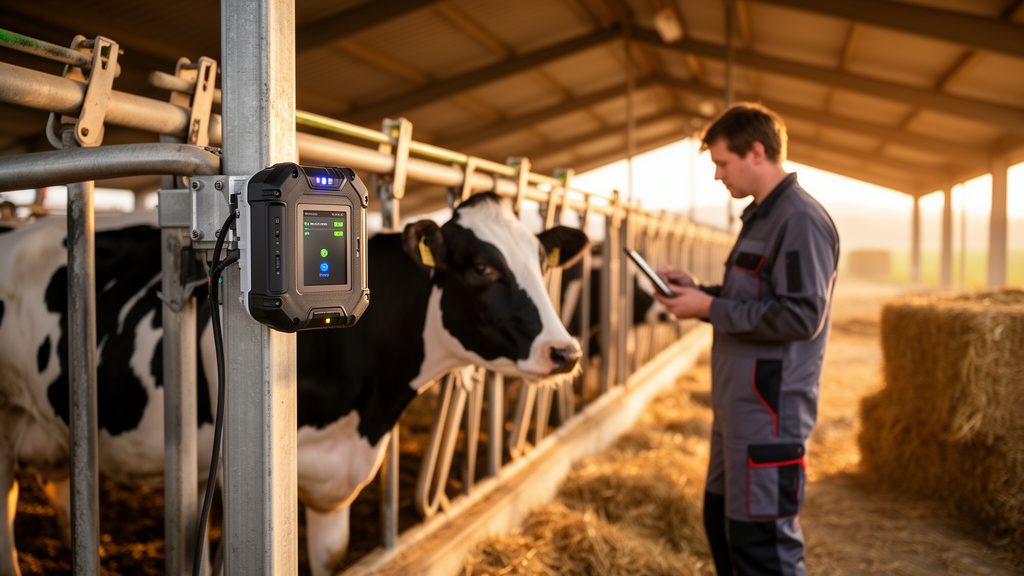
The Edge-AI component complements federated training with local inference. Each farm is equipped with an edge gateway, specified in the study as a Raspberry Pi-class device with a quad-core ARM processor, 4 GB of RAM, local SQLite storage, a TensorFlow Lite runtime, and Wi-Fi communication. The gateway handles preprocessing, missing-value handling, normalization, anomaly detection, local model training, real-time disease prediction, and alert generation. Because prediction happens on-site, the system can keep functioning during internet disruptions, a property the authors highlight as essential for rural deployments. Sensor data travel from the collars to the gateway over Bluetooth Low Energy or Wi-Fi, and the whole communication layer uses MQTT, a lightweight publish-subscribe protocol well suited to low-bandwidth environments.
The hybrid prediction model itself pairs two complementary learners. Gradient Boosting, an ensemble method that iteratively adds decision trees to correct the residual errors of previous trees, handles structured physiological features such as body temperature, pulse rate, accelerometer-derived activity measures, and movement intensity. It is well matched to noisy, nonlinear, and imbalanced tabular sensor data. The LSTM network, a recurrent architecture whose input, forget, and output gates regulate what information persists in its memory cells, models the temporal dimension: fluctuations in pulse rate, movement behaviour, feeding activity, restlessness, and physiological change over time. The outputs of both components are integrated to produce the final disease prediction, allowing the system to detect subtle temporal abnormalities that may precede severe clinical signs.
The evaluation partitioned observations from the 150 cows, monitored over a two-month period in the districts of Fatehgarh Sahib, Ludhiana, Sangrur, Patiala, Ropar, Hoshiarpur, and Nawan Shahr, into multiple virtual farm clients, each of which trained locally before federated aggregation. Preprocessing included mean-value imputation for missing readings, StandardScaler standardization, Isolation Forest outlier removal, daily time-series aggregation per cow, and health-status labelling based on veterinary thresholds and expert recommendations, with cows showing abnormal pulse rate, elevated temperature, or irregular activity categorized as unhealthy. Against the previously reported centralized baselines, the simulated FL-GBoost-LSTM model showed higher values on all four metrics, with the recall improvement from 77.77 to 88.21 percent particularly relevant, since missed abnormal-health cases are generally more consequential than false alarms. The authors caution, however, that this is a cross-study benchmark rather than a controlled head-to-head comparison, because differences in data partitioning, preprocessing, and evaluation protocols may influence the numbers.
On the communication side, the simulation-based analysis indicated that exchanging model updates instead of raw sensor streams could reduce communication overhead by roughly 68 percent compared with centralized cloud-centric processing, a figure the authors explicitly flag as requiring confirmation through large-scale deployment. They are equally careful about latency: physical inference time was not measured on a deployed Raspberry Pi, so the study claims no measured latency advantage over cloud inference, only an architecture that enables future benchmarking of latency, CPU utilization, memory, energy use, and throughput. The framework also stops short of formal privacy guarantees. Differential privacy, secure aggregation, and homomorphic encryption were not implemented, so the authors describe the system as a privacy-enhancing architecture rather than a fully privacy-preserving one.
The study is candid about its limits. Livestock datasets from different farms are likely to be non-identically distributed, reflecting differences in breed, feed, climate, and management, which can complicate federated convergence. Edge devices have constrained memory and energy budgets that may struggle with large deep learning models. The dataset of 150 cows is modest, and no large-scale operational deployment was attempted. The authors also note that the system is intended as decision support for farmers and veterinarians rather than a replacement for professional diagnosis, and that the collar was designed to be lightweight and non-intrusive so as not to interfere with the animals’ natural movement, feeding habits, or daily activities.
What the framework does offer is a template for the next generation of precision livestock farming: wearable sensing, on-farm intelligence, collaborative learning, and farmer-facing tools, including a bilingual mobile application in English and Punjabi that delivers real-time disease alerts, health reports, and probability scores. Future work will target real-world multi-farm deployment, systematic non-IID evaluation, formal privacy mechanisms, TinyML optimization for resource-constrained devices, and comprehensive benchmarking of computational, communication, and energy requirements. The authors also point to possible additions such as thermal imaging sensors, GPS-based livestock tracking, rumination microphones, and transformer-based prediction models. If those steps succeed, the architecture could evolve toward a digital-twin ecosystem for autonomous livestock healthcare, one in which a farmer’s herd data never need to leave the farm to benefit from collaborative model learning.
Subject of Research: Federated learning and edge AI for distributed livestock health monitoring in dairy cattle
Article Title: A Federated Edge Artificial intelligence (Edge-AI) Framework For Livestock Health Monitoring
Article References: Kaur, D. (2026). A Federated Edge Artificial intelligence (Edge-AI) Framework For Livestock Health Monitoring. Discover Artificial Intelligence, 6(1), Article 1629. https://doi.org/10.1007/s44163-026-02350-5
Image Credits: AI Generated
DOI: 10.1007/s44163-026-02350-5
Keywords: federated learning, edge AI, precision livestock farming, dairy cattle, smart neck collar, disease prediction, Gradient Boosting, LSTM, MQTT, Raspberry Pi, data privacy, Punjab India
News Source: Alan Morgan. (October 25, 2026). Federated Edge AI Keeps Dairy Cow Health Data on the Farm While Predicting Disease. Scienmag.