More than three million hip and knee replacements had been logged in the German Arthroplasty Registry by the end of 2024, and a striking share of the revision operations that followed traced back to a single culprit: aseptic loosening. The registry data show that this failure mode accounted for 21.0 percent of hip and 21.8 percent of knee revision surgeries, making it the most prevalent reason patients are forced back into the operating theatre. A new review published in Frontiers in Bioengineering and Biotechnology argues that the way the field evaluates implant surfaces may be part of the problem. A team from University Medicine Greifswald, Materion GmbH and the Produktionstechnologie-Institut WAVE gGmbH contends that titanium implants succeed or fail not merely through how much bone grows onto them, but through a far more intricate interplay involving immune cells, bone-resorbing cells and the coordinated process of bone remodelling.
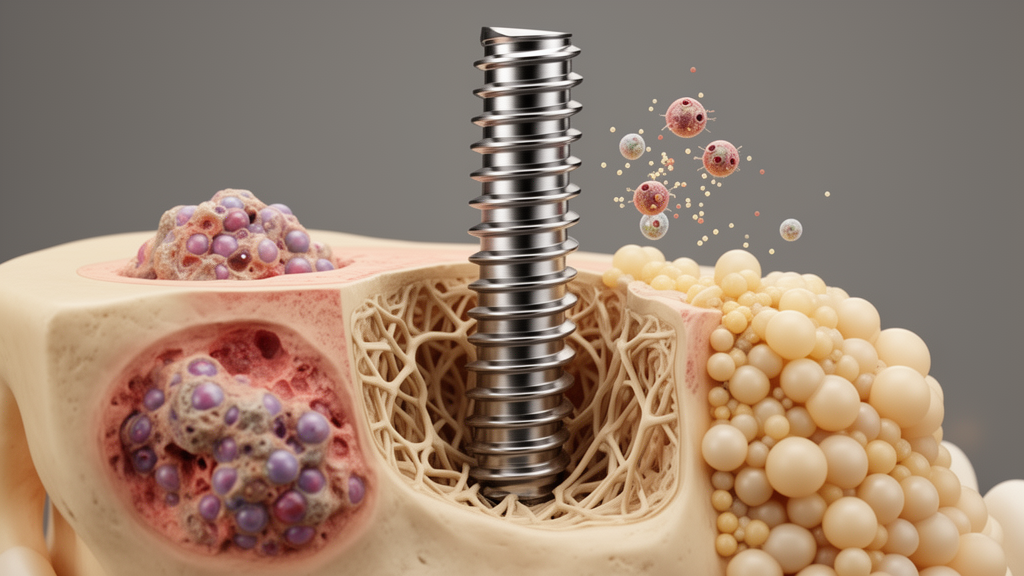
Titanium and its alloys, most famously Ti6Al4V, dominate musculoskeletal surgery because they pair a high strength-to-weight ratio with favourable fatigue performance, corrosion resistance and acceptable biocompatibility. Yet these alloys are essentially bioinert. They support tissue contact mainly through surface-mediated interactions and have limited ability to form direct chemical bonds with surrounding bone unless the surface is activated first. Wear, corrosion and ion release in bodily fluids add further engineering and biological limitations. Infection, peri-implant inflammation, wear-debris-induced osteolysis and insufficient osseointegration can all undermine long-term implant survival. The Greifswald-led team therefore treats the implant surface not as a passive structural boundary but as the first biological interface, one that actively governs bone remodelling and subsequent implant ingrowth.
The review’s central conceptual move is to reframe how surface cues are read by the body. After implantation, plasma proteins rapidly adsorb onto the implant and form a protein-conditioned layer, and the composition of that layer is dictated by surface properties such as roughness, wettability, surface oxide chemistry and coating composition. These parameters determine not only the quantity of adsorbed proteins but also their spatial distribution, conformation and bioavailability. In other words, material surface cues are first translated into a biological coating before any cell arrives. Incoming cells then interact mainly with this provisional protein layer rather than the bare titanium, using integrin-mediated recognition and downstream focal-adhesion signalling to initiate interfacial tissue integration. Early events such as protein adsorption, cell adhesion, proliferation and osteogenic marker expression, the authors stress, are merely initial steps that cannot reliably predict long-term implant stability.
Macrophages emerge as the central regulators of this process. Following the initial neutrophil-dominated inflammatory response, monocyte-derived macrophages become the predominant immune regulators at the implant interface and shape the early cytokine environment. Tissue-resident bone macrophages, known as osteomacs, support bone formation by secreting osteogenic growth factors while regulating the extracellular matrix. In vitro studies have shown that macrophage-conditioned media can alter the osteogenic differentiation of mesenchymal stromal cells, and macrophage-derived mediators such as interleukin-10 and oncostatin M enhance MSC osteogenic responses under specific experimental conditions. In vivo, macrophage depletion leads to persistent neutrophil accumulation, reduced local T cell and MSC numbers, and impaired biomaterial integration. Osteomacs also maintain homeostasis through efferocytosis, the phagocytic removal of apoptotic osteoblasts; if apoptotic cells are not efficiently cleared, their released contents can trigger local inflammation and disrupt orderly remodelling.
Macrophages also control the other half of the remodelling equation. Beyond serving as osteoclast precursors, they regulate osteoclastogenesis through their polarization state, RANKL signalling, the inflammatory environment and phagocytic feedback. Pro-inflammatory M1 macrophages enhance osteoclast differentiation by increasing RANKL expression and pro-inflammatory cytokine production, thereby promoting bone resorption, whereas M2 macrophages inhibit osteoclastogenesis through anti-inflammatory mediators. Crucially, osteoclasts are not simply destructive agents. They secrete factors that regulate osteoblast recruitment, differentiation and bone formation, coupling controlled resorption with osteogenesis. Evidence from high-turnover bone models, including osteoprotegerin-deficient and RANKL-transgenic mice, shows that enhanced osteoclast activity is accompanied by increased bone formation, possibly because osteoclast-derived leukemia inhibitory factor suppresses sclerostin in osteocytes, releasing the brakes on Wnt/β-catenin signalling.
Different cell lineages interpret the same implant surface in strikingly different ways. Osteoblasts recognize adsorbed matrix proteins through α1β1, α2β1 and α5β1 integrins, activating focal adhesion kinase and downstream ERK1/2 and AKT networks; F-actin remodelling then amplifies cytoskeletal tension to drive nuclear translocation of YAP, ultimately dictating osteogenic marker expression. Macrophage responses, by contrast, are bidirectional and context-dependent. Some literature indicates that rough surfaces can activate NF-κB-mediated pro-inflammatory signalling through cell membrane deformation and integrin reorganization, polarizing macrophages toward an M1 phenotype, while relatively smooth surfaces limit cell spreading and cytoskeletal tension, conditions associated with pro-reparative M2 polarization. Wettability adds a further twist: hydrophilic surfaces enhance specific albumin adsorption and favour anti-inflammatory environments, yet superhydrophobic surfaces can restrict cell spreading so severely that macrophages form three-dimensional spheroids, similarly guiding M2 polarization. A surface that supports osteoblast adhesion may still trigger an adverse macrophage response.
Against this backdrop, the review uses two exemplars to delineate topographical versus physicochemical surface engineering. Electrical discharge machining is a non-traditional electro-thermal process that uses controlled sparks within a dielectric medium to induce localized thermal erosion. Each discharge causes melting, evaporation and rapid re-solidification, generating a distinct modified layer in situ. For titanium alloys, EDM can produce a crater-like microporous topography with arithmetic mean roughness values reported between 10.8 and 17.6 micrometres, promote the incorporation of oxide or carbide phases, and significantly alter wettability and microhardness. Untreated Ti-6Al-4V shows a static contact angle of about 30 degrees, while EDM-treated surfaces drop to between 0 and 17.8 degrees, indicating strongly improved hydrophilicity. But the process demands careful balancing: higher pulse current and discharge duration promote recast-layer formation and microhardness while also increasing microcracks, blowholes and pitting, and overly thick white layers with micro-cracks are linked to lower fatigue strength and long-term stability risks.
The biological evidence for EDM surfaces is largely osteogenic. Across studies, EDM-modified Ti6Al4V has been associated with improved osteoblast proliferation, enhanced fatigue resistance and no overt cytotoxicity. Wire-cut EDM crater-like microtopography with submicron structures promotes early osteoblast adhesion but inhibits late-stage proliferation while significantly upregulating osteogenic genes. Higher discharge parameters enhanced alkaline phosphatase activity, osteogenic cell growth and nodule formation, and rougher EDM surfaces produced at higher currents increased ALP and osteocalcin levels. Mechanistic clues come from primary osteoblasts, where the amorphous TiO2 layer generated by EDM may upregulate the protein Hic-5 and osteogenic gene expression, participating in collagen crosslinking and matrix maturation. Whether specific EDM features influence osteoimmune crosstalk and coordinated remodelling, however, remains largely unknown, and the authors call for studies of RANKL/OPG signalling and secretome profiling before broad orthopaedic application.
Diamond-like carbon coatings take the physicochemical route instead. DLC is an amorphous carbon film containing mixed sp2- and sp3-hybridized bonds, with properties between graphite and diamond; its hardness, inertness, wear resistance and friction depend on the sp3/sp2 ratio, hydrogenation and doping. Rather than generating micro-scale craters, DLC functions as a thin interface that changes the outermost chemistry, surface energy, tribological behaviour and ion-barrier properties of the implant. Its protective credentials are dramatic: the wear rate of untreated Ti-6Al-4V falls from 4.30 × 10⁻⁴ to 2.97 × 10⁻⁸ cubic millimetres per newton per metre after DLC treatment, roughly a ten-thousand-fold reduction. By curbing wear debris, corrosion products and metal ion release, DLC may indirectly dampen chronic inflammation and the foreign-body response. Its Achilles heel is adhesion: a higher sp3 fraction improves hardness and wear resistance but raises intrinsic residual stress, compromising coating adhesion, and delamination risk in physiological fluids under mechanical loading has limited orthopaedic use.
DLC’s biological record hints that structure shapes immunity and remodelling alike. A lower ID/IG Raman ratio, indicating a more sp3-rich structure, coincided with improved cell adhesion, and DLC films with reduced sp2/sp3 ratios promoted a more anti-inflammatory cytokine profile, suggesting that a denser, highly cross-linked carbon network suppresses pro-inflammatory signalling. Hydrogenated DLC surfaces increased type I collagen mRNA in osteoblasts while suppressing tartrate-resistant acid phosphatase mRNA in osteoclast precursors, a rare direct glimpse of remodelling modulation. In an ovine implantation model, silicon-doped DLC involved macrophage responses without triggering a clear systemic pro-inflammatory disturbance, and in a tendon adhesion model, PLA/DLC membranes reduced ROS production, inhibited NF-κB activation and M1 polarization. Elemental doping with copper or phosphorus adds antimicrobial and electrochemical protection alongside improved osteoblastic cytocompatibility.
The review’s verdict is sobering but constructive. Current evidence for both EDM and DLC remains focused on conventional osteogenic endpoints, while direct data on macrophage and other immune-cell responses are still scarce. If a surface enhances osteoblast activity yet inadvertently activates pro-inflammatory macrophages or promotes osteoclast-mediated resorption, it could still lead to chronic inflammation or fibrous encapsulation. The authors therefore propose combining the two strategies as a promising interface-design concept, while cautioning that engineering complementarity does not automatically imply biological synergy. A hybrid EDM/DLC surface would need full re-characterization, including DLC adhesion and mechanical stability on EDM-modified substrates, residual thermal stresses, protein conditioning, osteoblast activity, macrophage phenotype, cytokine secretion and osteoclast resorption. The ultimate goal is not simply a better surface but a remodelling-informed evaluation framework, one that integrates immune cells, osteoclasts and bone formation-resorption coupling to rationally guide the design of titanium implants for durable long-term osseointegration.
Subject of Research: Osteoimmunological evaluation of EDM-textured and diamond-like carbon-coated titanium implant surfaces for osseointegration and bone remodelling
Article Title: Remodelling-informed evaluation of electrical discharge machining-textured and diamond-like carbon-coated titanium implants
Article References: Zhang, C., Schoon, J., Wienecke, M., Heeg, J., Schimmelpfennig, T.-M., Rickerts, L. M., Wassilew, G., & Schulze, F. (2026). Remodelling-informed evaluation of electrical discharge machining-textured and diamond-like carbon-coated titanium implants. Frontiers in Bioengineering and Biotechnology, 14, Article 1954906. https://doi.org/10.3389/fbioe.2026.1954906
Image Credits: AI Generated
DOI: 10.3389/fbioe.2026.1954906
Keywords: titanium implants, osseointegration, bone remodelling, osteoimmunology, electrical discharge machining, diamond-like carbon, macrophages, osteoclasts, implant surfaces, aseptic loosening, surface engineering, biomaterials
News Source: Denise Maddox. (October 24, 2026). Titanium Implant Surfaces Reassessed Through Bone Remodelling and Osteoimmunology. Scienmag.