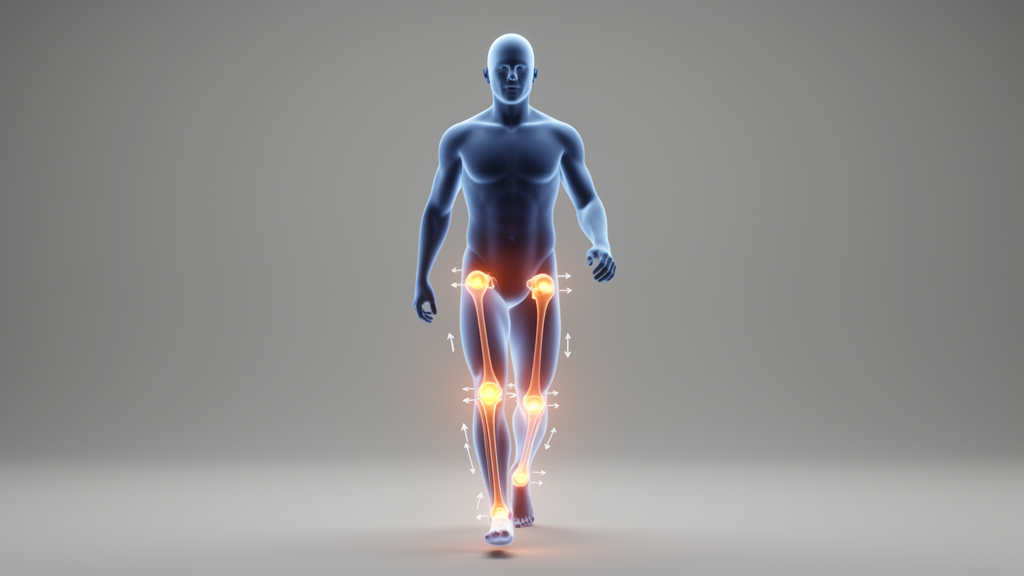
Walking after a stroke often shows a recognizable signature: the affected leg pushes off weakly, the two legs take steps of different lengths, and the body’s center of mass moves in an altered rhythm. A new modeling and analysis study published in Annals of Biomedical Engineering argues that these features are not simply failures of the damaged side, but mechanical adaptations that follow a predictable logic. Seyed-Saleh Hosseini-Yazdi, Karson Fitzsimons and John E. A. Bertram combined a simple powered walking model with a center-of-mass power and work analysis to ask how a unilateral loss of push-off reorganizes mechanical work across the gait cycle.
The starting point is the classical idea that each step requires work to redirect the body’s center of mass from one pendular arc to the next. In able-bodied walking, this step-to-step transition is handled largely by the trailing limb’s late-stance push-off, and the center of mass displays a characteristic four-phase power pattern. In hemiparetic gait, the paretic limb’s contribution to this transition is severely reduced, and the mechanical consequences had remained unclear. The researchers built a minimal model in which one limb can deliver reduced push-off and used it to predict how the remaining work should be redistributed.
The model’s central prediction is a threshold behavior. As long as paretic push-off stays above roughly 25 percent of the optimal level, the system compensates mainly after the step-to-step transition, restoring energy in the early stance of the following step. Once push-off falls below that threshold, the predicted strategy flips: compensation shifts to before the transition, through energy induction in advance, and a shortened paretic step length becomes mechanically favorable rather than merely a symptom of weakness. The empirical data showed the same pattern, with paretic step length remaining disproportionately short relative to walking speed.
The extremes of the model clarify what happens when push-off is effectively absent. With no paretic late-stance push-off, positive work emerges in early stance instead, and the vertical motion of the center of mass collapses to a single pendular oscillation per stride. As even limited paretic push-off returns, the center of mass undergoes two pendular motions per stride, and the four-phase power structure seen in able-bodied walking reappears. The analysis also found that reduced single-support duration and limited paretic positive work capacity constrain step length, which increases step length asymmetry and energy dissipation during stance.
The work balance across the two legs is strikingly asymmetric. Across the speeds examined, the paretic limb’s net work on the center of mass remained negative, while the nonparetic limb consistently performed positive net work. In other words, the sound side does more than carry the body forward; it appears to absorb the energetic burden that the impaired side can no longer supply at the transition.
The authors frame hemiparetic walking as a constrained optimization problem. Under this view, the shortened steps and the redistribution of work across phases of the gait cycle can be read as mechanically sensible responses to impaired transition mechanics, rather than random impairments. The findings extend classical step-to-step transition and total step work theories, developed for healthy walking, into the domain of pathological gait, and suggest that the degree of push-off loss determines which compensatory regime the nervous and musculoskeletal systems settle into.
Subject of Research: Mechanistic Reorganization of Step Work in Hemiparetic Walking: Modeling and Center-of-Mass Power/Work Analysis
Article Title: Mechanistic Reorganization of Step Work in Hemiparetic Walking: Modeling and Center-of-Mass Power/Work Analysis
Article References: Hosseini-Yazdi, S.-S., Fitzsimons, K., & Bertram, J. E. A. (2026). Mechanistic Reorganization of Step Work in Hemiparetic Walking: Modeling and Center-of-Mass Power/Work Analysis. Annals of Biomedical Engineering. https://doi.org/10.1007/s10439-026-04428-8
Image Credits: AI Generated
DOI: 10.1007/s10439-026-04428-8
Keywords: Mechanistic, Reorganization, Step, Work, Hemiparetic, Walking, Modeling, Center-of-Mass, Power, Analysis, scientific research
News Source: Cassandra Pierce. (October 24, 2026). Stroke Gait Changes Explained as a Mechanical Optimization Problem. Scienmag.