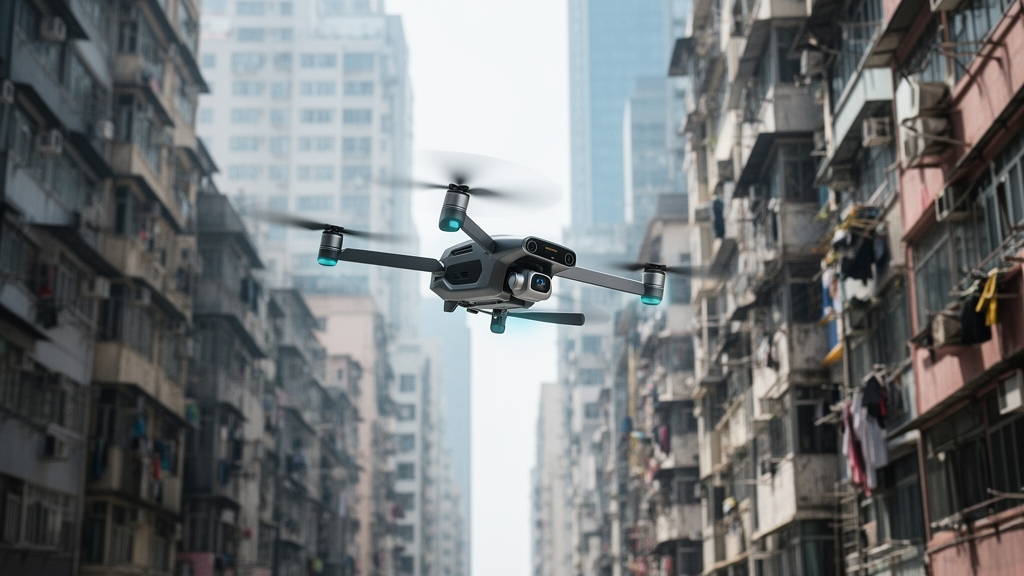
Researchers have developed a reinforcement learning method that lets unmanned aerial vehicles autonomously avoid obstacles in cluttered environments, and it outperformed established algorithms in simulated tests. The approach, called FA-PPO—feature-wise adaptive fusion proximal policy optimization—is described in a study published in the International Journal of Machine Learning and Cybernetics. In evaluations against three widely used baselines, FA-PPO was the only method tested that completed the autonomous obstacle-avoidance task in all three simulated scenarios.
Safe flight in dense environments depends on combining navigation information with environmental perception, and the new method is built around that principle. The researchers organized the drone’s observation space into three structured components: target-relative information, the UAV’s own motion state, and regularized geometric observations from light detection and ranging (LiDAR). Two modality-specific encoders then separately extract navigation-state features and LiDAR features from this input, keeping the two information streams distinct before they are combined.
The key innovation lies in how those features are fused. An observation-conditioned feature-wise weighting mechanism dynamically recalibrates individual latent features before policy optimization, allowing the system to adjust how much weight it gives to different pieces of information depending on the situation the drone faces. The learned policy outputs continuous three-axis velocity commands directly, giving the drone a smooth control signal rather than discrete decisions.
To test the method, the team ran simulations in three static-obstacle scenarios of increasing complexity, comparing FA-PPO against proximal policy optimization (PPO), soft actor–critic (SAC), and deep deterministic policy gradient (DDPG). Among the baselines, PPO achieved the highest maximum training reward, making it the strongest competitor. FA-PPO improved on that metric by 1.4 percent in the first scenario, 11.4 percent in the second, and 19.7 percent in the third, with the gains growing larger as environmental complexity increased.
Ablation experiments, in which components of the system are removed to test their contribution, confirmed that the feature-wise adaptive fusion mechanism was responsible for the performance advantage. FA-PPO also showed more stable reward convergence during training than the comparison methods, and the trajectories and forward-velocity profiles it produced were smoother than those of the baseline algorithms.
The authors indicate that the results demonstrate advantages in heterogeneous feature utilization and policy learning, pointing to potential applications for LiDAR-equipped UAVs in inspection, patrol missions, and autonomous navigation through cluttered static-obstacle environments. Because the evaluation was conducted entirely in simulation across static-obstacle settings, performance in dynamic or real-world conditions remains to be demonstrated, but the consistent improvement with rising complexity suggests the fusion mechanism becomes more valuable precisely where obstacle avoidance is hardest.
Subject of Research: A feature-wise adaptive fusion proximal policy optimization method for autonomous UAV obstacle avoidance using LiDAR and navigation features
Article Title: An autonomous obstacle-avoidance method for unmanned aerial vehicles based on FA-PPO
Article References: Zheng, J., Ma, M., Chen, Z., Gao, Y., & Ou, Y. (2026). An autonomous obstacle-avoidance method for unmanned aerial vehicles based on FA-PPO. International Journal of Machine Learning and Cybernetics, 17(11), Article 508. https://doi.org/10.1007/s13042-026-03349-1
Image Credits: AI Generated
DOI: 10.1007/s13042-026-03349-1
Keywords: UAV, obstacle avoidance, reinforcement learning, PPO, LiDAR, feature fusion, autonomous navigation, soft actor-critic, DDPG, drone flight control, simulation, machine learning
News Source: Denise Maddox. (October 24, 2026). FA-PPO Method Helps Drones Dodge Obstacles in Cluttered Skies. Scienmag.