• HOME
  • NEWS
  • EXPLORE
    • CAREER
      • Companies
      • Jobs
    • EVENTS
    • iGEM
      • News
      • Team
    • PHOTOS
    • VIDEO
    • WIKI
  • BLOG
  • COMMUNITY
    • FACEBOOK
    • INSTAGRAM
    • TWITTER
Saturday, October 24, 2026
BIOENGINEER.ORG
No Result
View All Result
  • Login
  • HOME
  • NEWS
  • EXPLORE
    • CAREER
      • Companies
      • Jobs
        • Lecturer
        • PhD Studentship
        • Postdoc
        • Research Assistant
    • EVENTS
    • iGEM
      • News
      • Team
    • PHOTOS
    • VIDEO
    • WIKI
  • BLOG
  • COMMUNITY
    • FACEBOOK
    • INSTAGRAM
    • TWITTER
No Result
View All Result
Bioengineer.org
No Result
View All Result
Home NEWS Science News Health

Predicting the incidence of type 2 diabetes using FINDRISC and machine learning approaches: evidence from a population-based cohort

by
October 24, 2026
in Health
Reading Time: 2 mins read
0
Predicting the incidence of type 2 diabetes using FINDRISC and machine learning approaches: evidence from a population-based cohort

Predicting the incidence of type 2 diabetes using FINDRISC and machine learning approaches: evidence from a population-based cohort

Share on FacebookShare on TwitterShare on LinkedinShare on RedditShare on Telegram

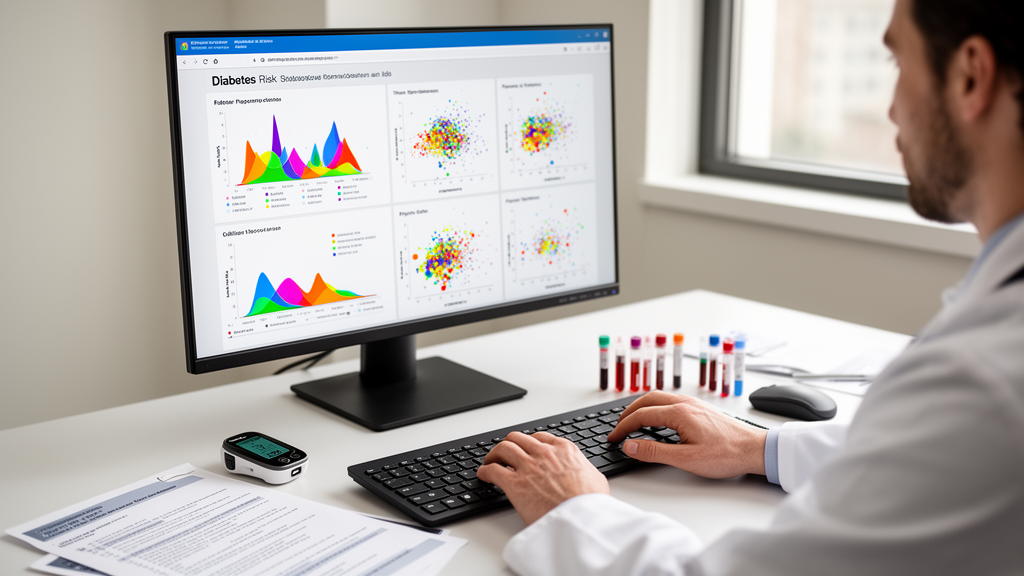
A large population-based cohort study has compared the established FINDRISC questionnaire with several machine learning algorithms for predicting who will develop type 2 diabetes. The research, published in BMC Endocrine Disorders, followed 8,859 participants with complete six-year follow-up data, during which 525 new cases of type 2 diabetes occurred, corresponding to a six-year incidence of 6.0 percent. FINDRISC, the Finnish Diabetes Risk Score, is a non-invasive screening questionnaire, and the study set out to compare its aggregate score with component-level machine learning models in the same cohort.

The investigators evaluated two complementary strategies. The first relied on the aggregate FINDRISC score as a single predictor, analyzed with conventional logistic regression. The second used the questionnaire’s individual items as features for four machine learning algorithms: decision tree, random forest, support vector machine, and artificial neural network. Model discrimination was assessed with the AUC-ROC, and calibration was examined using decile-based calibration plots and the Hosmer–Lemeshow test. To address class imbalance, the researchers applied SMOTE strictly within training folds during cross-validation.

The aggregate FINDRISC score achieved an AUC of 0.76, with a 95 percent confidence interval of 0.74 to 0.79, which the authors describe as acceptable discrimination for predicting six-year incident type 2 diabetes. When the questionnaire’s components were modeled individually using continuous anthropometric features, random forest achieved the highest observed discriminative performance, with an AUC of 0.81 and a 95 percent confidence interval of 0.79 to 0.83.

The study also examined screening thresholds for the FINDRISC score. A threshold greater than 12 yielded the highest Youden index, at 0.41, with sensitivity of 73.0 percent and specificity of 68.4 percent. A lower threshold, greater than 11, offered higher sensitivity of 78.9 percent but lower specificity of 61.1 percent.

The authors conclude that although the component-level machine learning models yielded higher observed AUCs in internal validation, the clinical significance of these modest differences remains uncertain. They note that further assessment of calibration, clinical utility, and external validation is needed, and that the standard FINDRISC therefore remains the practical tool for primary care screening. As a prospective population-based cohort analysis with internal validation, the study’s findings apply to the population studied, and the reported performance figures carry the uncertainty indicated by their confidence intervals.

Subject of Research: Comparative prediction of six-year type 2 diabetes incidence using the FINDRISC score and machine learning algorithms in a population-based cohort

Article Title: Predicting the incidence of type 2 diabetes using FINDRISC and machine learning approaches: evidence from a population-based cohort

Article References: Hamedi, A., Seif, M., Sharifi, M. H., Rezaianzadeh, A., Lashkardoost, H., & Hassanzadeh, J. (2026). Predicting the incidence of type 2 diabetes using FINDRISC and machine learning approaches: evidence from a population-based cohort. BMC Endocrine Disorders. https://doi.org/10.1186/s12902-026-02683-3

Image Credits: AI Generated

DOI: 10.1186/s12902-026-02683-3

Keywords: type 2 diabetes, FINDRISC, machine learning, random forest, risk prediction, population-based cohort, screening, AUC-ROC, logistic regression, incidence, Predicting, type

News Source: Teresa Odom. (October 24, 2026). Predicting the incidence of type 2 diabetes using FINDRISC and machine learning approaches: evidence from a population-based cohort. Scienmag.


Tags: AUC-ROCFINDRISCincidencelogistic regressionMachine Learningpopulation-based cohortPredictingRandom Forestrisk predictionscreeningtypeType 2 diabetes
Share12Tweet7Share2ShareShareShare1

Related Posts

Chinese Version of Needlestick Injury Prevention Beliefs Scale Proves Reliable for Nurses

Chinese Version of Needlestick Injury Prevention Beliefs Scale Proves Reliable for Nurses

October 24, 2026
District-Level Data Unite Malaria Burden and Vector Control in Tanzania

District-Level Data Unite Malaria Burden and Vector Control in Tanzania

October 24, 2026

Dengue Surge in Rohingya Refugee Camps Grows Larger but Slower Each Year

October 24, 2026

Rare primitive neuroectodermal tumor of the uterus diagnosed through molecular exclusion

October 24, 2026

POPULAR NEWS

  • When Cancer Immunotherapy Turns on the Heart

    When Cancer Immunotherapy Turns on the Heart

    29 shares
    Share 12 Tweet 7
  • Predicting the incidence of type 2 diabetes using FINDRISC and machine learning approaches: evidence from a population-based cohort

    29 shares
    Share 12 Tweet 7
  • Chinese Version of Needlestick Injury Prevention Beliefs Scale Proves Reliable for Nurses

    29 shares
    Share 12 Tweet 7
  • Satellites and ground stations expose hidden methane gaps across Europe

    29 shares
    Share 12 Tweet 7

About

We bring you the latest biotechnology news from best research centers and universities around the world. Check our website.

Follow us

Recent News

When Cancer Immunotherapy Turns on the Heart

Predicting the incidence of type 2 diabetes using FINDRISC and machine learning approaches: evidence from a population-based cohort

Chinese Version of Needlestick Injury Prevention Beliefs Scale Proves Reliable for Nurses

Subscribe to Blog via Email

Enter your email address to subscribe to this blog and receive notifications of new posts by email.

Join 85 other subscribers
  • Contact Us

Bioengineer.org © Copyright 2023 All Rights Reserved.

Welcome Back!

Login to your account below

Forgotten Password?

Retrieve your password

Please enter your username or email address to reset your password.

Log In
No Result
View All Result
  • Homepages
    • Home Page 1
    • Home Page 2
  • News
  • National
  • Business
  • Health
  • Lifestyle
  • Science

Bioengineer.org © Copyright 2023 All Rights Reserved.