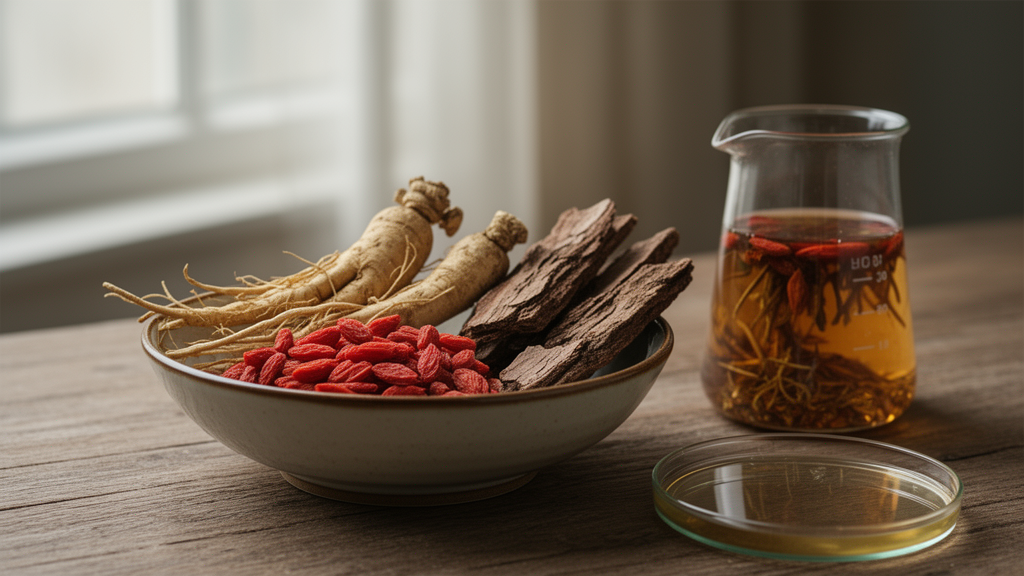
Chinese herbal medicine is widely used in China for recurrent urinary tract infection, often dispensed as damp-heat-clearing formulae during symptomatic phases and deficiency-supporting formulae during remission. A critical review from Beijing Tsinghua Changgung Hospital, published in Frontiers in Pharmacology, has now examined whether any defined preparation can be shown to prevent recurrent bacterial cystitis in women, and whether reported benefits connect to the underlying biology of recurrence. The authors’ conclusion is carefully worded: the evidence is inconclusive rather than uniformly negative, and it supports cautious hypothesis generation for specific preparations, but it does not justify a class-wide claim of efficacy or safety. Across ten clinical study clusters that directly addressed prospective recurrence or suppressive treatment, every comparative estimate was judged to be of very low confidence.
The review was not a formal systematic review but a structured search and report-level evidence mapping. The team searched PubMed, the China National Knowledge Infrastructure, and Wanfang Data up to 13 July 2026, then linked 103 report records into 96 study or unresolved-report clusters, corresponding to an estimated 91 to 95 provisional independent studies. Ten clusters were classified as core evidence, meaning they involved nonpregnant adult women with recurrent bacterial cystitis, a prospectively assigned herbal intervention, and an extractable prospective recurrence or suppressive-treatment outcome. Forty-two clusters were supporting, thirty-nine peripheral, and five excluded. Confidence was appraised narratively across domains including allocation, participant flow, recurrence ascertainment, denominator integrity, comparator identity, and safety reporting. No core cluster escaped either one critically compromised domain or at least two serious limitations.
The clinical landscape explains why caution is warranted. A 2024 meta-analysis pooled 22 randomized trials and 1,934 participants and reported adjunctive signals during treatment and follow-up, but its interventions and populations were heterogeneous, its analyses were largely per protocol, and it offered no study-level risk-of-bias synthesis. An earlier Cochrane review covering seven trials and 542 women judged all trials to be at high risk of bias and rated the evidence as very low quality. The compatible reading, the review’s authors argue, is not established class-wide efficacy but the existence of formula-specific signals embedded in a clinically and methodologically fragile literature. Because Chinese herbal medicine spans commercial polyherbal tablets, hospital preparations, modified classical formulae, and individualized prescriptions, a result for one formulation cannot be generalized to the category as a whole.
Some trials were comparatively well described. A randomized double-blind double-dummy trial of a modified Bazheng formula in 122 women reported 5 versus 7 recurrences across 61 participants per arm over six months, a difference that was not statistically significant. Yet only 48 and 50 participants remained in the recurrence analysis, the outcome was further restricted to recovered participants, missing data were handled inconsistently, and no non-inferiority margin or confidence interval was prespecified, so the trial cannot support a claim of non-inferiority to antibiotic prophylaxis. A multicenter study of individualized herbal medicine enrolled 300 women but analyzed only 230 completers, used a one-tenth-dose herbal comparator never shown to be pharmacologically inert, and did not report arm-level adverse events. A United Kingdom feasibility trial showed that standardized and individualized herbal products could be manufactured under good-manufacturing-practice conditions and delivered within a regulated primary-care framework, but it was not powered for efficacy, and its individualized comparison was invalidated when prescriptions intended as placebo were found to contain roughly 70 to 80 percent active botanical drugs.
Publication integrity problems compound the fragility. The most directly extractable data for Sanjin tablets came from a 2008 three-arm study of 95 women in remission: over six months of suppressive treatment, recurrence occurred in 12 of 32 participants on Sanjin, 13 of 31 on rotating low-dose antibiotics, and 4 of 32 on the combination. Sanjin alone did not outperform antibiotic suppression, and the lower rate in the combination arm remains an adjunctive signal from a small open study. A 2011 Sanjin maintenance study stated that 68 participants were enrolled while its groups contained 30 and 28; the reported P value below 0.01 is incompatible with the implied counts of 2 of 30 versus 4 of 28, which recalculation shows are not significant. A 2019 paper reproduced the title, protocol structure, statistical language, discussion, and references of a 2017 trial of Er Ding Er Xian and Zi Shen Qing Li while changing authors, institutions, and sample size, and was therefore not counted as independent replication. That 2017 trial itself reported post-treatment recurrence only among participants who had remained recurrence-free during treatment, a responder-conditioned denominator rather than an intention-to-treat estimate.
Other direct signals share similar defects. The Zhuolin granule program, spanning a doctoral thesis, a clinical article, and a linked gut-microbiome paper, suggested fewer recurrences among 120 postmenopausal women, but rates were calculated after losses and among post-randomization responders, and the microbiome substudy contained only five and four post-treatment stool samples per group without testing mediation. Fuzheng Qingre Lishi reported 4 of 31 versus 11 of 31 recurrences, yet the parent report stated one sample size while its outcome denominators implied another. Two reports of a staged regimen using modified Yinqiao Bazheng San during acute treatment followed by modified Zhibai Dihuang Tang after antibiotic withdrawal reported 0 of 27 versus 4 of 27 and 0 of 46 versus 6 of 46 recurrences. Recalculation of the first count yields a two-sided P value of approximately 0.111, unsupported by the stated claim of P below 0.05, and the second study allocated participants by treatment plan rather than randomization. Modified Gualou Qumai Wan was associated with 2 of 40 versus 9 of 40 recurrences, but both groups received intensive antibiotic co-treatment and culture-defined recurrence was not established.
Against this backdrop, the review situates what is known about recurrence biology. Recurrent urinary tract infection is not biologically uniform: an episode may represent reinfection with a different strain or re-emergence of the same strain from intestinal, vaginal, urinary, intracellular, or tissue-associated reservoirs. In mice, uropathogenic Escherichia coli forms intracellular bacterial communities and quiescent intracellular reservoirs that survive apparent urine sterilization and later re-emerge; filamentous bacteria have been detected in urine from a subset of women with acute cystitis, and bladder-wall bacteria were visualized in a highly selected cohort of postmenopausal women with refractory disease. Longitudinal multi-omics sampling in women with a history of recurrent infection has identified gut ecological and immune differences, with UTI-associated strains often persisting in the gut despite antibiotics. Mouse studies further suggest that a Th2-skewed bladder response may favor epithelial repair at the expense of protective clearance, and that infection history can imprint persistent urothelial stem-cell states. These frameworks establish plausibility, not proof that every human recurrence follows one route.
The experimental pharmacology is more rigorous in places but rarely models recurrence. An aqueous Persicaria capitata extract, chemically characterized by tentative profiling of 78 constituents and validated quantification of gallic acid, protocatechuic acid, quercitrin, and quercetin, did not directly inhibit uropathogenic E. coli growth at tested concentrations while altering motility, fimbrial and flagellar structure, and adhesion or invasion in bladder epithelial cells. Cynaroside, a purified flavonoid, similarly reduced motility, biofilm-associated phenotypes, and expression of the virulence genes fimH, papG, and fliC, and provided the review’s strongest cell-level causal evidence: CAV1 knockdown attenuated its anti-adhesion and barrier effects, while expression of an siRNA-resistant CAV1 construct partially restored them. Yet both rat studies began dosing two days before a single intravesical challenge, and none of the reviewed experiments incorporated antibiotic clearance followed by spontaneous relapse, strain-resolved gut-to-bladder reseeding, or reactivation of a quiescent reservoir. A change in an acute virulence readout is neither a validated predictor of human recurrence nor evidence of reservoir eradication.
Product characterization emerged as a decisive weakness. Many clinical reports used traditional drug names without accepted botanical names, medicinal parts, processing, manufacturer, batch number, chemical fingerprint, or voucher specimens. The Yinhua Miyanling Tablet report supplied a finished-product lot and a six-batch HPLC similarity assessment but contained internal conflicts, mapping one botanical drug to an unrelated plant species and describing a seed drug as stems and leaves. The review also flags a control-design concern: the one-tenth-dose herbal preparations used as putative placebos in two trials were never demonstrated to be pharmacologically inactive, and residual activity could alter estimated treatment contrasts in either direction. The authors call for complete prescription and dose reporting, accepted botanical names, batch-linked certificates of analysis, chromatographic fingerprints, and quantified marker compounds, consistent with existing reproducibility recommendations and the reporting guideline for Chinese herbal formulae.
The practical implications are restrained. The evidence does not support replacing guideline-based evaluation or prevention of recurrent cystitis with herbal medicine, and clinicians encountering patients already using such products should confirm that symptoms are compatible with localized bacterial cystitis, obtain urine testing when indicated, and ensure that botanical use does not delay antimicrobial treatment when clinically required. The review’s research agenda is specific: intention-to-treat recurrence trials of chemically characterized products during remission, with matched placebos, blinded endpoint adjudication, and recurrence reported as participant events, episode counts, and time-to-event outcomes. Mechanistic work should combine longitudinal stool, vaginal, catheterized urine, and urothelial sampling with whole-genome sequencing to distinguish persistence from reinfection, and prespecified mediation models to test whether changes in pathogen carriage, microbial communities, mucosal immunity, or barrier function actually explain any clinical effect. Until such studies exist, the measured signals remain hypotheses awaiting a fair test.
Subject of Research: Chinese herbal medicine for recurrent urinary tract infection: clinical evidence, experimental pharmacology, and recurrence mechanisms
Article Title: Chinese herbal medicine for recurrent urinary tract infection: formulation-specific clinical evidence, experimental pharmacology, and unresolved recurrence mechanisms
Article References: Zhang, P., Zhang, X., Ji, C., & Hu, W. (2026). Chinese herbal medicine for recurrent urinary tract infection: formulation-specific clinical evidence, experimental pharmacology, and unresolved recurrence mechanisms. Frontiers in Pharmacology, 17, Article 1950004. https://doi.org/10.3389/fphar.2026.1950004
Image Credits: AI Generated
DOI: 10.3389/fphar.2026.1950004
Keywords: recurrent urinary tract infection, Chinese herbal medicine, ethnopharmacology, uropathogenic Escherichia coli, clinical evidence quality, microbiome, urothelial barrier, botanical identity, randomized trials, mucosal immunity, antimicrobial prophylaxis, evidence appraisal
News Source: Kristina Jarvis. (October 24, 2026). Chinese Herbal Medicine for Recurrent UTI: Signals Too Fragile to Trust. Scienmag.