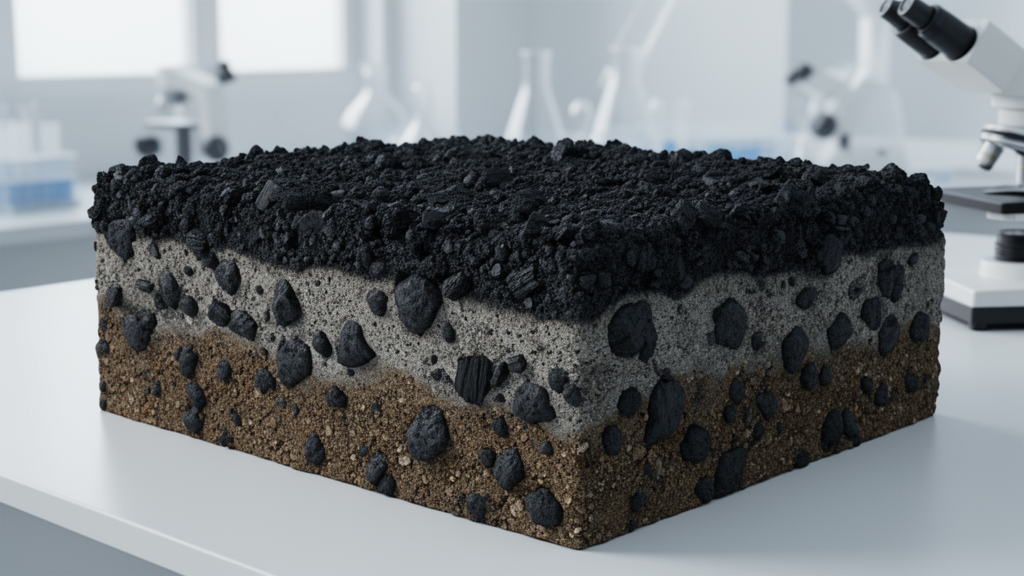
Adding bamboo biochar to cement-stabilized coastal soft soil can raise its unconfined compressive strength by up to 53 percent at 28 days of standard curing, and pairing the modified soil with carbonation curing allows it to store measurable amounts of carbon dioxide, according to a laboratory study that combined mechanical testing with a suite of microstructural analyses. The strongest and most stable material emerged at a bamboo biochar content of 6 percent and a CO2 concentration of 40 percent during curing, a combination that also produced the finest pore structure and the best resistance to cyclic deformation under rotating principal stress conditions.
The study addresses a persistent tension in geotechnical engineering. Roads and railways increasingly must cross soft soil regions marked by high compressibility, high water content and low bearing capacity, and under repeated traffic loading these soils suffer excessive and uneven settlement that drives up construction and maintenance costs. The traditional remedy, cement or lime stabilization, carries a heavy carbon price: producing one ton of cement emits approximately 0.88 tons of CO2, and cement manufacturing contributes around 7.5 percent of global CO2 emissions. Reducing cement demand while improving stabilization efficiency has therefore become a pressing goal for the construction industry.
Bamboo biochar has attracted attention as a candidate additive because of its structure. During pyrolysis, biochar generates numerous organic and volatile substances that leave a unique honeycomb porous skeleton, giving the material a high specific surface area, excellent water retention and high porosity. Researchers attribute its mechanical benefits to two mechanisms: the ultra-high specific surface area provides additional nucleation sites for cement hydration reactions, leading to more hydration products that bond between internal particles, and the extremely small particle size fills pores, compacting the internal structure. Biochar is also regarded as easily manufacturable, environmentally friendly and non-toxic, lacking the alcohol, phenol and methylene compounds found in raw biomass that can harm the environment. Bamboo itself is widely distributed across subtropical and tropical regions, with global bamboo forests covering 22 million hectares, roughly 3.2 percent of total forest area.
In the new experiments, the team used coastal soft soil collected from a construction site in Shaoxing City, P.O 42.5 silicate cement fixed at 5 percent content, and bamboo biochar at 0, 2, 4, 6 and 8 percent. The optimal moisture content of the mix was determined to be 19 percent. Specimens were cured under standard conditions for 7, 28 and 56 days, and separately subjected to CO2 curing for 15 hours in a chamber supplied with CO2 at concentrations of 20, 40 and 60 percent, after which they received a further 28 days of standard curing at relative humidity of at least 95 percent and 20 ± 2 degrees Celsius.
The unconfined compressive strength results showed a consistent pattern. At all curing ages, strength first increased and then decreased as biochar content rose, peaking at 6 percent biochar with maximum values of 1136, 3018 and 3679 kilopascals after 7, 28 and 56 days respectively. Compared with the biochar-free control, the modified soil showed strength increases of 14 to 45 percent at 7 days, 18 to 55 percent at 28 days and 9 to 30 percent at 56 days, a progression the authors interpret as evidence that cement hydration is still incomplete at 7 days, largely complete by 28 days and essentially concluded by 56 days. The decline at 8 percent biochar was attributed to agglomeration of excess powder and to the biochar’s water absorption depriving cement hydration of sufficient free water at the fixed 19 percent moisture content. Carbonation curing raised strength further, with the optimum again at 40 percent CO2; at 20 percent the carbonation reaction proceeded too slowly, while at 60 percent the reaction ran so rapidly that excessive calcium carbonate formation caused localized volume expansion, creating new pores or cracks that reduced strength.
The study went beyond static strength to examine cyclic mechanical response, an area the authors identify as insufficiently understood for biochar-modified cement soils. Using a hollow cylinder apparatus that can independently control axial force and torque, they reproduced the rotation of principal stress directions that moving traffic loads induce in real subgrades, something conventional cyclic triaxial tests cannot fully capture. Tests on the 6 percent biochar mix at a confining pressure of 100 kilopascals, cyclic stress ratios of 0.3 to 0.5 and torsion-shear ratios from 0 to 1/2 showed that cumulative strain rose rapidly in early loading cycles and then stabilized, increasing with both cyclic stress ratio and torsion-shear ratio. When the torsion-shear ratio climbed from 0 to 1/2, the material shifted from a plastic stability state to a plastic creep state under standard shakedown classification, and both positive and shear stiffness declined. Carbonation curing reduced cumulative strain relative to standard curing at identical stress conditions, with the most stable behavior at 40 percent CO2, which the authors link to calcium carbonate produced by carbonation densifying the sample’s internal structure.
To predict long-term settlement, the researchers fitted their cumulative strain curves with two empirical models. Within the tested loading conditions, the Logarithmic Power model outperformed the Hyperbola model, achieving coefficients of determination of at least 0.95 under both standard and CO2 curing, against a minimum of 0.78 for the Hyperbola model. The authors caution that both models were calibrated and evaluated on the same dataset without independent validation, so the results demonstrate fitting performance only within the investigated stress, curing and cycle ranges.
Microstructural testing explained the macro-scale behavior. Scanning electron microscopy showed the control soil with a loose structure, obvious cracks and pores, while the 6 percent biochar mix was more compact, with needle-shaped hydration products connecting soil particles. After CO2 curing, particles were closely arranged with abundant reaction products between them. X-ray diffraction identified ettringite, quartz and hydrated calcium silicate in uncarbonated samples, with a stronger hydrated calcium silicate peak in the biochar mix confirming promoted hydration; after carbonation, the hydrated calcium silicate peak disappeared and a new calcite peak appeared at 2 theta of 29.7 degrees, confirming that CO2 had reacted with hydration products to form calcium carbonate. Infrared spectroscopy added a vibration band at 1419 inverse centimeters corresponding to carbonate groups in calcium carbonate in the carbonated samples.
Mercury intrusion porosimetry tracked the pore refinement. The combined proportion of small pores and micropores rose from 52.6 percent in the control to 56.8 percent with 6 percent biochar, and after carbonation at 40 percent CO2 the small-pore proportion reached 66.3 percent with micropores at 1.6 percent, the best pore structure among all samples. At 60 percent CO2, however, the proportions of large and medium pores increased by 0.2 and 4.9 percentage points respectively, consistent with the strength loss seen at that concentration. Thermogravimetric analysis quantified relative CO2 uptake from carbonate decomposition between 550 and 725 degrees Celsius: the control and the biochar mix under standard curing stored 3.2 and 3.3 percent respectively, while carbonated biochar specimens stored 4.2, 4.4 and 4.6 percent at CO2 concentrations of 20, 40 and 60 percent, increases of roughly 27 to 39 percent over standard curing. Notably, the highest CO2 uptake at 60 percent did not coincide with the best mechanical performance, which occurred at 40 percent, illustrating that more intensive carbonation does not automatically yield a better material.
The authors frame the work as a laboratory evaluation of the synergistic effects of CO2 curing and biochar incorporation in coastal cement soil, and they are explicit about its limits. Large-scale application of carbon dioxide curing in practical projects still requires further research, particularly in determining the most suitable CO2 curing time, and future studies should examine durability under more complex environmental conditions such as freeze-thaw cycles, wet-dry cycles and ionic attack. Within those bounds, the study offers a detailed portrait of how a single biochar content and a single intermediate CO2 concentration can align mechanical performance, pore refinement and carbon storage in a stabilized soil meant to carry the weight of moving traffic.
Subject of Research: Mechanical properties and carbon sequestration of bamboo biochar-modified cement-stabilized coastal soft soil
Article Title: Experimental study on mechanical properties, microscopic mechanisms, and carbon sequestration evaluation of cement soil modified with bamboo biochar
Article References: Wu, H., Wang, W., Fu, J., Li, N., Yang, J., Wang, X., & Wu, E. (2026). Experimental study on mechanical properties, microscopic mechanisms, and carbon sequestration evaluation of cement soil modified with bamboo biochar. Case Studies in Construction Materials, 25, Article e06646. https://doi.org/10.1016/j.cscm.2026.e06646
Image Credits: AI Generated
DOI: 10.1016/j.cscm.2026.e06646
Keywords: bamboo biochar, cement soil, carbon sequestration, CO2 curing, soft soil stabilization, unconfined compressive strength, hollow cylinder torsional shear, calcite, pore structure, shakedown theory, thermogravimetric analysis, sustainable construction
News Source: Denise Maddox. (October 24, 2026). Bamboo biochar strengthens cement-stabilized soft soil while locking away carbon dioxide in laboratory study. Scienmag.