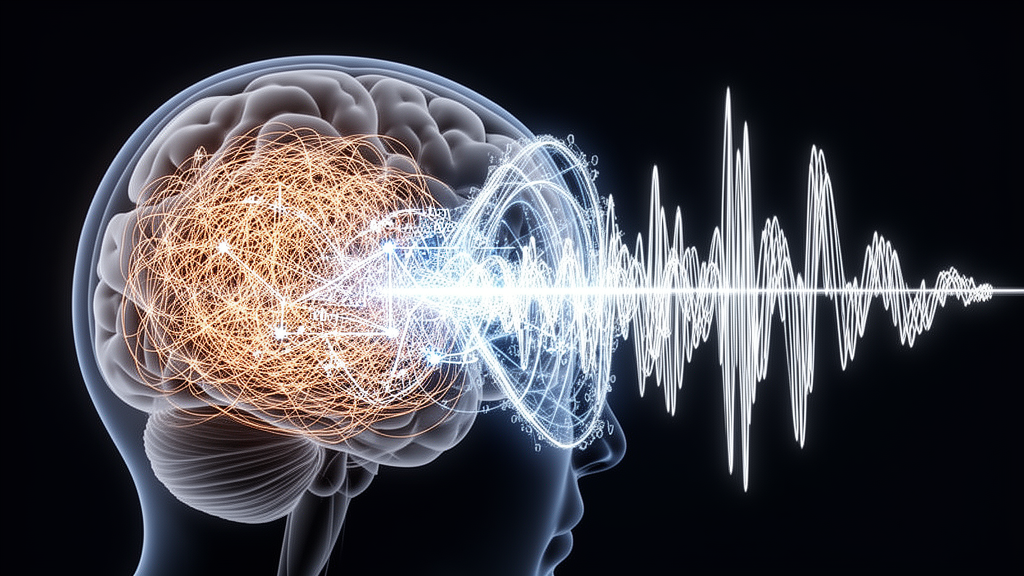
Sleep spindles—brief bursts of 11–16 Hz sigma-band activity that ripple through the brain during non-rapid eye movement sleep—are among the most informative signatures of healthy sleep, reflecting thalamocortical coordination and serving as biomarkers of sleep stability and cognitive processing. Yet detecting them automatically has long frustrated researchers, because scalp EEG recordings suffer from low signal-to-noise ratio, pronounced nonstationarity, and striking variability between individuals. A new study published in Neural Computing and Applications proposes a refreshingly different answer: instead of treating spindle detection as an event-classification problem for machine learning models, Levent Özbek reformulates it as a state-space inference task, solved with an innovation-driven adaptive Kalman filter (AKF) built on a low-dimensional kinematic model of sigma-band amplitude.
The heart of the method is a decision variable called an exponentially weighted innovation-variance proxy. In Kalman filtering, the innovation is the gap between what the model predicts and what the sensor actually measures; a sudden local mismatch in the sigma-band amplitude dynamics flags a candidate spindle. This makes the detector inherently causal—it uses only past and present data—and, crucially, interpretable: clinicians and researchers can trace exactly why each event was flagged, something deep neural networks rarely allow. The study also evaluated several alternative adaptive variants within the same recursive framework, including covariance-matching, Sage–Husa adaptation, normalized innovation squared (NIS), and dual adaptive Kalman filtering, providing a systematic comparison of responsiveness against conservativeness.
The experiments drew on six full-night C3–M2 EEG recordings, a standard central scalp derivation used in sleep research. The proposed AKF configuration produced stable catalogues of spindle-like sigma events under duration constraints, while the covariance-matching, Sage–Husa, and dual adaptive variants each yielded informative contrasts in how aggressively or cautiously they flagged events. One strict NIS-based configuration behaved in the opposite extreme: under the chosen consistency and duration constraints it suppressed every accepted event entirely. Rather than reporting a misleading zero-valued comparison table, the authors discuss that configuration qualitatively, an unusually transparent choice that underscores how sensitive detection thresholds can be in noisy physiological data.
The author is careful about the method’s limits. The Kalman recursion itself is causal, but the reported proof-of-concept results relied on offline zero-phase sigma filtering as a preprocessing step—a filter that peeks at future samples. A deployable real-time system would need to swap this for a causal sigma-band filter, and the study does not claim to have validated such a deployment. Nor is the approach presented as a replacement for modern learning-based detectors, which currently dominate benchmark performance. Instead, the paper positions adaptive state-space modeling as a low-latency, interpretable, and uncertainty-aware alternative, and as a promising foundation for future hybrid systems that combine deep learning with Kalman filtering.
The significance may lie less in beating state-of-the-art benchmarks than in changing the framing of the problem. By recasting spindle detection as a question of tracking sigma-band dynamics—and of measuring when those dynamics deviate from a learned kinematic model—the method offers a window into what the detector is actually sensing. For sleep medicine, where spindle counts feed into assessments of sleep quality and cognitive health, an algorithm whose decisions can be audited, whose computational cost is minimal, and whose behavior adapts to each patient’s shifting EEG statistics could prove a valuable complement to opaque neural networks. The findings support adaptive state-space modeling as an interpretable counterpart to purely amplitude-based detection, and they sketch a credible path toward hybrid architectures that marry the pattern-recognition power of deep learning with the causal, self-correcting rigor of recursive estimation.
Subject of Research: Adaptive Kalman filtering for real-time detection of sleep spindles in EEG recordings
Article Title: Adaptive state-space modeling of EEG dynamics for real-time sleep spindle detection
Article References: Özbek, L. (2026). Adaptive state-space modeling of EEG dynamics for real-time sleep spindle detection. Neural Computing and Applications, 38(20), Article 841. https://doi.org/10.1007/s00521-026-12573-3
Image Credits: AI Generated
DOI: 10.1007/s00521-026-12573-3
Keywords: sleep spindles, EEG, Kalman filtering, state-space modeling, adaptive filtering, sleep medicine, neuroscience, signal processing, sigma-band oscillations, real-time detection, Adaptive, state-space
News Source: Denise Maddox. (October 24, 2026). Kalman Filter Approach Offers Interpretable Real-Time Sleep Spindle Detection. Scienmag.