

• HOME
  • NEWS
  • EXPLORE
    • CAREER
      • Companies
      • Jobs
    • EVENTS
    • iGEM
      • News
      • Team
    • PHOTOS
    • VIDEO
    • WIKI
  • BLOG
  • COMMUNITY
    • FACEBOOK
    • INSTAGRAM
    • TWITTER
Wednesday, April 1, 2026
BIOENGINEER.ORG
No Result
View All Result
  • Login
  • HOME
  • NEWS
  • EXPLORE
    • CAREER
      • Companies
      • Jobs
        • Lecturer
        • PhD Studentship
        • Postdoc
        • Research Assistant
    • EVENTS
    • iGEM
      • News
      • Team
    • PHOTOS
    • VIDEO
    • WIKI
  • BLOG
  • COMMUNITY
    • FACEBOOK
    • INSTAGRAM
    • TWITTER
  • HOME
  • NEWS
  • EXPLORE
    • CAREER
      • Companies
      • Jobs
        • Lecturer
        • PhD Studentship
        • Postdoc
        • Research Assistant
    • EVENTS
    • iGEM
      • News
      • Team
    • PHOTOS
    • VIDEO
    • WIKI
  • BLOG
  • COMMUNITY
    • FACEBOOK
    • INSTAGRAM
    • TWITTER
No Result
View All Result
Bioengineer.org
No Result
View All Result
Home NEWS Science News Biology

IUPUI cell biologist tackles age-related hearing loss

Bioengineer by Bioengineer
September 14, 2017
in Biology
Reading Time: 2 mins read
0
Share on FacebookShare on TwitterShare on LinkedinShare on RedditShare on Telegram
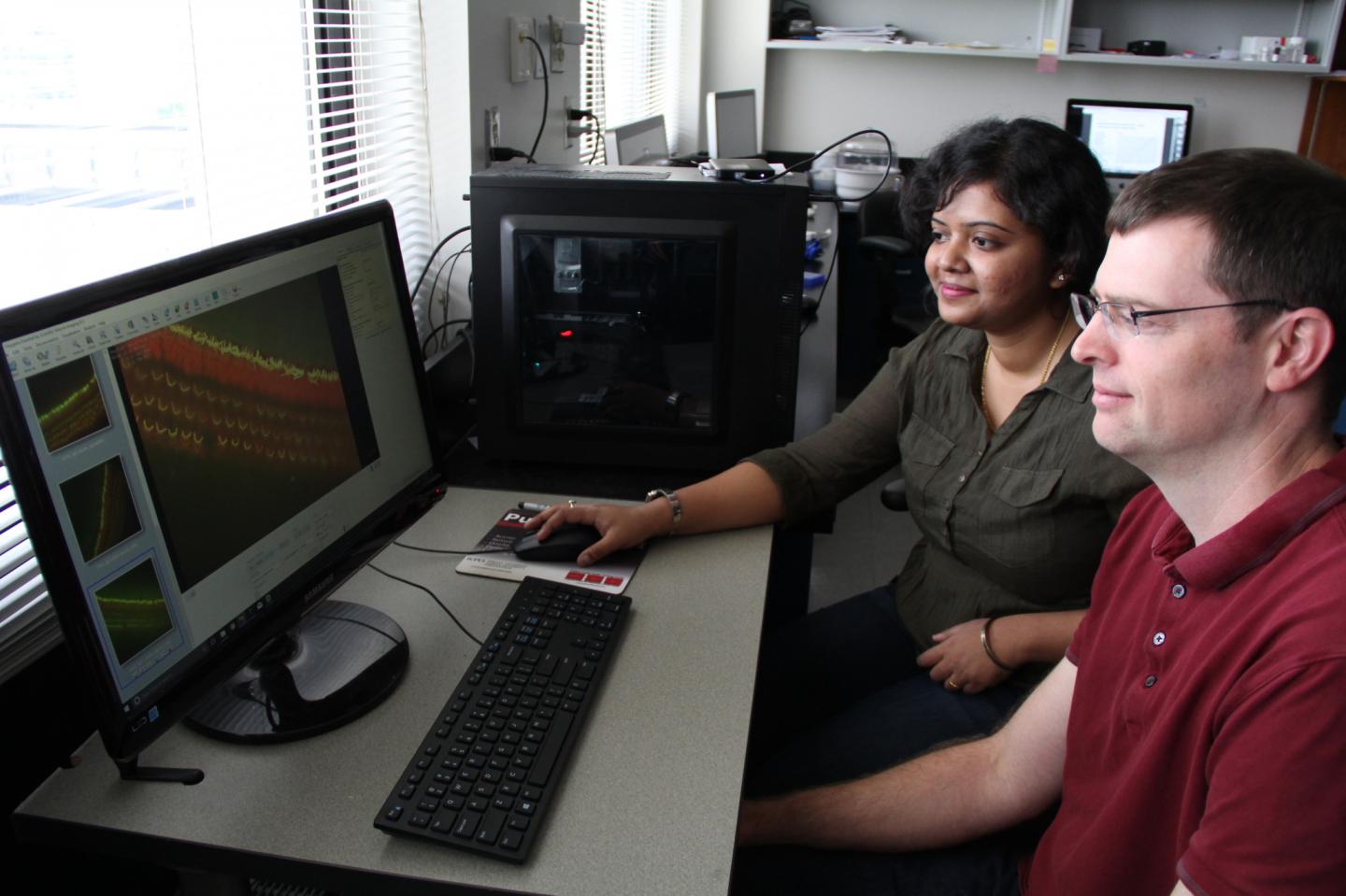
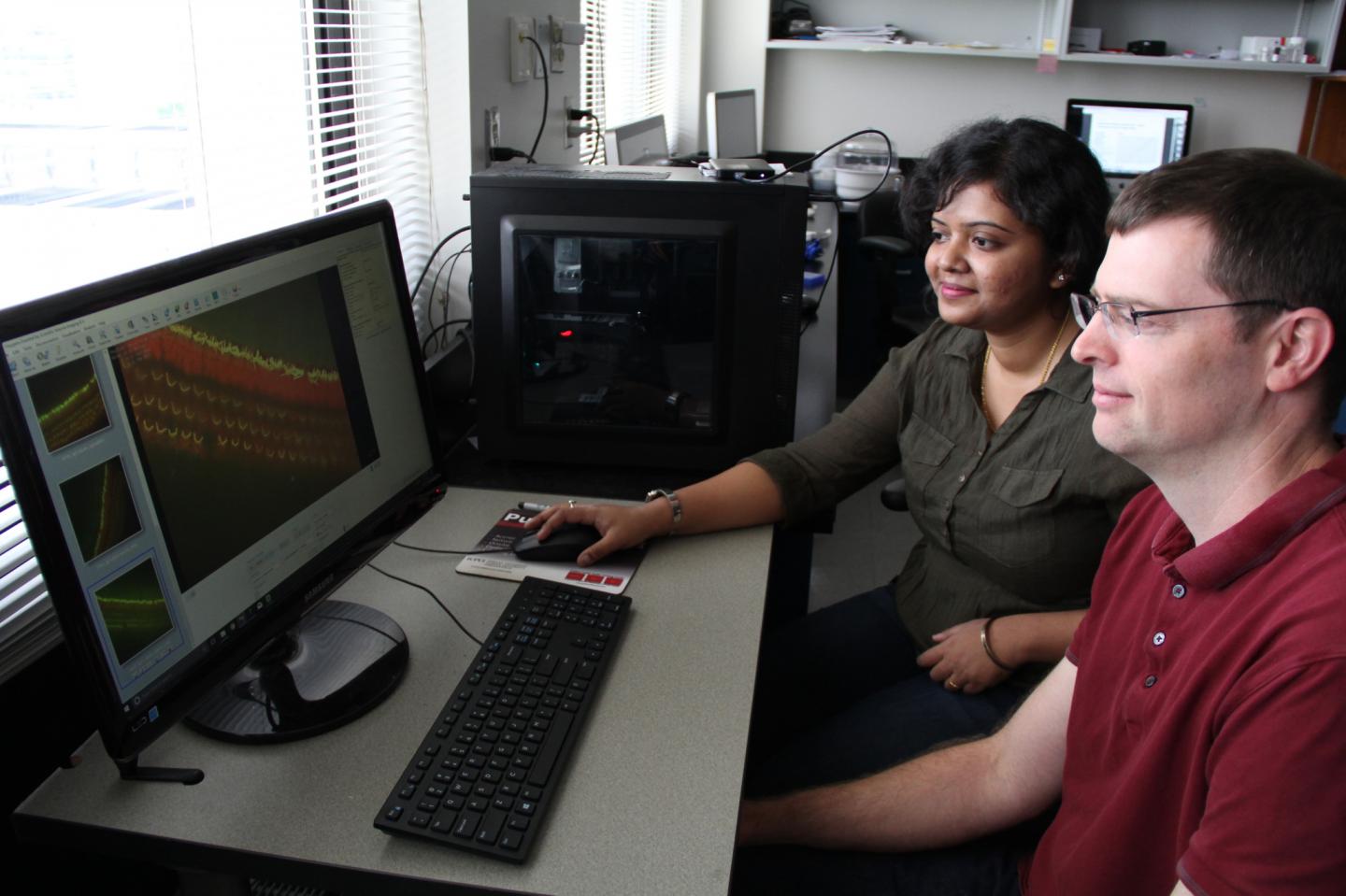
IMAGE

Credit: School of Science at IUPUI

INDIANAPOLIS — Cell biologist Benjamin J. Perrin of the School of Science at Indiana University-Purdue University Indianapolis is advancing knowledge of age-related hearing loss with the goal of informing possible therapeutic cell-regeneration approaches to the often-debilitating problem. Perrin's work is supported by a new $1.9 million five-year grant from the National Institute on Deafness and Other Communication Disorders.

Approximately 15 to 20 percent of American adults have trouble hearing. Almost everyone experiences at least some degree of hearing loss as they age, with the greatest loss typically occurring between ages 60 and 69.

Perrin is tackling the problem at the cellular level by exploring the function of the portion of the sensory cells in the inner ear that are responsible for detecting sound waves. These bundles of rod-like protrusions, called stereocilia, bend as sound hits them, opening ion channels. When stereocilia work properly, they convert sound waves into electric signals that are transmitted to the body's neurons, thus enabling one to hear speech, music and other sound.

Stereocilia may be abnormal at birth; they deteriorate as we age; and they can be damaged or destroyed by disease, toxins or loud noises. They do not grow back; hearing loss occurs if stereocilia malfunction or degenerate.

"To successfully convert sound waves into electric signals that can be understood by neurons, the stereocilia have to be exactly the right shape, size and conformation," Perrin said. "We are studying the dynamics and stability of how proteins move in and out of stereocilia to gain a better understanding of how these micromachines maintain themselves over long periods of time.

"If you want to try to regenerate stereocilia, you have to know how these living machines work in the first place. With this knowledge, it may be possible in the future to regenerate them to prevent or restore hearing loss. We are hoping to solve a biological puzzle with implications for millions of people."

Perrin envisions the development of a maintenance-of-living-cells approach — remodeling or regrowing a tiny piece of the cell before the whole cell is dead — rather than totally replacing them.

Each semester, three IUPUI graduate students and two to five undergraduates will work on the projec

###

t under Perrin's tutelage, conducting sophisticated experiments on mouse sensory cells, which are very similar to human sensory cells, and analyzing the data obtained from those experiments.

Cytoskeletal Stability in Stereocilia Maintenance is supported by NIDCD grant R01DC015495-01A1.

Media Contact

Cindy Fox Aisen
[email protected]
317-843-2275

http://science.iupui.edu/

Original Source

http://science.iupui.edu/news/iupui-cell-biologist-tackles-age-related-hearing-loss-19-million-nidcd-grant

Share13Tweet8Share2ShareShareShare2

Related Posts

Do Your Genes Influence How Lifestyle Choices Affect Aging?

Do Your Genes Influence How Lifestyle Choices Affect Aging?

April 1, 2026
Combining Single-Cell Multiomics Unlocks Precise Identification of Rare Cell Types and States

Combining Single-Cell Multiomics Unlocks Precise Identification of Rare Cell Types and States

March 31, 2026

Genetically Engineered Marmosets Pave the Way for Advancements in Human Deafness Research

March 31, 2026

How Great Hammerhead Sharks Outsmart Ocean Temperature Swings: Insights from FIU Researchers

March 31, 2026
Please login to join discussion

POPULAR NEWS

  • blank

    Revolutionary AI Model Enhances Precision in Detecting Food Contamination

    96 shares
    Share 38 Tweet 24
  • Imagine a Social Media Feed That Challenges Your Views Instead of Reinforcing Them

    1006 shares
    Share 398 Tweet 249
  • Promising Outcomes from First Clinical Trials of Gene Regulation in Epilepsy

    51 shares
    Share 20 Tweet 13
  • Popular Anti-Aging Compound Linked to Damage in Corpus Callosum, Study Finds

    43 shares
    Share 17 Tweet 11

About

We bring you the latest biotechnology news from best research centers and universities around the world. Check our website.

Follow us

Recent News

Cutting-Edge “Smart” Drugs Revolutionize Cancer Treatment

KIST-IAE Collaborative Team Surpasses Performance Limits in Lithium-Air Batteries with Innovative Two-Dimensional Catalyst

Brain Metastases Show Unique Macrophage Spatial Patterns

Subscribe to Blog via Email

Enter your email address to subscribe to this blog and receive notifications of new posts by email.

Join 78 other subscribers
  • Contact Us

Bioengineer.org © Copyright 2023 All Rights Reserved.

Welcome Back!

Login to your account below

Forgotten Password?

Retrieve your password

Please enter your username or email address to reset your password.

Log In
No Result
View All Result
  • Homepages
    • Home Page 1
    • Home Page 2
  • News
  • National
  • Business
  • Health
  • Lifestyle
  • Science

Bioengineer.org © Copyright 2023 All Rights Reserved.