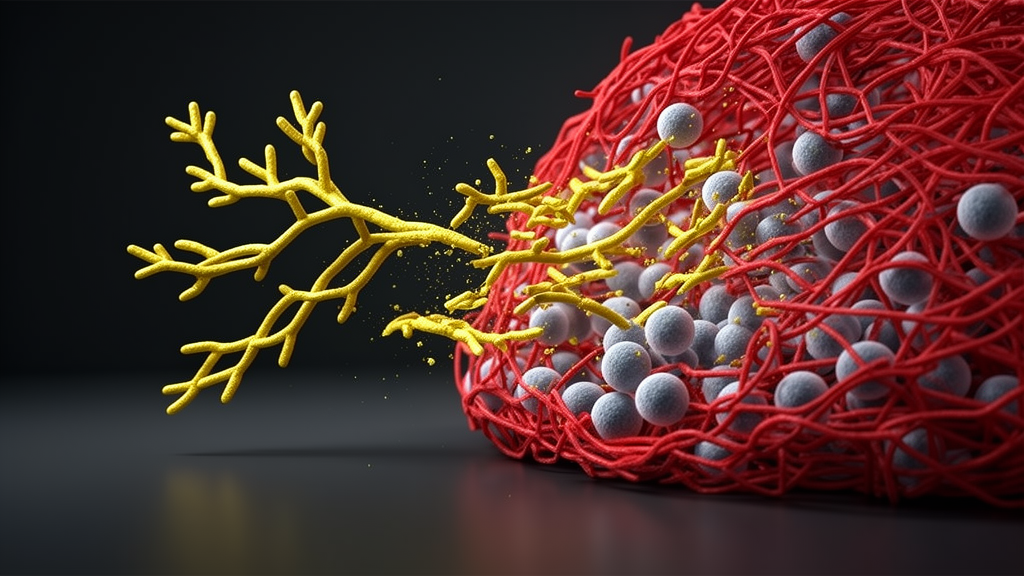
Engineered enzymes called FibriLysins can dismantle the fibrin armour that Staphylococcus aureus builds around its abscess communities, according to a preclinical study published in Nature Microbiology. The lead variant, FL-028, reduced bacterial counts in laboratory models of staphylococcal abscess communities by 3.4 log10 units and in biofilms by 2.3 log10 units. In a mouse model of fracture-related bone infection, FL-028 outperformed the standard-of-care antibiotic vancomycin by one log unit and eliminated the presence of staphylococcal abscess communities in tissue sections. Each FibriLysin combines a staphylokinase, a plasminogen activator that degrades fibrin, with an endolysin, a cell-wall-degrading enzyme derived from bacterial viruses. Because the fibrin scaffold surrounding these multicellular bacterial communities is host-derived rather than bacterially encoded, the researchers argue that the pathogen has no simple route to evolve resistance against the fibrinolytic approach.
The rationale for the design comes from a defining feature of staphylococcal pathogenesis. S. aureus infections are characterized by fibrin-embedded multicellular communities that limit the diffusion of small-molecule antibiotics to the metabolically diverse bacterial cells inside them. These structures include staphylococcal abscess communities, known as SACs, and biofilms, both of which contain fibrin. The FibriLysin concept fuses staphylokinase, abbreviated SAK, to an endolysin so that the two activities act in spatial proximity: the SAK module stimulates fibrin degradation and thereby provides an entry point for the endolysin to reach bacteria residing within the multicellular community. Once exposed, the bacteria are rapidly lysed, and the endolysin remains active regardless of the bacterium’s metabolic state, a property the researchers identify as a key advantage over antibiotics that target metabolic processes.
To build the fusion proteins, the team first performed a sequence similarity search using a known staphylokinase to identify the most diverse SAK variants in public sequence databases, then constructed a phylogenetic tree and selected the three most divergent representatives, termed SAK1 to SAK3, for recombinant expression in Escherichia coli. All three were validated as plasminogen activators in vitro. The endolysin partner, RODI∆ami, is an engineered derivative of the S. aureus phage endolysin LysRODI in which the amidase domain was truncated to enhance catalytic efficiency and stability. It emerged as the lead candidate from a panel of twelve engineered antistaphylococcal endolysins previously generated by modular domain shuffling, owing to its superior specific lytic activity, low minimum inhibitory concentration values, strong biofilm-removal ability and robust physicochemical stability. Using the VersaTile platform, a modular DNA assembly framework that recombines predefined functional domains into a single open reading frame, the researchers fused the three SAKs through nine different linkers to RODI∆ami, producing 27 constructs.
Screening of crude lysates assessed endolysin functionality with a muralytic assay on S. aureus peptidoglycan and SAK activity with a plasminogen activation assay. This initial round yielded a positive hit rate of 78 percent, with 21 of the 27 constructs preserving the activity of both enzymatic components. Variants showing robust, dose-dependent plasminogen activation were then checked for structural integrity by western blot and for antibacterial activity against a panel of five staphylococcal strains after purification. Based on this combined performance, FL-028 was selected as the lead FibriLysin for in-depth characterization and in vivo studies.
FL-028 was then tested against an extended panel of 34 diverse clinical S. aureus isolates reflecting both community-acquired and hospital-acquired diversity. It showed antibacterial activity against 30 of these isolates in a minimum inhibitory concentration assay, and a core-genome phylogenetic tree revealed that strains from diverse common clonal complexes were susceptible, while the four less susceptible isolates were distributed across the tree rather than clustering on one branch. The lead variant also retained its plasminogen-activating activity in heat-inactivated human serum, across a broad pH range and at elevated temperature. Its antibacterial activity persisted in the presence of pooled human serum and plasma, indicating that potential antibodies retained by humans against SAK2 did not impair function.
The team next evaluated FL-028 in a previously developed three-dimensional SAC model, in which S. aureus forms structured multicellular communities within a human plasma-supplemented collagen matrix surrounded by a fibrin-rich pseudocapsule. Mature SACs were treated for 48 hours with 10 micromolar FL-028 or with a mixture of its individual components. Confocal laser scanning microscopy, using fluorescent staining for fibrin and for living bacteria, showed that the fibrin signal disappeared completely after treatment with SAK2 or FL-028, while fibrin remained detectable in untreated controls and in samples treated with the endolysin alone. In terms of bacterial killing, FL-028 achieved a 3.4 log10 reduction in colony-forming units, whereas the combination of the two unfused proteins reduced counts by only 2.1 log10 units, a statistically significant difference indicating that fusing the two enzymes into one molecule provides a real benefit over co-administration.
A parallel biofilm experiment produced consistent results. S. aureus biofilms were grown for 48 hours on titanium disks in tryptic soy broth supplemented with 1 percent human plasma, a setup relevant to implant-associated infections. As in the SAC model, fibrin could no longer be detected by microscopy after SAK2 or FL-028 treatment, and FL-028 achieved a significant 2.3 log10 reduction in colony-forming units compared with the untreated control, again performing significantly better than the unfused enzyme mixture. Activity was also confirmed against Staphylococcus epidermidis biofilms, which do not incorporate fibrin, showing that the antibacterial effect extends beyond S. aureus and operates even in the absence of fibrin degradation.
Comparisons with vancomycin, the standard of care, proved particularly revealing. In the SAC model, vancomycin at 10 micrograms per millilitre, ten times its minimum inhibitory concentration, barely killed any of the bacteria residing inside the abscess community, demonstrating that the pseudocapsule inhibits antibiotic activity. When vancomycin was combined with SAK2 alone, the plasminogen activator potentiated the antibiotic by providing access to the embedded bacteria. The combination of vancomycin with FL-028 produced a significant reduction in bacterial counts compared with both the untreated control and vancomycin alone. In the biofilm model, the pattern differed: adding SAK2 to vancomycin did not further reduce bacterial burden, but combining vancomycin with FL-028 resulted in a 3.2 log10 killing of the biofilm population.
Before efficacy testing, the team assessed safety. No toxicity was observed against fibroblasts in vitro over a 170-hour viability assay. Because plasminogen activators could in principle delay bone healing, given the importance of fibrin in early fracture repair, the researchers evaluated FL-028 in non-infected mice with a plate-fixed femoral osteotomy. They noted that SAKs display favourable properties as plasminogen activators because their interaction with plasminogen is rapidly inhibited by host factors such as alpha-2-antiplasmin, thereby stimulating only local fibrinolysis. FL-028 was injected locally at the osteotomy site once daily from day 5 to day 18. Histological examination revealed no significant differences in bone bridging between treated and control animals, mechanical four-point bending tests confirmed preserved structural integrity, and micro-computed tomography showed no significant differences in bone volume, with both groups showing comparable new bone formation by day 21.
The decisive test came in a mouse model of fracture-related infection. Forty-four mice underwent femoral osteotomy with plate fixation, and the osteotomy was inoculated at surgery with 10,000 colony-forming units of S. aureus JAR, a clinical strain cultured from a patient with a musculoskeletal infection and sensitive to vancomycin. After five days of infection development, the wound was surgically debrided and treatment began, continuing from day 5 to day 18 with daily local injections of FL-028, the unfused enzymes, subcutaneous vancomycin, or the combination. After 14 days of treatment, both FL-028 and the unfused enzyme combination had significantly reduced the bacterial burden in bone, outperforming vancomycin by one log unit, while adding vancomycin to FL-028 did not further improve the outcome compared with FL-028 alone. Post-mortem histology supported the proposed mechanism: Picro-Mallory and Brown-Brenn staining showed degradation of the fibrous pseudocapsule surrounding the abscess communities in FL-028-treated tissue, fluorescence in situ hybridization revealed dispersed rather than aggregated bacteria, and nearly zero abscess communities could be retrieved from tissue sections in the fibrinolytic treatment groups, compared with significantly more in the control and vancomycin groups. Of the 80 mice enrolled across the in vivo studies, 16 were excluded after reaching humane endpoints, mostly due to wound dehiscence or implant-related fracture, and histological assessments were performed by investigators blinded to treatment allocation.
The authors frame FibriLysins as a third-generation endolysin strategy that incorporates key aspects of host pathogenesis into antibacterial design, noting that previous clinical trials with first- and second-generation endolysins have struggled to demonstrate clear clinical superiority. They argue that coagulation is a central and conserved feature of S. aureus pathogenicity, and that because the protective scaffold consists of host-derived fibrin, there is no simple pathway for the bacterium to evolve resistance to fibrinolytic attack, while the endolysin moiety is also considered evolutionarily robust because several studies have failed to evoke resistance following exposure to subinhibitory concentrations. They further suggest that fibrin degradation could expose embedded bacteria to higher antibiotic doses, potentially increasing the efficacy of existing treatments. The researchers also acknowledge open questions: little is known about the biological role and therapeutic safety profile of staphylokinase, and although circulating half-life is less critical for direct local injection, the optimal dosing regimen and route of administration remain to be determined before any clinical translation. For now, the findings stand as preclinical evidence from in vitro models and mouse studies that a single fusion protein can strip the fibrin shield from staphylococcal communities and expose the bacteria to enzymatic destruction.
Subject of Research: Engineered FibriLysin enzymes targeting fibrin-encapsulated Staphylococcus aureus biofilms and abscess communities
Article Title: FibriLysins disrupt Staphylococcus aureus biofilms and abscess communities
Article References: De Maesschalck, V., Chittò, M., Siverino, C., Gens, L., Zeiter, S., Hangartner, A., Harzé, S., Vanhoffelen, E., Van Laere, C., Kerremans, A., Voet, M., Boon, M., Van Win, T., Vande Velde, G., Wagemans, J., Metsemakers, W.-J., Richards, R. G., Moriarty, T. F., & Lavigne, R. (2026). FibriLysins disrupt Staphylococcus aureus biofilms and abscess communities. Nature Microbiology. https://doi.org/10.1038/s41564-026-02513-1
Image Credits: AI Generated
DOI: 10.1038/s41564-026-02513-1
Keywords: Staphylococcus aureus, FibriLysins, endolysin, staphylokinase, biofilm, abscess community, vancomycin, fracture-related infection, antimicrobial resistance, fibrinolysis, preclinical study, Nature Microbiology
News Source: Kristina Jarvis. (October 23, 2026). FibriLysin fusion enzyme strips fibrin shield from staphylococcal abscess communities. Scienmag.