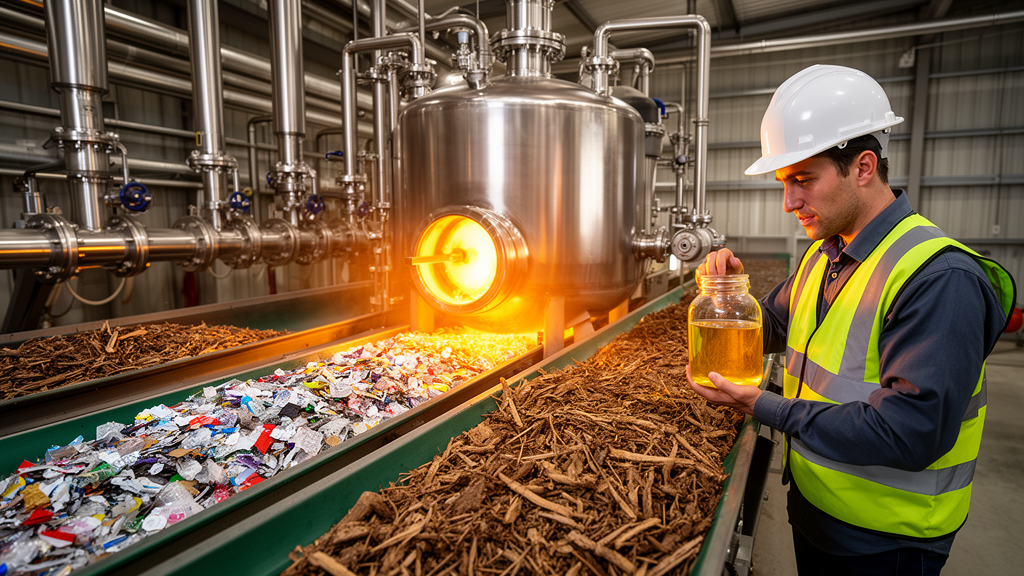
Two of the most stubborn waste streams in modern industry — non-recyclable polypropylene manufacturing scraps and leftover biomass such as sawdust, rice straw and algae — can be converted into liquid fuel, according to a new study published in Biotechnology for Biofuels and Bioproducts. Researchers report that co-hydrothermal liquefaction, a process that uses hot, pressurized water to break down mixed feedstocks, transforms these materials into an energy-dense bio-crude, with a catalyst made from yet another form of industrial waste doing much of the work.
The study, led by Sukanya Hongthong and Surachai Wongcharee, was conducted under subcritical water conditions at 350 degrees Celsius. By co-processing polypropylene waste with three different biomass residues — sawdust, rice straw and the microalga Chlorella — the team tested whether combining plastic with biomass could address a known weakness of biomass-only liquefaction: bio-crude derived from plants and algae is rich in oxygen, which lowers its energy density.
The polypropylene proved to be more than a co-passenger. When plastic manufacturing waste was blended into the reaction, the fuel characteristics of the resulting oil improved substantially. The highest measured higher heating value reached 32.95 megajoules per kilogram, and the atomic oxygen-to-carbon ratio dropped from 0.43 to 0.19. Both numbers point in the same direction: less oxygen in the oil, more hydrocarbon-like content, and therefore a liquid closer to fossil crude in energy terms. FTIR spectroscopy and Van Krevelen analysis were consistent with increased hydrocarbon formation and a reduction in oxygenated functional groups after catalytic treatment.
The catalyst itself is a striking part of the story. Rather than a synthetic zeolite, the researchers used an alumina–silica waste material recovered from industrial liquid nitrogen processing. Characterization by scanning electron microscopy, FTIR spectroscopy and nitrogen physisorption showed a mesoporous structure, with a BET surface area of 226.6 square meters per gram and an average pore diameter of 5.3 nanometers.
Adding this waste-derived catalyst changed the product distribution measurably. In the best-performing combination, the Chlorella–polypropylene blend, the maximum bio-crude yield rose to 47.2 percent by weight, while the solid residue fell from 46.7 percent to 37.3 percent. Less of the feedstock ending up as solid residue means more is converted into the desired liquid product. The authors propose that the improvements arise from catalyst-assisted cracking of the polypropylene combined with enhanced interactions between plastic-derived hydrocarbons and biomass-derived intermediates during co-liquefaction.
There is also a climate-relevant angle. In a screening-level environmental assessment, the team estimated the embodied carbon footprint of the waste-derived catalyst at approximately 0.13 kilograms of CO2-equivalent per kilogram, which they report as substantially lower than values for conventional synthetic and bio-derived zeolite catalysts. The assessment is screening-level, however, and the authors describe it as an estimate rather than a full life cycle analysis.
The broader appeal of the approach lies in the number of waste streams it consumes at once. According to the study, non-recyclable polypropylene manufacturing waste and lignocellulosic or algal biomass residues are commonly disposed of by landfill or incineration. Co-hydrothermal liquefaction with a waste-based catalyst uses two such streams as feedstock and a third as the catalyst that upgrades the product.
The authors are careful about what their results establish. The findings come from laboratory-scale experiments, and the paper flags the gaps that remain before any scale-up: catalyst stability, the composition of the aqueous phase left after liquefaction, long-term catalyst reusability, and comprehensive life cycle and techno-economic assessments all require further investigation. The researchers also note the catalyst characterization was performed to determine the influence of catalyst addition on product quality, leaving questions of durability under repeated use open.
Even so, the study offers a concrete data point in the search for circular approaches to both plastic and fuel production. A yield of 47.2 percent bio-crude with a heating value approaching 33 megajoules per kilogram, achieved with a catalyst that is itself a waste product, shows how waste management, catalysis and fuel chemistry can intersect in a single reaction — provided follow-up work confirms catalyst durability and that the favorable carbon accounting holds up under full life cycle scrutiny.
Subject of Research: Catalytic co-hydrothermal liquefaction of polypropylene manufacturing waste and biomass using an industrial alumina–silica waste catalyst
Article Title: Valorization of non-recyclable polypropylene manufacturing waste via catalytic co-hydrothermal liquefaction with biomass using industrial alumina–silica waste as a heterogeneous catalyst
Article References: Hongthong, S., & Wongcharee, S. (2026). Valorization of non-recyclable polypropylene manufacturing waste via catalytic co-hydrothermal liquefaction with biomass using industrial alumina–silica waste as a heterogeneous catalyst. Biotechnology for Biofuels and Bioproducts. https://doi.org/10.1186/s13068-026-02834-7
Image Credits: AI Generated
DOI: 10.1186/s13068-026-02834-7
Keywords: hydrothermal liquefaction, polypropylene waste, bio-crude, heterogeneous catalyst, alumina-silica waste, biomass valorization, Chlorella, rice straw, sawdust, deoxygenation, carbon footprint, waste-to-fuel
News Source: Drew Townsend. (October 23, 2026). Industrial Trash Turns Plastic Waste and Biomass Into Higher-Quality Fuel. Scienmag.