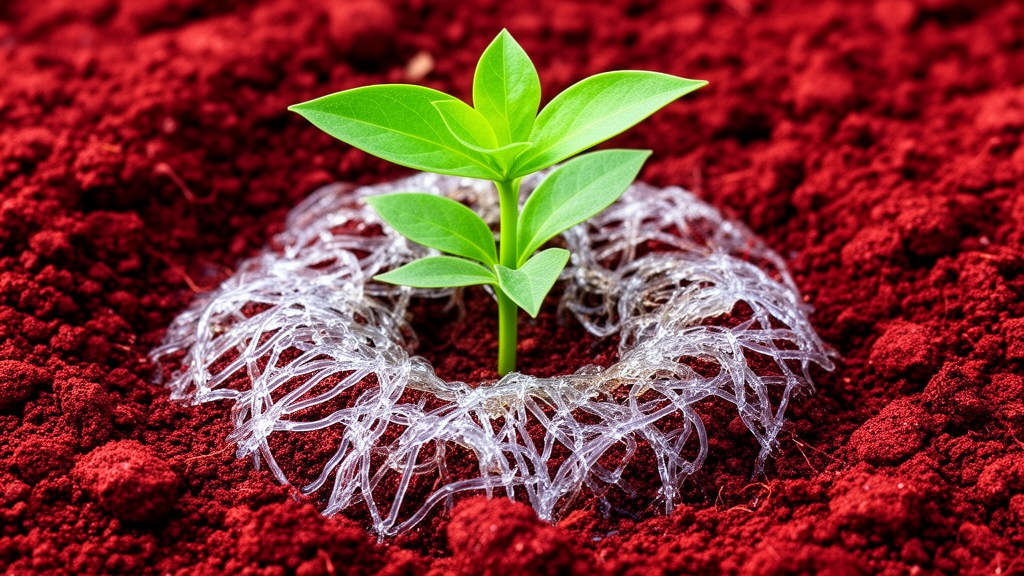
Red soil covers 2.18 million square kilometers of southern China, roughly 22.7% of the national land area, and it is the country’s second most extensively eroded soil type. Highly erodible by nature, and battered by natural disasters and decades of intensive human development, the region now has about 160,000 square kilometers affected by active soil erosion. The consequences are severe: vegetation struggles to re-establish, land degrades, and soil fertility declines. Vegetative measures, planting grasses and herbs to anchor slopes, are widely recognized as an effective conservation strategy, but they carry a stubborn weakness. During the early growth stages, the short and fine roots of young plants cannot extend beyond the shear failure surface of a slope, which means they simply cannot stabilize the surface soil when it is most vulnerable. A new experimental study published in Frontiers in Ecology and Evolution argues that a humble marine ingredient, seaweed polysaccharides, can fill exactly that gap.
Seaweed polysaccharides are macromolecular polysaccharides drawn from the cell walls of algae. In their natural state they are biodegradable and water-soluble, and they can undergo chelation reactions with high-valent cations in the soil. That chemistry leads to the encapsulation, binding, and filling of soil pores, solidifying the soil and enhancing its strength. Previous work has hinted at their promise: at a concentration of 1 mg/mL, seaweed polysaccharides pushed the germination rate of rapeseed to 90.67%, and earlier mechanical experiments found that soil shear strength peaked when the polysaccharide content reached 1%. What remained unknown was how these compounds interact with plant growth, the mechanics of the root-soil complex, and the erosion resistance of red soil specifically. To find out, a research team led by the Changjiang River Scientific Research Institute designed a three-stage experimental program combining pot trials, direct shear testing, and simulated rainfall.
The test soil came from the surface layer, 0 to 30 centimeters, of a typical slope in Changtai County, Zhangzhou City, Fujian Province. After transport to the institute’s Rainfall Hall in Wuhan, the soil was sieved through a 5-millimeter mesh and characterized: air-dried moisture content of 3.2%, bulk density of 1.35 g/cm³, pH of 5.35, and organic matter of 6.62 g/kg. The texture, 11.2% clay, 18.3% fine silt, 28.1% coarse silt, and 42.4% sand and gravel, classified it as loam. The plant chosen was tall fescue, a perennial cool-season grass tolerant of drought, acidity, salt stress, and barren ground, with a germination rate exceeding 98%. The seaweed polysaccharide curing agent itself is a white powder that, when blended with water, forms a colorless, odorless, viscous liquid with a pH between 6.8 and 7.2 at 1% concentration and a gelation time ranging from 60 to 3600 seconds.
The vegetation experiment tested five seaweed polysaccharide rates, 0%, 1%, 2%, 3%, and 4%, with 100 tall fescue seeds sown per pot and measurements of germination rate, plant height, stem diameter, and pH recorded at 7, 14, 28, 42, and 56 days. The results revealed a clear optimal concentration window. Seeds in the 2% pots germinated first, followed three days later by the 1% group. By day 21, germination rates had stabilized at 84.12%, 90.35%, 76.69%, and 72.35% for the 1%, 2%, 3%, and 4% treatments respectively. Compared with the untreated control, the 1% and 2% concentrations increased germination by 4.01% and 10.24%, while 3% and 4% reduced it by 3.42% and 7.76%. Plant height and stem diameter followed the same pattern: at 1%, both reached their maximum values, rising 15% and 12% above the control. Beyond 2%, inhibition set in and grew more pronounced above 3%.
The explanation for that threshold lies in gel physics. High concentrations of seaweed polysaccharides bind with water to form thicker gels that strengthen connections between soil particles and shrink the pore spaces between them, choking off air circulation. Because tall fescue is a monocot grass, excessively compacted soil can physically hinder the movement of the seedling radicle, reducing germination. The salts contained in the polysaccharides and their chelation with high-valent cations also raise the soil’s Na⁺ concentration, altering the osmotic pressure around seeds and weakening their ability to absorb water. Over the 56-day trial, soil pH steadily decreased, a sign that proliferating soil microorganisms were breaking down the organic matter in the polysaccharides and driving acidification. Low concentrations shifted the soil environment from acidic toward neutral and promoted seedling emergence, while high concentrations formed a high-strength crust that cut the soil interior off from outside air and hindered growth.
The mechanical stage of the study was a two-factor orthogonal test with five polysaccharide concentrations and five root incorporation levels, 0%, 0.2%, 0.4%, 0.6%, and 0.8%, yielding 75 direct shear groups tested under normal stresses of 25, 50, 75, and 100 kPa at a shearing rate of 0.8 mm/min. The stress-strain curves showed two modes, strain hardening and strain softening, and the pattern shifted with treatment. Roots alone shifted the curve upward modestly, raising shear strength by 13.43% to 23.36% across the tested normal stresses, and friction traces of roots were found along the shear failure surface, evidence that soil and roots bear force and deform cooperatively. Seaweed polysaccharides alone shifted the curve far more dramatically, enhancing shear strength by 49.08% to 93.54% depending on concentration and stress level. Below 2%, the curves showed strain hardening; above 2%, strain softening appeared at low normal stresses.
The cohesion and internal friction angle data told the most striking story of the entire investigation. Analysis of variance showed both parameters were significantly affected by polysaccharide concentration, root content, and their interaction, with concentration by far the dominant factor, an F-value of 5422.6 for cohesion. Compared with the control, adding roots alone increased cohesion by 21.82% to 43.76%, polysaccharides alone by 103.68% to 180.52%, and the combination by 143.33% to 220.65%. Cohesion peaked at 30.05 kPa with 3% polysaccharides and 0.6% roots. The internal friction angle rose 13.92% to 31.76% with polysaccharides alone and 14.83% to 39.45% with the combined treatment, peaking at 32.85° with 3% polysaccharides and 0.8% roots. Both parameters rose and then fell with increasing concentration, indicating that once all available exchangeable cations in the soil have been consumed in the gelation reaction, the surplus polysaccharides, being highly hydrophilic, actually weaken the soil.
Scanning electron microscopy and energy dispersive spectroscopy revealed the microscopic mechanism behind those numbers. The original red soil showed a loose particle structure with noticeable pores, reflecting its poor mechanical properties. Adding roots filled internal pores and formed a more stable skeletal structure with the soil. Adding polysaccharides produced flocculent agglomerates that bound soil particles and filled pores, turning loose particles into tightly packed larger aggregates. With both treatments, red soil particles and roots were tightly wrapped by the flocculent gel, creating what the authors call a seaweed polysaccharide-red soil-root three-phase unit structure. EDS scans showed that in treated samples the peak intensities of Si and Al dropped while C, Ca, Na, and Fe rose, indicating that calcium and iron ions chelate with the hydroxyl groups of the polysaccharides to form stable chelates and complexes that accumulate on the soil surface, with preferential binding to Ca²⁺ forming an entangled three-dimensional network that coats soil surfaces.
The rainfall experiments translated those laboratory gains into erosion protection. Using a steel runoff trough set at a 20° slope, the team applied 30 minutes of simulated rainfall at 60 and 120 mm/h, intensities grounded in meteorological surveys of the study area. At 60 mm/h, total erosion fell from 79.64 grams in the control to 10.17 and 8.83 grams in the 1% and 2% polysaccharide-root treatments, reductions of 87.23% and 88.91%. At 120 mm/h, erosion dropped from 163.42 grams to 25.89 and 20.08 grams, cuts of 84.16% and 87.71%. Raising the polysaccharide content from 1% to 2% at a constant 0.6% root level reduced erosion by an average of 17.81% further. Runoff increased in the treated slopes, by up to 178.61%, suggesting the gel-protected surface lets more water pass over it rather than carving into it, forming a smooth gel-like protective film that weakens the erosive impact of rainwater.
The authors conclude that seaweed polysaccharides, which cost below 10 RMB per kilogram, could serve as a new alternative or integrated solution for slope restoration in red soil regions, with a recommended application rate of 2% for optimizing vegetation improvement, mechanical enhancement, and erosion resistance together. The three-phase unit structure acts as a flexible bridge during shearing, converting external stress into tensile stress transmitted through the root-polysaccharide bond and preventing the formation and propagation of local damage. Important caveats remain. The erosion-reducing effect is influenced by rainfall frequency, and previous studies suggest erosion in treated soils may gradually increase with repeated rainfall events. The team calls for systematic field observations of the gel structures under prolonged rainfall, wet-dry cycles, and freeze-thaw actions, along with research into how the polysaccharides interact with soil microbial communities, before the technology can be deployed reliably in practical engineering projects.
Subject of Research: Seaweed polysaccharides as a soil stabilizer and plant growth enhancer in the eroded red soil region of southern China
Article Title: Enhancement of plant growth and soil stabilization by seaweed polysaccharides in the red soil region of Southern China
Article References: Xu, W., Chen, X., Wang, J., Hong, Q., Shao, D., & Zhang, Z. (2026). Enhancement of plant growth and soil stabilization by seaweed polysaccharides in the red soil region of Southern China. Frontiers in Ecology and Evolution, 14, Article 1998787. https://doi.org/10.3389/fevo.2026.1998787
Image Credits: AI Generated
DOI: 10.3389/fevo.2026.1998787
Keywords: Enhancement, plant, growth, soil, stabilization, seaweed, polysaccharides, region, Southern, China, scientific research
News Source: Drew Townsend. (October 23, 2026). Seaweed Polysaccharides Supercharge Plant Growth and Soil Strength in Eroded Red Soil. Scienmag.