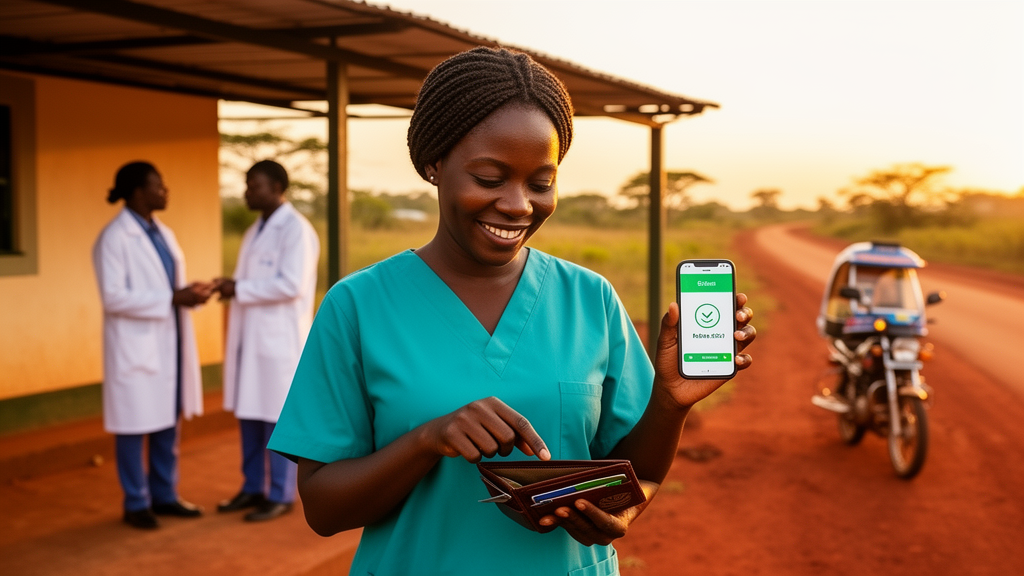
When Nigeria pays its immunization campaign workers through mobile transfers and bank accounts rather than cash in envelopes, the workers themselves say they feel more satisfied, more motivated, and more willing to trek to remote villages to vaccinate children — but only when the money actually arrives. That is the central message of a qualitative study published in Frontiers in Digital Health, in which researchers from the University of Ibadan and Makerere University School of Public Health interviewed 171 health workers across three Nigerian regions and the Federal Capital Territory about their lived experience of the country’s shift from cash to digital remuneration. The findings paint a nuanced picture: digital financial services genuinely outperform cash on transparency, speed, and security, yet a single mistyped account number or a dead mobile network can erase those gains entirely, leaving some workers nostalgic for the era of table payments.
The research team conducted twelve in-depth interviews, twelve key informant interviews, and twelve focus group discussions involving 147 discussants between May and July 2023, each interview lasting roughly 35 minutes. Participants were purposively selected to span two levels of the health system. At the operational level were Community Health Officers, Community Health Extension Workers, and Junior Community Health Extension Workers — the frontline personnel who fan out during polio and measles campaigns. At the strategic and tactical level were State and Local Immunisation Officers, veterans with 16 to 34 years of experience organizing and supervising campaign logistics and payments. All participants had firsthand experience with both payment modalities, and data collection continued iteratively until new interviews stopped generating substantively fresh themes.
The context makes the question urgent. Nigeria, home to roughly 227 million people in 2023, has more than 60 million adults living in rural areas, and about half of those rural residents — along with a quarter of urban dwellers — are financially excluded. Traditional cash payment systems in health programmes have long been associated with operational inefficiencies, poor documentation, delayed or incomplete disbursements, and security risks. Most organizations that engage health workers have consequently transitioned to digital payments, drawn by greater transparency, donor confidence, and financial accountability. Yet the potential benefits of digital financial services may stall in resource-constrained settings where limited network coverage, weak identification systems, cyber fraud, transaction costs, and low financial literacy remain formidable barriers.
What the researchers found was that the perceived advantage of digital payment lay not in the technology itself but in the characteristics of the payment process it enabled. Workers valued receiving the accurate amount directly into their own accounts, with no intermediary skimming a cut along the way. In the coded transcripts, transparency and timeliness of digital payments were cited by many respondents, while the encouragement of a savings culture was mentioned by the majority or all of them. As one Community Health Officer in Sokoto put it, digital payment motivated personnel because once account details were correct, the alert arrived immediately — workers knew that when they worked, they would be paid. Supervisory officers emphasized that electronic transfers eliminated the practice of unit heads splitting cash payments and pocketing a share.
The ripple effects extended beyond the paycheck itself. Because smartphone ownership was a criterion for receiving digital payments, supervisors found themselves encouraging workers to buy Android phones, and workers without personal bank accounts opened them to avoid missing out on pay. Participants described improved money security — no longer vulnerable to robbery while traveling to payment centers in another local government area — and better financial management, since money sitting in a bank was less likely to be spent impulsively at the market. Several noted that transport costs to collection points had previously consumed a meaningful fraction of what they earned; one discussant remarked that when collecting cash, workers sometimes spent more on transport than the payment itself was worth.
Cash, however, retained genuine advantages that the digital transition had failed to replicate. Under the cash system, money often arrived before campaign activities commenced, and workers could track down exactly where a problem originated when something went wrong. Participants described table payments as certain: workers presented an identity card and passport photograph and received their money on the spot. Some also suspected that electronic systems enabled ghost workers — payments to fictional persons — because no one physically verified the recipient. Cash payments frequently included transport allowances disbursed at the point of payment, easing fieldwork logistics. And cash depended on no infrastructure at all: no network, no bank reconciliation, no waiting for an alert that might never sound.
The challenges of digital payments were substantial and concrete. Irreconcilable bank details — account numbers that did not match the name on the account — produced delayed or failed payments, sometimes because workers submitted other people’s account information, a practice that itself carried costs, since borrowing an account required compensating its owner. Delays could stretch to months; one participant described working since May and being paid three or six months later. Transaction failures left some workers paid and others empty-handed after the same exercise, prompting local chiefs to threaten barring campaign teams from their communities until outstanding wages were settled. Bank charges deducted from earnings, poor internet connectivity particularly in rural areas, and outright exclusion of workers lacking smartphones or bank accounts compounded the frustration. Resolving these problems was itself burdensome, requiring bank statements and repeated visits.
Cash carried its own heavy burdens, which the digital era had obscured. Workers described queuing for over three hours at payment centers, sometimes under a hot sun, with some people collapsing in line. Security concerns loomed large: participants cited touts and fraudsters who could snatch freshly collected cash, and in remote areas, the threat of bandits who could strike at any time made transporting money dangerous. Fraudulent intermediaries could slash payments into portions, keeping some for themselves — a practice direct bank transfers rendered impossible. The logistics of arranging for dispersed workers to converge on payment points was itself described as exhausting work by supervising officers.
The study’s demographic composition adds an important gender dimension. Female discussants dominated the focus groups at 73.5 percent, consistent with the predominance of women in the health workforce globally and in Nigeria. The authors note evidence that over half of female health campaign workers in Nigeria report managing their bank accounts in secret, a constraint rooted in social norms that can limit the full benefits of digital financial inclusion. Research cited in the paper suggests that female health workers with access to reliable digital payments report higher job satisfaction and motivation, making gender-sensitive approaches to digital and financial inclusion — particularly in rural areas where these constraints concentrate — a policy priority.
From the workers themselves came concrete recommendations for making digital remuneration deliver on its promise: verification of account details before payments are processed, ideally through an application that automatically validates submitted bank information; confirmation calls to recipients when money is sent; free and easy bank account opening for rural workers; provision of smartphones and improved network coverage; training on the electronic platforms, where knowledge gaps were acknowledged; and prompt payment, ideally within days of campaign completion rather than months. The authors caution that their findings reflect perceptions rather than objectively measured outcomes such as vaccination coverage or absenteeism, that the study covered four states in three geopolitical zones and may not generalize everywhere, and that self-reported data carry recall and social desirability biases. The study also did not collect sufficient data to estimate the full financial cost of digital payment relative to cash — including platform fees, training, technical support, and the administrative burden of resolving failed transactions — a gap the researchers say future work should fill. What the qualitative evidence does establish is that the benefits of digital remuneration are conditional on implementation reliability: accurate account verification, accessible mechanisms for resolving payment problems, appropriate training, and dependable connectivity. Where those conditions hold, digital payments foster the confidence that keeps campaign workers returning; where they fail, the same systems can introduce new barriers between workers and the money they have already earned.
Subject of Research: Health workers' experiences with digital versus cash payments during immunization campaigns in Nigeria
Article Title: Health workers’ experiences with digital and cash payments during health campaigns in Nigeria: a qualitative study
Article References: Alabi, J., Adeniji, F. P., Adewole, D. A., Bello, S., Aweko, J., Ekirapa, E., Waiswa, P., & Fawole, O. I. (2026). Health workers’ experiences with digital and cash payments during health campaigns in Nigeria: a qualitative study. Frontiers in Digital Health, 8, Article 1780807. https://doi.org/10.3389/fdgth.2026.1780807
Image Credits: AI Generated
DOI: 10.3389/fdgth.2026.1780807
Keywords: digital financial services, health workers, immunization campaigns, Nigeria, cash payments, qualitative research, health worker motivation, payment systems, financial inclusion, rural health, mobile money, public health
News Source: Ophelia Keating. (October 23, 2026). Digital Payments Lift Nigerian Health Workers’ Morale — When the Systems Work. Scienmag.