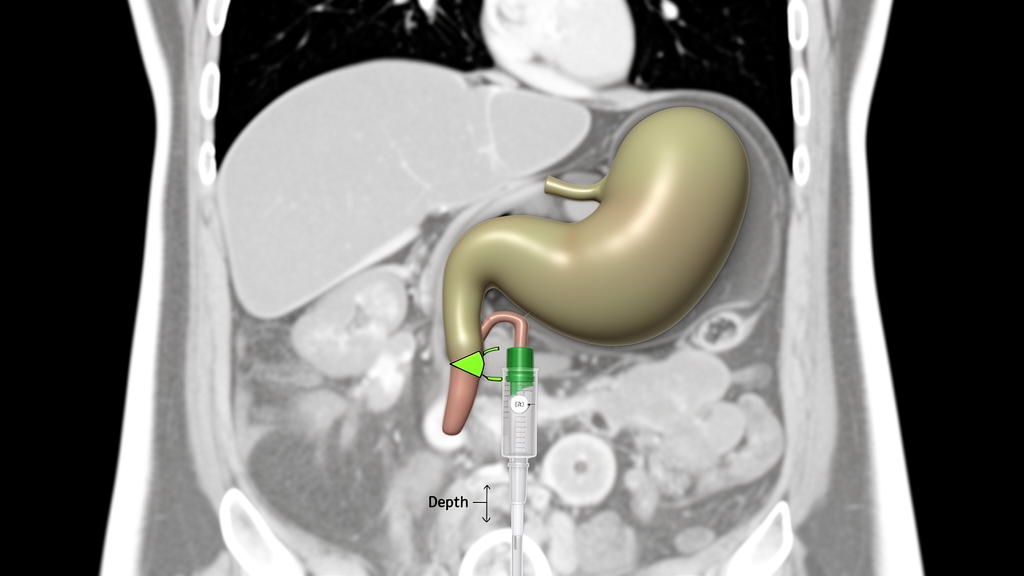
A catheter placed into an inflamed gallbladder does not always follow the path intended, according to a study published in BMC Medical Imaging. Led by Zhongyu Li and Huiming Yi with colleagues, the research examined percutaneous transhepatic gallbladder drainage, an ultrasound-guided procedure for acute cholecystitis. Using computed tomography as the reference, the team found that in 8 of 100 patients, or 8.0 percent, the catheter configuration suggested it had not traversed the perimuscular connective tissue, a layer concentrated at the deepest part of the gallbladder fossa.
The investigation was a single-center study conducted in two sequential phases. The first phase retrospectively reviewed 100 patients who underwent the drainage procedure for acute cholecystitis between 2021 and 2024. On CT and ultrasound images, the researchers measured the position of each catheter, the depth ratio of the gallbladder fossa, the projected ratio of the gallbladder length, and gallbladder dimensions. They then used receiver operating characteristic analysis to estimate an exploratory cutoff value of the depth ratio that could discriminate patients whose scans showed the CT-defined endpoint of a catheter trajectory not passing through the connective tissue layer.
The results pointed squarely at one measurement. The depth ratio of the gallbladder fossa was significantly lower in the group with properly positioned catheters, with a P value below 0.001, while the projected ratio of gallbladder length and gallbladder dimensions showed no significant differences between groups. The depth ratio achieved an area under the curve of 0.906 for discriminating the CT-defined endpoint. Using an exploratory cutoff of 65.69, the measurement showed a sensitivity of 87.5 percent and a specificity of 83.7 percent.
To understand the anatomy behind the numbers, the team carried out a second, prospective phase in 50 patients undergoing laparoscopic cholecystectomy. During these operations, the surgeons directly observed the distribution and dimensions of the perimuscular connective tissue. Those intraoperative observations confirmed that the tissue is concentrated at the deepest portion of the gallbladder fossa, the very region the depth ratio is designed to quantify.
The authors are careful about what these findings do and do not show. Conventional ultrasound-guided drainage did not consistently produce a trajectory with a CT appearance consistent with traversal of the perimuscular connective tissue, and the depth ratio should be regarded as an exploratory trajectory-related imaging parameter rather than a validated clinical decision tool. A lower depth ratio was associated with a CT-inferred trajectory consistent with tissue traversal and a lower likelihood of CT-defined catheter dislodgement, but the imaging phase was retrospective, the endpoint was defined by imaging appearance rather than confirmed clinical outcomes, and the researchers state that prospective validation is required before the measurement can inform practice.
Subject of Research: Association of gallbladder fossa depth ratio with catheter trajectory during percutaneous transhepatic gallbladder drainage
Article Title: Association of gallbladder fossa depth ratio with catheter trajectory during percutaneous transhepatic gallbladder drainage
Article References: Li, Z., Yi, H., Liu, Y., Xie, Y., Wang, D., Zhang, J., & Zhang, W. (2026). Association of gallbladder fossa depth ratio with catheter trajectory during percutaneous transhepatic gallbladder drainage. BMC Medical Imaging. https://doi.org/10.1186/s12880-026-02974-0
Image Credits: AI Generated
DOI: 10.1186/s12880-026-02974-0
Keywords: Association, gallbladder, fossa, depth, ratio, catheter, trajectory, during, percutaneous, transhepatic, drainage, scientific research
News Source: Ophelia Keating. (October 23, 2026). Gallbladder Fossa Depth on CT May Predict Catheter Path in Drainage Procedure. Scienmag.