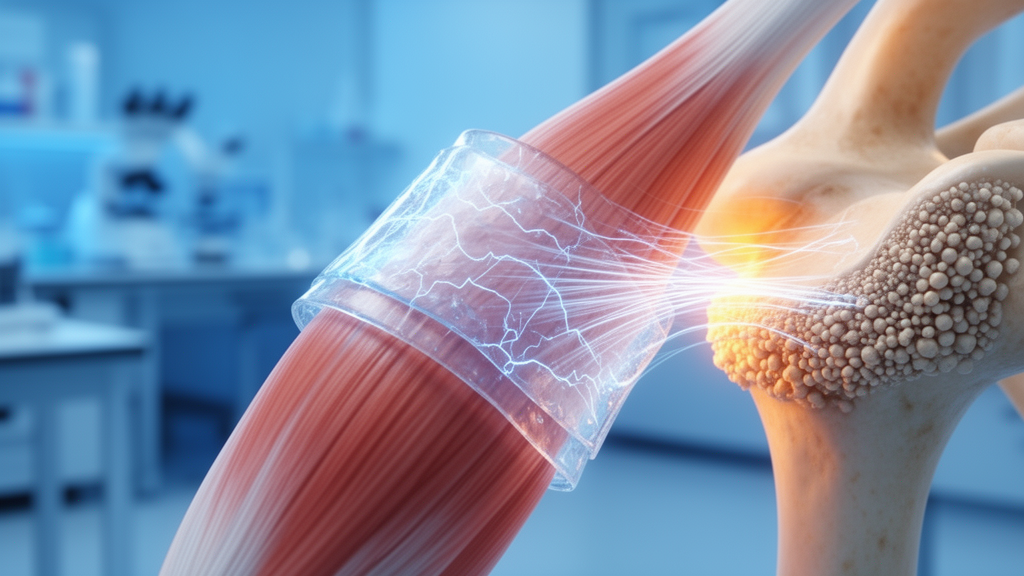
Osteoporosis is not simply a disease of losing bone; it is a disease of losing the wrong tissue in bone’s place. When estrogen levels fall after menopause, the cells that resorb bone become overactive, and the mineral that disappears is frequently replaced by fat. That shift in the balance between osteogenesis, the formation of new bone, and adipogenesis, the formation of fat cells, leaves fractures unable to heal properly, a problem made worse by inflammatory signals such as tumor necrosis factor-alpha that linger in the defective tissue. A new study now reports a material that attacks this imbalance from an unusual angle: a soft hydrogel that harvests the mechanical energy of ordinary movement and converts it into electrical stimulation, coaxing bone cells to build while telling fat-forming cells to stand down.
The material, described by researchers working with rat models of estrogen-deficient bone loss, is a sandwich-structured composite built from three components with complementary jobs. At its core lies an electrospun membrane of polyvinylidene fluoride, or PVDF, a dielectric polymer whose electronegative fluorine atoms and hydrogen atoms give it a high dipole moment. When mechanical stress deforms PVDF, the polymer generates an electrical potential, a property that depends heavily on its crystalline structure. The β-phase of PVDF is the most piezoelectric form, and electrospinning proved decisive here: infrared spectroscopy of the spun fibers showed pronounced absorption peaks at 841, 1275, and 1434 per centimeter, signatures of abundant β-phase content, while the starting powder instead displayed the α-phase peak at 763 per centimeter. X-ray diffraction confirmed the same transformation, with the membrane showing a sharp β-phase crystallization peak at 20.6 degrees corresponding to the (110/200) crystal plane.
That piezoelectric core was then embedded in a hydrogel of regenerated silk fibroin, a protein derived from silkworm cocoons that is prized for its biocompatibility and its ability to be molded into defect-filling shapes and to survive thousands of compression cycles. Silk fibroin alone, however, is bioinert and not conductive, so the researchers added MXene, a two-dimensional titanium carbide material, at a concentration of 4 milligrams per milliliter. Scanning electron microscopy showed that pure silk fibroin gels form a beehive-like structure with large pores created by expanding ice crystals, but adding MXene nanosheets produced a denser network with smaller, more uniform pores, apparently because the nanosheets bound the silk fibrils and limited ice crystallization. The final construct, with PVDF membranes layered between MXene-loaded silk hydrogel, maintained the fibrous architecture of the electrospun core while gaining the conductivity needed to distribute electrical charges across the gel surface in contact with growing tissue.
The mechanical and electrical characterization revealed why the sandwich design matters. The average compressive strength of the hydrogel rose from 1.046 to 1.097 megapascals when MXene was added, and the compressive modulus increased from 1.116 to 1.306 megapascals, roughly double the strength of earlier silk-based hydrogels developed for femoral defects. Adding one, two, or three PVDF layers left these mechanical properties essentially unchanged, at 1.093, 1.087, and 1.089 megapascals respectively, meaning the piezoelectric upgrade came at no structural cost. The electrical output told a different story. Silk fibroin alone produced an irregular potential of about 25 millivolts under compression. With MXene, the signal became steady at roughly 54 millivolts. With a single PVDF layer, the voltage jumped to about 199 millivolts with a current near 2500 nanoamperes, and stacking three layers pushed the output to nearly 492 millivolts. The piezoelectric coefficient climbed in parallel, from 15.98 picocoulombs per newton for silk alone to 48.58 picocoulombs per newton with three layers, and reached 63.3 picocoulombs per newton when interfacial polarization on the MXene was accounted for. Because the layers can be added or removed at will, the stimulation intensity is tunable to the demands of a particular defect.
To test whether this self-generated electricity could actually change cell behavior, the team built a compact compression device from solenoids and relays that fit inside a standard cell incubator and delivered repetitive forces of up to 8 newtons, twice per minute, a load chosen to match the roughly 7 newtons of internal force that micro-CT-based modeling suggests the rat distal femur experiences during gait. The first evidence of cellular responsiveness came quickly: within 60 seconds of stimulation, MC3T3 pre-osteoblast cells showed a measurable calcium flux, detected by Fura Red fluorescence, and that response was largely abolished when the cells were preincubated with tetrodotoxin, a calcium channel blocker. This confirmed that the piezoelectric signal was being transduced through voltage-sensitive channels rather than being an artifact of the mechanical loading itself.
The critical experiments were run under inflammatory conditions, with tumor necrosis factor-alpha added to the culture medium at 50 nanograms per milliliter to mimic the cytokine environment found in ovariectomized rats and postmenopausal women. After 14 days of piezoelectric stimulation, alkaline phosphatase activity was visibly more vigorous than in unstimulated controls, and calcium deposits were distributed diffusely across the bone marrow stromal cells rather than appearing unevenly. Western blotting showed elevated expression of osteopontin and RUNX2, a transcription factor essential for osteoblast differentiation. Just as striking was what the stimulation suppressed. When cells were pushed toward the fat lineage, the lipid droplets stained by Oil Red O were significantly fewer and smaller in the stimulated groups, and when macrophages were induced to become bone-resorbing osteoclasts with M-CSF and RANKL, fewer large multinucleated osteoclasts formed under piezoelectric stimulation, confirmed by reduced tartrate-resistant acid phosphatase activity. In other words, a single physical signal simultaneously promoted bone formation, discouraged fat accumulation, and dampened bone resorption.
To understand how, the researchers turned to multi-omics, combining transcriptomic sequencing with liquid chromatography-mass spectrometry metabolomics on stimulated and unstimulated cells. Differentially expressed genes sorted into 79 pathways and metabolites into 46, but one pathway stood out across all comparisons: glycerophospholipid metabolism. The genes governing downstream glycerophospholipid degradation were first perturbed by the inflammatory stimulus and then reversed by piezoelectricity. Among them, Pla2g4a, which encodes the enzyme cytosolic phospholipase A2, emerged as a central player. Its expression rose 5.7-fold after piezoelectric stimulation, and the cPLA2 protein increased roughly threefold. When the researchers silenced Pla2g4a with siRNA, reducing expression to 0.29-fold, the fat-suppressing effect of the electrical stimulation was reversed, as Sudan Black B staining showed glycerophospholipids accumulating again in the cells. The mechanistic picture is that cPLA2 catalyzes the hydrolysis of membrane lipids, releasing arachidonic acid that feeds prostaglandin E2 production, a molecule previously linked to osteoblast recruitment. The authors caution that these multi-omics findings came from the MC3T3 pre-osteoblast cell line, which cannot fully recapitulate the lineage commitment decisions of primary bone marrow stromal cells, though complementary experiments in rat bone marrow stromal cells confirmed cPLA2’s role in adipogenesis.
The in vivo work established how profoundly estrogen deficiency distorts the bone-fat balance before any treatment. Three months after surgical removal of both ovaries, rats had gained significantly more weight than sham-operated controls, and micro-CT revealed reduced bone volume and bone surface in the femurs, with trabeculae that were thicker but fewer and more widely separated. Dual-energy X-ray absorptiometry showed significantly decreased femoral bone mineral density, while the fat-to-total-weight ratio of the femur rose, and histology confirmed that marrow spaces once occupied by trabeculae were now filled with adipocytes. Immunostaining showed the ratio of the bone-inducing factor BMP2 to the fat-inducing factor PPARγ had fallen significantly in the subchondral and epiphyseal regions, a molecular fingerprint of the osteoporotic shift.
Into this hostile environment the team implanted the piezoelectric hydrogel, creating 3-millimeter-wide defects in the femoral condyles of osteoporotic rats and measuring the hindlimb kicking force, which averaged 6.688 newtons, closely matching the in vitro loading conditions. After 12 weeks, the differences between groups were unmistakable. Untreated defects remained filled with disorganized mesenchymal tissue and only traces of collagen, while defects receiving plain silk fibroin hydrogel grew a thin bone layer along the graft surface that never fully mineralized. Hydrogels containing only MXene or only PVDF, which cannot generate effective piezoelectric stimulation together, produced thinner collagen layers and inferior micro-CT metrics. The full MXene/PVDF/RSF construct, by contrast, showed significantly higher bone volume fraction than every other group, thicker trabeculae, and evidence that the graft itself was degrading and being replaced by mineralized, mature bone. PPARγ expression, the hallmark of adipogenesis, was scarce in the tissue adjacent to the piezoelectric implant, and cPLA2 was expressed precisely in the newly grown tissue where the implant had degraded and electricity had been generated, tying the animal results back to the metabolic mechanism identified in culture.
The study’s authors frame the material as a rehabilitation platform for bone defects exacerbated by endocrine inflammation, and the design logic is elegant: the body already supplies the energy, in the form of muscle contractions with every step, and the implant simply converts that motion into a biological signal. The work remains at the preclinical stage, conducted in rats, and the mechanistic insights rest partly on a cell line whose metabolism may not mirror primary human stromal cells. Yet the convergence of evidence, from crystallography and piezoelectric measurements through multi-omics to defect healing in osteoporotic bone, offers a coherent demonstration that electrical cues generated by movement can retune a metabolic pathway long associated with fat storage and, in doing so, give failing bone a chance to rebuild itself.
Subject of Research: A piezoelectric MXene/PVDF/silk fibroin hydrogel that promotes bone regeneration and suppresses fat formation in osteoporotic bone defects through glycerophospholipid metabolism
Article Title: Sandwich-structured PVDF/protein piezoelectric hydrogel regulates osteogenesis and adipogenesis through glycerophospholipid metabolism in osteoporotic inflammatory bone defects
Article References: Chen, W., Zhang, S., Huang, L., Huang, Y., Liang, M., Liu, X., Wang, N., Li, J., Liang, H., Su, D., Chen, Z., Zhou, D., Li, Y., Zhang, J., Su, Y., Gu, Y., & Jiang, L. (2026). Sandwich-structured PVDF/protein piezoelectric hydrogel regulates osteogenesis and adipogenesis through glycerophospholipid metabolism in osteoporotic inflammatory bone defects. Materials Today Bio, 41, Article 103770. https://doi.org/10.1016/j.mtbio.2026.103770
Image Credits: AI Generated
DOI: 10.1016/j.mtbio.2026.103770
Keywords: piezoelectric hydrogel, PVDF, silk fibroin, MXene, osteoporosis, bone regeneration, osteogenesis, adipogenesis, glycerophospholipid metabolism, cPLA2, electrical stimulation, bone tissue engineering
News Source: Denise Maddox. (October 23, 2026). Piezoelectric Hydrogel Turns Muscle Motion Into Signals That Rebuild Bone in Osteoporosis. Scienmag.