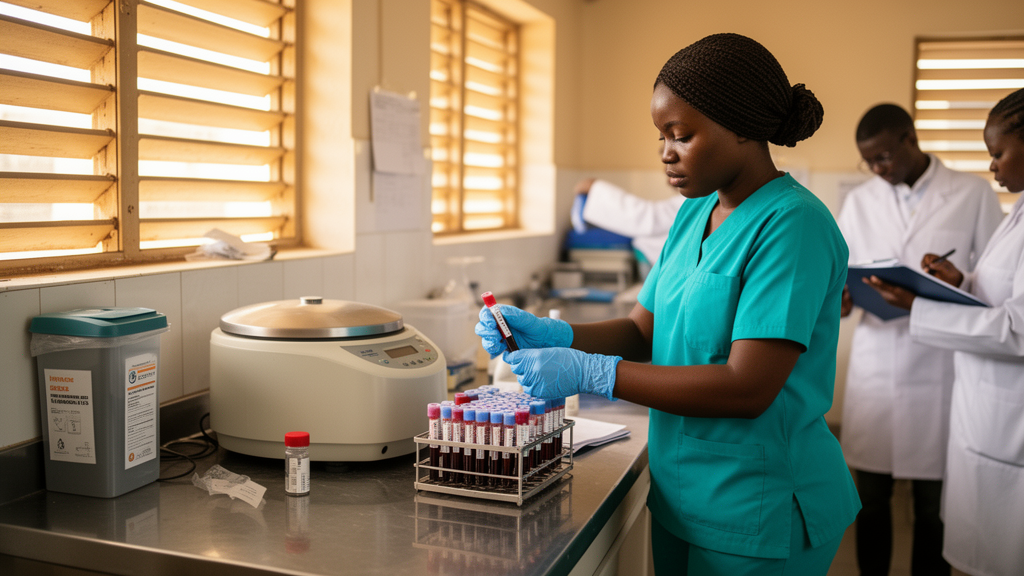
Healthcare workers in a rural local government area of southern Nigeria show generally solid knowledge of blood-borne infections such as hepatitis B, HIV and syphilis, but a substantial minority still fall short, according to a new survey published in BMC Infectious Diseases. The study, led by Amina Momodu and colleagues, assessed awareness and knowledge of these occupational hazards among 330 healthcare workers across all 47 registered health facilities in Etsako West Local Government Area of Edo State, and found that while more than eight in ten had heard of blood-borne infections, roughly one in four of those aware of the infections lacked adequate knowledge about them. Blood-borne infections are recognized worldwide as important occupational hazards for healthcare workers.
The researchers focused on three infections of particular occupational relevance: syphilis, hepatitis B and HIV. Limited awareness or inadequate knowledge of these infections, the authors note, can increase the risk of occupational exposure and compromise the health and safety of healthcare workers themselves. To measure how well frontline staff understood these risks, the team recruited clinicians, nurses, medical laboratory scientists and ward attendants from every registered health facility in the local government area.
Data were collected using a pretested structured questionnaire that combined open-ended and close-ended response formats, and the responses were analyzed with IBM SPSS version 21.0 software. Awareness was assessed first with a simple dichotomous question asking respondents whether they had ever heard of blood-borne infections; anyone answering yes was counted as aware. Knowledge was then measured more rigorously among the aware respondents using eleven questions spanning four domains: the definition of blood-borne infections, their modes of transmission, their prevention, and the types of infections involved.
Each correct response earned one point and each incorrect response zero, producing a total score that could range from 0 to 11. Univariate and bivariate analyses were used to describe the variables and to assess associations between socio-demographic factors and knowledge levels. The headline result was encouraging at the level of basic awareness.
A large majority of respondents, 281 of the 330 surveyed, or 85.2 percent, had heard of blood-borne infections. Among those who were aware, the hospital was by far the most commonly reported source of information, cited by 142 respondents, or 50.5 percent. School came next at 85 respondents, or 30.2 percent, followed by health talks and seminars at 29 respondents, or 10.3 percent, and the media at 14 respondents, or 5.0 percent.
Awareness was not evenly distributed across professional categories. It was highest among clinicians, followed by medical laboratory scientists, then nurses, and lowest among ward attendants. Knowledge scores told a similar story.
Overall, 212 healthcare workers, or 75.4 percent of those aware of blood-borne infections, demonstrated good knowledge, while 69, or 24.6 percent, had poor knowledge. The analysis found that knowledge was significantly associated with educational qualification, age and professional category, indicating that the gaps in understanding are patterned along socio-demographic and occupational lines. The authors conclude that healthcare workers in Etsako West demonstrated varying levels of knowledge and awareness of blood-borne infections, and they state that these findings highlight the need for targeted educational interventions and regular infection prevention and control training to improve knowledge among all categories of healthcare workers.
The study's design and scope deserve attention when weighing its implications. It was a questionnaire-based survey confined to registered health facilities in a single local government area of Edo State, so the findings describe that specific workforce and setting rather than Nigerian healthcare workers as a whole.
Subject of Research: Knowledge and awareness of blood-borne infections among healthcare workers in Edo State, Nigeria
Article Title: Knowledge and awareness of blood-borne infections among healthcare workers in Etsako West Local Government Area, Edo State, Nigeria
Article References: Momodu, A., Shuaib, B. I., & Ogboghodo, E. O. (2026). Knowledge and awareness of blood-borne infections among healthcare workers in Etsako West Local Government Area, Edo State, Nigeria. BMC Infectious Diseases. https://doi.org/10.1186/s12879-026-14619-2
Image Credits: AI Generated
DOI: 10.1186/s12879-026-14619-2
Keywords: blood-borne infections, healthcare workers, hepatitis B, HIV, syphilis, occupational health, Nigeria, infection prevention and control, knowledge survey, Edo State, public health, Knowledge
News Source: Kristina Jarvis. (October 23, 2026). Most Healthcare Workers in Southern Nigeria Know the Basics of Blood-Borne Infections, but Gaps Persist. Scienmag.