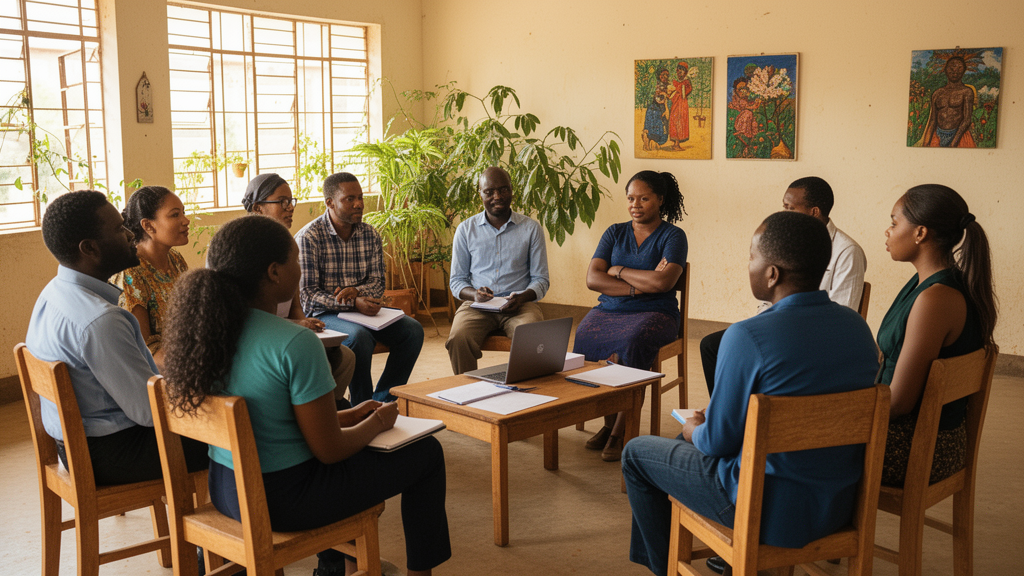
A team of community actors and social justice scholar-advocates has described a methodological framework for studying grassroots responses to the COVID-19 pandemic, built around what the researchers call Dialogical and Non-extractivist Approaches, or DNA.
The framework underpins a global health study examining how community mobilization in made-marginalized places sought to influence policymaking toward health equity and social justice during the pandemic.
The project brings together collaborators in two Global South countries, Brazil and Peru, and two Global North countries, Canada and Germany.
Rather than treating communities as sources of data to be extracted and analyzed elsewhere, the approach centers dialogue between researchers and community actors as the core of the research process.
The study aims both to understand community actions and organizing and to preserve the memories of made-marginalized people and places during the crisis.
The framework draws on principles of non-extractivism and Freirean action research. The authors describe their work as aspirationally named, using analytic narration to explore what global health research anchored in an ethical dialogic praxis could look like in practice.
Notably, the team chose not to emphasize research results in this account. Instead, the essay relays the group’s experiences of countering dominant, asymmetrical approaches to global health research, both in theory and in practice.
This stance rests on a shared belief that community engagement is central to societal transformation. By documenting how the transnational collaboration was carried out, the authors offer an in-depth account of the possibilities of conducting global health research that treats community partners as co-producers of knowledge rather than subjects of study.
Subject of Research: Dialogical, non-extractivist research methods for studying community mobilization during the COVID-19 pandemic
Article Title: Community mobilization and policy demands in the context of the COVID-19 pandemic: A transnational dialogic non-extractive research approach
Article References: Iguiñiz-Romero, R., Pereira, P. L. N., Falge, C., Mayell, S., Fauvel, M., Martens, T., Farias, L. W., Diaz Gomez, L., Trivellato, P., Satzinger, F., Ventura, D. D. F. L., Knipper, M., Monnais, L., & Birn, A.-E. (2026). Community mobilization and policy demands in the context of the COVID-19 pandemic: A transnational dialogic non-extractive research approach. PLOS Global Public Health, 6(10), e0006384. https://doi.org/10.1371/journal.pgph.0006384
Image Credits: AI Generated
DOI: 10.1371/journal.pgph.0006384
Keywords: COVID-19, global health, community mobilization, non-extractivism, Freirean action research, health equity, Brazil, Peru, Canada, Germany, research methodology, social justice
News Source: Tiffany Hanley. (October 23, 2026). Researchers Rethink Global Health Methods Through Dialogic, Non-Extractivist COVID-19 Study. Scienmag.