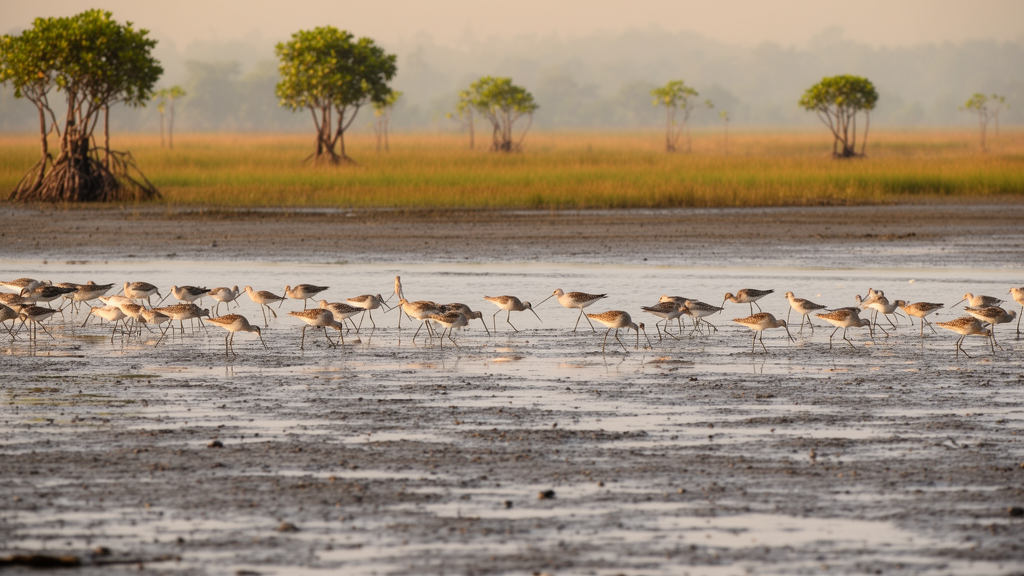
Black-tailed godwits feeding at Nijhum Dweep National Park in Bangladesh consume both animal prey and plant material, including bivalves, crustaceans, mollusks, fish, rice kernels, and rhizomes of uri grass. The study provides a first look at godwit diet at a non-breeding site associated with the overlapping Central Asian and East Asian–Australasian flyways, where the limosa, melanuroides, and bohaii subspecies have recently been recorded together. The investigation focused on Nijhum Dweep, a 16,352-hectare Important Bird and Biodiversity Area in the Meghna Estuary of the Bay of Bengal.
Its habitats include mangrove forest, intertidal mudflats, sandy beaches, brackish marshes, and agricultural land, and approximately 8,000–9,000 godwits forage on the park’s intertidal flats. The site lies in the Ganges–Brahmaputra–Meghna delta, whose Asian godwit populations include three subspecies that differ in body and bill size. Those differences could influence how birds access prey buried in mud or forage in different depths, but dietary information had previously been unavailable for most Asian flyway sites.
The study therefore combined a seasonal survey of potential food with a limited dietary comparison to describe what the birds were consuming. From October 2018 through March 2019, researchers collected 600 sediment cores from 120 locations used by foraging godwits. Each sample was taken with a 5-by-5-centimeter metal quadrat corer extending 15 centimeters into the sediment, then immediately rinsed through a 600-micrometer sieve.
Preserved organisms were counted, photographed with a phone camera mounted on a compound microscope, measured, and identified as precisely as possible using regional taxonomic references. The samples contained 10 macrozoobenthic taxa. Polychaetes occurred in 79% of samples and oligochaetes in 73%, while bivalves appeared in 49% and decapods in 39%.
Gastropods occurred in only 9%, making them the least frequently encountered potential prey group in the sediment. Although the overall benthic community was broadly stable, individual taxa followed distinct seasonal patterns. Relative abundance of both bivalves and decapods rose from relatively low levels in October–November to their highest levels in February, after which decapod abundance declined slightly in March.
Gastropod abundance declined throughout the sampling period. Bivalve body size steadily decreased from October to March, whereas decapod body size increased from November to January and then remained stable. Polychaetes and oligochaetes had much larger bodies than the hard-shelled bivalves, decapods, and gastropods.
A three-dimensional non-metric multidimensional scaling analysis produced substantial overlap among monthly samples and a stress value of 0.11, indicating generally similar community composition. PERMANOVA nevertheless detected a significant month effect, but month explained only 5.9% of total variation in assemblage structure, and differences were generally greater between early-season and late-season months than between adjacent months within either period. To characterize the birds’ diet, the team collected 15 fecal samples and 15 regurgitated pellets on 15 January 2019, in the middle of the non-breeding season.
The material was gathered from a roost at Damar Char immediately after a flock departed, reducing the risk that samples came from another species or had been deposited earlier. In the laboratory, the samples were thawed, disaggregated, washed under running water, and sieved; undigested remains were then assigned to the lowest practicable taxonomic level. Bivalves occurred most frequently among animal remains, appearing in 46% of feces and 24% of pellets.
Decapods appeared in 15% of feces and 19% of pellets, and gastropods in 8% and 10%, respectively. Fish remains occurred only in pellets, at a frequency of 5%. The researchers considered opportunistic scavenging plausible because eel goby, kuchia, and mudskippers occur in the delta’s mudflats.
Comparisons with January sediment samples revealed distinct patterns of prey selection. The study used Ivlev’s electivity index, in which zero means consumption proportional to availability, positive values indicate selection, and negative values indicate avoidance. Gastropods had the strongest positive value, E = 0.90, followed by bivalves at E = 0.58 and decapods at E = 0.39.
The high gastropod value was especially notable because gastropods were the least abundant of the five potential prey groups considered. No polychaete or oligochaete remains were detected in the droppings, despite the high abundance of those taxa in the sediment. The observations therefore do not support the conclusion that the birds simply consumed the most numerous prey available; instead, they document selection among available macrozoobenthos during the January sampling period.
Plant material supplied a striking additional component of the diet. Rice kernels occurred in 23% of fecal samples and 29% of pellets, while rhizomes of uri grass, Porteresia coarctata, occurred in 8% and 14%, respectively. These observations extend earlier reports of plant consumption by godwits in the East Atlantic Flyway, where rice kernels were recorded in Senegal and Portugal and seagrass rhizomes in France.
Daytime surveys in the Bangladeshi study area found little evidence of godwits feeding in rice fields, but the presence of kernels in nearly one-quarter of fecal samples indicates that rice was consumed at the site. The authors suggested possibilities rather than established a feeding location: birds might take discarded grain at night or near roosts in agricultural areas. Cultivation begins in June in the park, and harvesting around mid-October leaves kernels on the ground during the early non-breeding period.
The dietary evidence comes with important limitations. All 15 fecal samples and 15 pellets came from a single location in a single month, so the analysis cannot establish the full geographic or seasonal variation in prey use across the delta. Microscopic examination of undigested remains can also fail to detect soft-bodied prey that has been completely digested, a recognized limitation of this method.
The researchers therefore did not treat the absence of polychaete and oligochaete remains as definitive proof that the birds never consume them. Polychaete remains were detected in Eurasian curlew droppings at the park with the same method, and godwits have been observed taking polychaete worms there. Individual birds might also target soft-bodied prey under different conditions, while some benthic animals may be too large, too deeply buried, or too costly to handle.
The measured selectivity values therefore characterize the available prey and sampled diet in January rather than a fixed dietary rule across all birds, places, and seasons. The results identify Nijhum Dweep as an important seasonal feeding site with a diet that includes both animals and plants. They also highlight a potential overlap between the needs of migratory godwits and local people: bivalves and decapods are eaten by people in the delta and also have commercial value.
The authors recommended monitoring these populations because they face pressure from consumption, commercial use, and habitat alteration. Nijhum Dweep’s coastal landscape is continually reshaped by erosion, sediment deposition, shifting sandbars, and changing channels, while mangrove planting and conversion of land for rice cultivation add further changes. Broader dietary sampling across the season, DNA metabarcoding, and movement tracking are needed to determine how the three co-occurring subspecies partition resources.
Until those studies are available, the observations establish a mixed, selective diet at one of the most important non-breeding sites in the Asian flyway network without showing how the diet changes throughout the entire year.
Subject of Research: Black-tailed godwit diet and prey selection at a Bangladeshi non-breeding site
Article Title: Black‐Tailed Godwits Eat Animal and Plant Material at a Key Non‐Breeding Site at the Overlap of Two Asian Flyways
Article References: Das, D. K., Khandakar, N., Ali, M. S., Vansteelant, W. M. G., El‐Hacen, E.-H. M., & Piersma, T. (2026). Black‐Tailed Godwits Eat Animal and Plant Material at a Key Non‐Breeding Site at the Overlap of Two Asian Flyways. Ecology and Evolution, 16(10), Article e74479. https://doi.org/10.1002/ece3.74479
Image Credits: AI Generated
DOI: 10.1002/ece3.74479
Keywords: Black-tailed godwits, bird diet, prey selection, intertidal mudflats, Nijhum Dweep, Bangladesh, benthic invertebrates, rice consumption, Asian flyways, co-occurring subspecies, Black, Tailed
News Source: Margaret Porter. (October 22, 2026). Field study reveals plant-eating godwits at Bangladesh non-breeding site. Scienmag.